


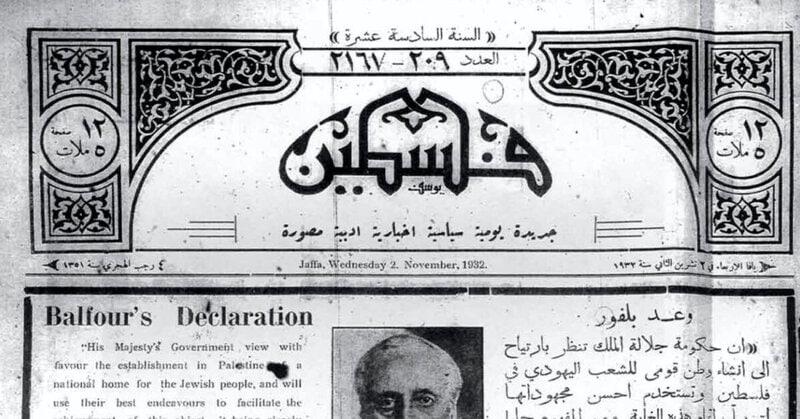
On the morning of 2 November 1917, a British foreign secretary picked up his pen and wrote a letter that would reorder the map of the modern world — and it ran to fewer words than most parking tickets. What follows are nine distinct facts about the Balfour Declaration that explain how a single page of diplomatic correspondence ignited a conflict still burning more than a century later.
1. The entire promise fits in 67 words
The Balfour Declaration’s final published text is exactly 67 words long — shorter than most tweet threads, yet consequential enough to reshape the modern Middle East. The brevity was not accidental. The vagueness packed into those few lines allowed British officials to signal entirely different things to entirely different audiences at the same time, performing a kind of geopolitical sleight of hand in plain sight.
Every one of those words had been fought over in cabinet. The document’s tidy, almost innocent shortness masked months of tortured negotiation, with competing factions arguing fiercely over phrasing before arriving at language that managed to be both sweeping in ambition and studiously imprecise in commitment. The final text read: “His Majesty’s Government view with favour the establishment in Palestine of a national home for the Jewish people, and will use their best endeavours to facilitate the achievement of this object, it being clearly understood that nothing shall be done which may prejudice the civil and religious rights of existing non-Jewish communities in Palestine, or the rights and political status enjoyed by Jews in any other country.”
2. A foreign secretary writing to a private citizen — not a treaty, not a law
The Declaration took the form of a personal letter from Foreign Secretary Arthur James Balfour to Baron Walter Rothschild, a wealthy British banker and amateur zoologist regarded as Britain’s most illustrious Jewish citizen. It was not presented to Parliament for ratification, not enshrined in a treaty conference, and not signed by a head of state. It was, in the most technical sense, one gentleman’s letter to another — and that mattered enormously for everything that followed.
Because it was addressed to a private individual rather than embedded in a formal international agreement, its legal standing was ambiguous from day one. Critics argued for decades that this format allowed Britain to make a sweeping geopolitical promise while shouldering none of the binding obligations a proper treaty instrument would carry. The choice of form was, in retrospect, as consequential as the choice of words. The House of Commons Library’s research briefing on the Balfour Declaration offers a detailed account of the document’s ambiguous constitutional status and its downstream legal complications.
3. Britain promised land it did not own

On 2 November 1917, when Balfour signed the letter, Palestine was still legally part of the Ottoman Empire — a state Britain was actively fighting in the First World War. Britain held no sovereignty over the territory and possessed no legal authority to pledge it to anyone. It was, in the bluntest terms, a promise of something that was not Britain’s to give.
The declaration was issued partly as a wartime maneuver, designed to win Jewish sympathy internationally — particularly in the United States and Russia — and thereby bolster support for the Allied cause at a moment when the war’s outcome remained deeply uncertain. The strategic calculation was cold and clear; the legal foundation beneath it was not. Britain was, in effect, writing a check drawn on an account it did not yet hold, and whose existing account holders had not been asked.
4. The word ‘state’ was never used — on purpose
The document promised only a “national home for the Jewish people,” a phrase that had no settled meaning in international law at the time it was written. That gap was not an oversight — it was the point. Zionist leaders privately read “national home” as a stepping stone toward full statehood, a coded commitment to an eventual Jewish polity in Palestine.
Arab leaders and certain British officials insisted with equal conviction that the phrase implied nothing of the kind, that a cultural or civic homeland fell well short of sovereign nationhood. That single deliberate ambiguity fed decades of conflicting legal and political interpretation, with both sides citing the same 67 words as vindication of irreconcilable positions. Britannica’s account of the Balfour Declaration traces in detail how this constructed vagueness generated disputes that outlasted the British Mandate itself.
5. Ninety percent of Palestine’s population was mentioned only as ‘existing non-Jewish communities’

Arabs made up roughly 90 percent of Palestine’s inhabitants in 1917, yet the Declaration never named them. They appeared in the text only in the passive, depersonalizing phrase “existing non-Jewish communities in Palestine” — defined entirely by what they were not, rendered as a demographic footnote in the document deciding their future. The clause ostensibly written to protect their rights simultaneously denied them a named identity within it.
Palestinians have pointed to this erasure ever since as evidence that their consent was never considered a prerequisite for the promise being made. They were not parties to any negotiation, not consulted at any draft stage, and not acknowledged by name. Scholars writing in The Conversation on the Declaration’s centenary have argued that this grammatical erasure was not incidental but structural — the document’s language encoded the power imbalance it was simultaneously helping to create.
6. Jewish cabinet members helped water down the original draft
The earliest Zionist-proposed draft was far more muscular, explicitly endorsing Palestine as the national home of the Jewish people and supporting Jewish immigration and settlement as of right. What emerged in November 1917 was considerably softer — and some of the most effective pushback came from within the Jewish community itself. Senior British cabinet members who were themselves Jewish, most notably Secretary of State for India Edwin Montagu, argued forcefully that establishing a Jewish national home abroad would threaten the status of Jews who regarded Britain as their homeland and owed it their primary loyalty. Montagu went so far as to circulate a memorandum titled “The Anti-Semitism of the Present Government,” accusing his own colleagues of treating British Jews as a people apart.
Montagu’s opposition — and that of others who shared his anxieties — directly produced the hedged, qualified language of the final text. It is one of the Declaration’s sharper ironies: a document about Jewish national destiny was meaningfully shaped by Jewish voices arguing against its strongest formulations. The result was a promise that satisfied almost no one completely and gave everyone just enough to keep fighting over.
7. It only gained binding legal force five years after it was written
When issued in 1917, the Declaration had no formal standing in international law. It was a letter expressing sympathy and intent — diplomatically significant, politically explosive, but legally unenforceable. Britain had made a promise it could, in theory, simply walk away from, because no binding mechanism compelled it to honor the commitment.
That changed in 1922, when the League of Nations incorporated the Declaration’s language directly into the terms of the British Mandate for Palestine, granting Britain official administrative authority over the territory and, for the first time, giving the promise genuine legal force. Only at that point did the document’s aspirational politics intersect with formal international law — as the House of Commons Library’s research briefing on the subject details — half a decade after the ink had dried on Balfour’s original letter. Even then, the Mandate’s incorporation of the Declaration’s ambiguous language simply elevated the contradictions to a higher legal plane rather than resolving them.
8. Palestinians call it ‘Balfour’s promise’ — a name that encodes a grievance
In Arabic, the document is known as وعد بلفور — “Wa’d Balfour,” meaning Balfour’s promise — rather than a declaration or an agreement. The distinction is not merely linguistic. “Promise” frames the act as a unilateral pledge made by one party about another people’s land, without consultation, without consent, and without the participation of those most directly affected. A “declaration” carries the weight of authority; a “promise” carries the weight of presumption and, when broken or disputed, of betrayal.
The naming convention has persisted for over a century, functioning as a precise shorthand for the core Palestinian objection to the document’s legitimacy. Al Jazeera’s centenary examination of the Declaration explores how this framing has never faded from Palestinian political and cultural discourse — because the underlying grievance it describes has never been resolved. The word chosen to name a document can itself become a political act that outlasts the document’s authors by generations.
9. The same 67 words contained a built-in contradiction they never resolved

The Declaration simultaneously pledged to support a Jewish national home in Palestine and to protect the civil and religious rights of the non-Jewish communities who formed the overwhelming majority of the population. Both commitments appear in the same document, in the same breath, with equal apparent sincerity. No mechanism, no arbitrator, and no follow-up framework was provided to reconcile them when — not if — they came into conflict.
They came into conflict almost immediately. The British Mandate period that followed was, in large measure, a prolonged and ultimately failed attempt to honor two promises that pulled in opposite directions across the same narrow strip of land. Violence between Jewish and Arab communities escalated through the 1920s and 1930s, culminating in the Arab Revolt of 1936-39 and Britain’s eventual withdrawal and the 1948 war that accompanied Israeli independence and Palestinian displacement. Historians examining the Declaration’s legacy for the BBC have described this structural ambiguity as the original sin of modern Middle Eastern statecraft — a contradiction written into the founding document and never, in the century since, written out.
Sixty-seven words, one letter, two incompatible promises — the Balfour Declaration was less a solution to any problem than a detonator set carefully in place. Britain’s wartime pragmatism produced a document whose authors understood its tensions, chose expediency over precision, and left the consequences for others to absorb. The reverberations of that November afternoon in 1917 have not stopped echoing yet.

 English
 Arabic
 French
 Portuguese
 Deutsch
 Turkish
 Dutch
Dutch
 Italiano
 Russian
 Romaian
 Portuguese (Brazil)
 Greek
Greek