


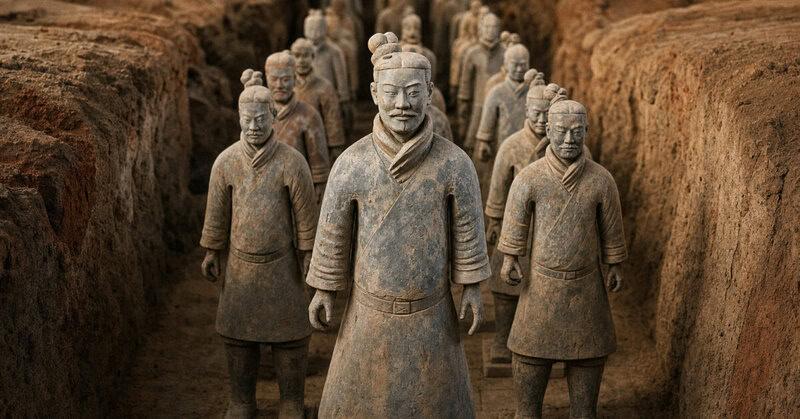
The Terracotta Army gets the postcards and the documentaries, but it is only the most famous face of something far larger and stranger: a landscape of ancient China artifacts that stretches from meteorite-forged iron buried in sacrificial pits to ceramic tripods shaped by hands that lived three thousand years before the first emperor drew breath. Every decade of excavation rewrites what we thought we knew, and the revisions keep getting more startling. This article works through nine of the most significant finds and the questions they refuse to stop asking.
1. Bronze Masks With Telescoping Eyes That Stare Back Across 3,000 Years

Somewhere in a museum case, a face looks out at you that does not look quite human. The bronze masks of Sanxingdui — unearthed in Sichuan province and now among the most debated ancient China artifacts in existence — carry eyes that push outward from the face in long cylindrical tubes, like twin periscopes straining toward something only they can see. Nothing else in the ancient Chinese artistic record comes close to this design. No other culture of the same era, east or west of Sichuan, produced anything like them.
Whether those protruding eyes represent divine sight, supernatural beings, or a cosmology we simply no longer have the key to remains genuinely unresolved. Sanxingdui left no written records, so the masks speak in a language archaeology has not yet cracked — making them one of ancient China history‘s most haunting open questions. Three competing interpretations circulate among specialists: the eyes as symbols of supernatural perception granted to priests, as representations of a deity specific to Sichuan cosmology, and as purely aesthetic conventions that diverged from Central Plains traditions without any recoverable theological meaning. None has won the argument. The stare endures; the explanation does not.
2. China’s Oldest Meteoritic Iron Object — Forged From a Fallen Star, Buried in a Ritual Pit

At some point, someone at Sanxingdui picked up a piece of metal that had not come from the earth — it had fallen from the sky. Research published in 2026 confirmed that a small iron artifact from the Sanxingdui site was made from meteoritic iron, derived from a meteorite rather than smelted ore, making it the earliest known Bronze Age meteoritic iron artifact from China. The people who held it clearly understood it was different: they did not lose it or discard it. They buried it deliberately, as an offering.
That act of intentional deposition is what makes the find so resonant. The discovery pushes back the timeline of purposeful engagement with meteoritic metal in China further than any previously documented find, rewriting a chapter of Chinese archaeological discoveries around early iron use. It also raises a pointed question: how did the Sanxingdui people identify this metal as exceptional? Meteoritic iron looks different from bronze, but recognizing its extraterrestrial origin would have required either accumulated observational knowledge or a cultural framework that categorized unusual materials as sacred by default. Either possibility implies a more sophisticated material literacy than the civilization’s Bronze Age label alone suggests. A civilization looked at a rock from space and decided it belonged to the gods.
3. Sanxingdui’s Sacrificial Pits: A Civilization That Buried Its Treasures on Purpose

Royal tombs dominate the popular imagination of ancient archaeology — a dead king surrounded by the things he loved. Sanxingdui operates on an entirely different logic. Every extraordinary object recovered from the site, including the towering bronze trees that reach toward a ceiling no longer there, the alien masks, and the meteoritic iron piece, came not from a burial but from ritual pits where objects were deliberately deposited. Many show signs of having been burned before they went into the ground.
This makes Sanxingdui archaeologically singular among sites of ancient China history. It is not a tomb assemblage but something closer to a mass consecration — possibly the moment a civilization chose to offer its most sacred objects in a single dramatic act, perhaps marking the close of a religious era or a political rupture. The pits are not a graveyard. They are a frozen decision, and the collection they preserved is a curated snapshot of everything Sanxingdui believed mattered most. The burning before burial matters too: fire in ritual contexts across many ancient cultures signals transformation rather than destruction — the objects were not disposed of but sent somewhere.
4. A Sichuan Bronze Culture So Different It Might As Well Have Been on Another Continent

In the same centuries that Central Plains cultures along the Yellow River were producing the angular, zoomorphic Chinese Bronze Age artifacts we recognize from textbook illustrations — vessels bristling with taotie masks and geometric registers — the people of Sichuan were doing something else entirely. They were casting life-sized human figures, abstract trees taller than a man, and those protruding-eyed masks. The two traditions share a metal and an era and almost nothing else.
When the first Sanxingdui pits came to light in the 1980s, the stylistic shock was so severe that some scholars initially struggled to accept the objects as authentically ancient Chinese. That resistance has since given way to a more expansive understanding: ancient Chinese civilization was never a single stream flowing from one source, but a mosaic of highly distinct, largely independent cultures developing in parallel across an enormous and varied landscape. Sanxingdui is the most vivid proof of that plurality yet found. It also invites a practical question the field is still working to answer: given how dramatically these traditions differ, how much contact, trade, or mutual awareness existed between Sichuan and the Yellow River basin during this period? The archaeological evidence suggests some exchange of goods and ideas, but the artistic traditions remained stubbornly separate.
5. A 5,000-Year-Old Tomb Interpreted as a Gateway to a Prehistoric Kingdom

Long before the Shang dynasty cast its first bronze vessel, long before any name we can read was attached to a Chinese throne, someone was already organizing people into hierarchies complex enough to build monuments. Archaeologists examining a roughly 5,000-year-old tomb discovered in China have described it as a possible gateway structure to a prehistoric kingdom — a finding that suggests state-level political organization was taking shape in the Neolithic period, millennia before the dynasties that dominate ancient China history textbooks.
The implications are considerable. If the interpretation holds, it means that the social stratification we associate with Bronze Age China — rulers and ruled, sacred and profane, monumental architecture and ritual power — had roots far deeper and older than the traditionally recognized first dynasties. The designation of the structure as a gateway rather than simply a tomb is itself significant: a gateway implies a threshold, and a threshold implies a bounded political space worth protecting, which in turn implies administrators, resources, and authority. The tomb does not just mark a burial; it may mark the edge of a world we have barely begun to excavate.
6. Three-Legged Tripod Vessels From China’s Neolithic Potters — Thousands of Years Before the Bronze Age

Before there was bronze, there was clay, and Chinese Neolithic potters were doing extraordinary things with it. Among the earliest Chinese archaeological discoveries are sophisticated ceramic tripods — three-legged, deep-bodied vessels used for cooking and ritual — produced by cultures that predate bronze casting by millennia. Britannica records that Neolithic Chinese assemblages also include goblet-like serving vessels, bowls, and pot supports, reflecting a ceramic tradition of considerable complexity and standardization — not the fumbling experiments of people just learning to fire clay, but the output of communities with established conventions about form and function.
What is striking is the persistence of the tripod form across time and material. The three-legged shape recurred across centuries and eventually crossed into bronze, where it became one of the defining silhouettes of Chinese Bronze Age artifacts. That continuity suggests the tripod carried meaning beyond its utility — that it was a shape with cultural or ritual weight, inherited and re-expressed generation after generation in whatever medium a culture had mastered. When Zhou dynasty bronze-casters produced a ding, they were not simply making a practical object in a fashionable style. They were reaching back to a formal tradition that their ancestors’ ancestors had established in fired clay.
7. The Hougang Stratigraphy: Pottery Layers That Let Archaeologists Read Time Like a Book

Not every landmark in Chinese archaeology announces itself with a golden mask or a jade burial suit. The Hougang lower stratum — one of China’s foundational archaeological reference layers — offers something quieter but arguably more important: a structured sequence of pottery forms that allows researchers to trace the development of early Chinese material culture layer by layer, the way a geologist reads stone. Changes in vessel shape, firing technique, and decoration across the Hougang sequence function as a chronological key, helping anchor other Chinese archaeological discoveries to both relative and absolute dates.
This kind of stratigraphic record is unglamorous work. Nobody writes a bestseller about pottery typology. But without the Hougang sequence and sites like it, the dazzling bronzes and the sacrificial pits and the terracotta soldiers would float in time without an anchor. Stratigraphy is the scaffolding on which everything spectacular in ancient China history is hung. It is also a reminder that the most consequential archaeological contributions are sometimes methodological rather than material — a reliable dating framework is worth more to the field than any single spectacular object, because it makes every other find more legible.
8. The Terracotta Army’s Sheer Scale Makes It Famous — But It Represents Only One Emperor’s Obsession

Among the most widely circulated terracotta army facts is the sheer number of figures: roughly 8,000 individual soldiers, each with distinct facial features, arrayed in underground vaults to guard Qin Shi Huang, the first emperor of a unified China, through eternity. The number is staggering enough. The scale of the broader funerary complex is more so — an estimated 56 square kilometers of planned landscape, with the emperor’s main burial mound itself still unexcavated as of the mid-2020s, partly out of technical caution and partly out of deliberate restraint while conservation methods continue to improve. Ancient texts describe rivers of mercury flowing through the mound’s interior, and soil samples have registered anomalously high mercury concentrations in the surrounding area, lending the old accounts unexpected credibility.
But the army’s fame can create a kind of tunnel vision. It is one node — spectacular, yes, but one node — in a vast and still-living archive of ancient China artifacts that stretches from Neolithic pottery kilns to meteorite-metal offerings in Sichuan. The Terracotta Army represents the funerary logic of a single, historically distinctive ruler who unified warring states by force and then spent the rest of his reign building monuments to his own permanence. It is extraordinary precisely because it is excessive, an outlier rather than a representative sample. The ground beneath China is among archaeology’s largest active archives, and the Terracotta Army is less a destination than a signpost pointing toward how much more remains underground.
9. Bronze Age China’s Ritual Vessels Were Also Political Instruments

A ding — the heavy bronze tripod cauldron that appears in museum collections worldwide — was not simply a beautiful object or a cooking pot elevated to sacred use. Under Zhou dynasty ritual law, the number and size of bronze vessels a noble could legitimately display and use was precisely codified by rank. Owning the wrong number was not an embarrassing excess but a political statement, and ancient texts record rulers being formally criticized for exceeding their bronze entitlement. These Chinese Bronze Age artifacts were, in the most literal sense, instruments of power — their presence, absence, and quantity legible to any informed observer in ways that required no written label.
This is what makes tomb archaeology in ancient China such a precise exercise in social reading. When archaeologists count the bronzes in a burial — the ding, the gui grain vessels, the bells — they are not cataloguing luxury goods. They are reading a declaration: this is who this person claimed to be, or who their survivors insisted they were, in the hierarchy of a world where metal spoke the language of legitimacy. A burial that exceeds its owner’s living rank may record posthumous aspiration, political revisionism, or the grief of survivors who could not bear to understate what they had lost. Every vessel is an argument.
From meteorite iron offered to unseen gods in Sichuan to bronze cauldrons counted like political ballots in Zhou dynasty tombs, the artifacts still emerging from Chinese soil keep insisting on the same lesson: the story of ancient China history is far wider, stranger, and less finished than any single army of terracotta soldiers could contain. The most important excavation is always the one that hasn’t happened yet.

 English
 Arabic
 French
 Spanish
 Portuguese
 Deutsch
 Turkish
 Dutch
Dutch
 Italiano
 Russian
 Romaian
 Greek
Greek