


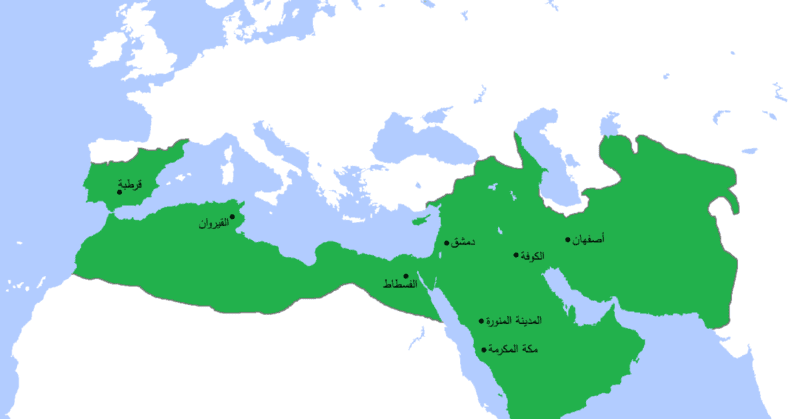
In the autumn of 732 CE, an Umayyad army stood in the vineyards of central France, less than 200 miles from Paris, at the outermost edge of an empire that had swallowed more of the known world than Alexander the Great ever touched. They had marched from Damascus across three continents. They had crossed the Strait of Gibraltar, rolled over the Visigoth kingdom of Iberia, and pressed north through the Pyrenees — all within a single human lifetime. It was, by almost any measure, the most spectacular run of conquest in recorded history. And within twenty years, the dynasty behind that march would be shattered, its ruling family hunted to near-extinction, its capital abandoned, its name erased from the coins of the realm.
That arc — from the edge of Paris to a massacre at a banquet table in Iraq — is one of the most instructive stories in medieval history. It is a story about what empires promise, what they fail to deliver, and how that gap eventually kills them.
Before the Caliphate: The World the Umayyads Inherited

To understand how the Umayyads rose so fast and fell so hard, you have to begin with a death. When the Prophet Muhammad died in 632 CE, he left behind a transformed Arabian Peninsula and a community ablaze with religious conviction — but no clear blueprint for succession. The question of who should lead cracked the early Muslim community almost immediately, producing the first four caliphs (the Rashidun, or “rightly guided”), who expanded Islam’s reach at breathtaking speed while managing mounting internal tensions that periodically erupted into open violence.
The First Fitna — the civil war that convulsed the young caliphate through the 650s and into the 660s — was the fault line that made the Umayyad era possible. Out of that conflict emerged Muawiya I, the governor of Syria and a scion of the Banu Umayya, one of Mecca’s most powerful merchant clans. Shrewd, patient, and deeply pragmatic, Muawiya consolidated power following the assassination of Ali ibn Abi Talib in 661 CE, establishing the Umayyad Caliphate as the second of the four major Islamic caliphates and the first to be governed by a single hereditary dynasty.
That last detail is the original sin the dynasty could never fully expiate. The Umayyads were the first rulers in Islamic history to make caliphal succession explicitly dynastic, treating a spiritual office belonging to the entire Muslim community as a family inheritance. Their critics — and there were many from the very beginning — called it plainly what it appeared to be: an Arab kingdom dressed in caliphal robes. The charge stung because it was not entirely wrong. The Umayyad dynasty had transformed a community built on the principle of equality before God into something that looked uncomfortably like the aristocratic power structures Islam had originally promised to dismantle. That tension would never be resolved. It would only be deferred — until it was not.
The Machine of Conquest: How Eighty Years Built the Largest Empire on Earth

Whatever their legitimacy problems at home, the Umayyads could build an empire abroad. Between 661 and roughly 720 CE, they assembled the largest territorial state the world had yet seen, stretching from the Iberian Peninsula in the west to Sindh in modern-day Pakistan and the steppes of Transoxiana in the east. The speed and geographic ambition of this expansion still staggers historians.
The engine powering it was threefold. First, a professionalized Arab military caste, battle-hardened through decades of warfare and motivated by religious conviction as well as the material rewards of conquest. Second, a sophisticated tax-and-tribute system that turned newly acquired territories into revenue streams financing further campaigns. Third — and perhaps most impressive — an institutional genius for absorbing the administrative machinery of the empires they defeated. When the Umayyads overran the remnants of Byzantine North Africa and the Sassanid Persian heartland, they did not dismantle the bureaucracies they found. They hired them, Arabized them gradually, and put them to work.
Two conquests bookend the era with particular drama. In 698 CE, the fall of Carthage — once Rome’s most formidable rival — sealed Umayyad control of North Africa and opened the door to the Atlantic. Then, in 711 CE, a Berber general named Tariq ibn Ziyad led a Muslim force across a narrow strait into Hispania, landing beneath a great limestone rock that would permanently bear his name: Jabal Tariq, the Mountain of Tariq — Gibraltar. Within a decade, the Visigoth kingdom had effectively ceased to exist. The expansion under the Umayyad Caliphate had no parallel in the ancient or medieval world for pace and reach.
But woven into every victory was a structural flaw that would eventually unravel everything. As the caliphate expanded, it absorbed enormous numbers of non-Arab peoples — Persians, Berbers, Copts, Sogdians, and others — who converted to Islam with genuine conviction. These converts were classified as mawali, or client non-Arab Muslims, and the treatment they received was a standing insult to the faith they had adopted. They were denied equal shares of war spoils. They were taxed as though they remained outsiders even after conversion. They were told, in effect, that faith without Arab ancestry was worth less. The empire was simultaneously evangelizing Islam and discriminating against the very converts it was making — a contradiction that could not hold indefinitely.
Cracks in the Marble: The Grievances That Fueled Revolution

Resentment built slowly, then all at once. By the early eighth century the mawali were not a marginal population — they constituted a vast share of the caliphate’s subjects and much of its military manpower. Their grievance was not merely economic. It was theological. Islam explicitly taught the equality of all believers. The Umayyad state explicitly violated that teaching. That contradiction could not hold forever.
Beneath the mawali question ran a deeper current of contested legitimacy that the dynasty had never managed to wash away. A significant portion of the Muslim world had never accepted the Umayyads as rightful rulers, mourning instead the line of Ali ibn Abi Talib and his son Husayn, whose killing at the Battle of Karbala in 680 CE had become the defining wound of what would eventually crystallize as Shia Islam. Karbala did not fade with time — it burned. Every year it was commemorated, the Umayyad regime was implicitly indicted by the memory of it.
At the top of the structure, things were also visibly rotting. The 740s produced a rapid and humiliating succession of weak caliphs, their reigns growing shorter as factions within the Umayyad family warred over the throne. Civil conflict erupted in Iberia, revolts shook North Africa, and tribal warfare flared in Syria — all within the same decade. The dynasty that had out-maneuvered two of antiquity’s greatest empires was struggling to manage its own relatives.
The pressure cooker was Khurasan — the vast eastern province covering much of modern Iran and Central Asia. It was dense with aggrieved mawali, radical preachers, and, crucially, the underground network of a rival clan: the Abbasids, descendants of Muhammad’s uncle Abbas ibn Abd al-Muttalib. They had been quietly organizing for decades, building coalitions across ethnic and tribal lines and carrying a single, powerful promise: a caliphate for all Muslims, not merely Arab ones. The transition from Umayyad to Abbasid rule was not a straightforward dynastic succession. It was a revolution with an ideological program.
The Abbasid Revolution: How an Empire Dies in a Decade

The black banners rose in Khurasan in 747 CE. Black against the Umayyads’ white — a deliberate visual declaration of war that was simultaneously a theological statement. The Abbasid movement, led in the east by Abu Muslim, was a masterclass in revolutionary messaging: it recruited mawali and Arabs alike, framed the uprising not as an ethnic rebellion but as an Islamic restoration, and promised that the caliphate would finally honor all Muslims as equals regardless of lineage. That message moved through the disaffected east like fire through dry grass.
What followed was almost startling in its speed. The Umayyad military machine, which had once seemed unstoppable, shattered with shocking rapidity against a force animated by genuine grievance and ideological clarity. At the Battle of the Zab in 750 CE — fought along a tributary of the Tigris River in what is now Iraq — the last significant Umayyad army was broken. The last caliph, Marwan II, fled south through Syria and into Egypt, where he was hunted down and killed. Then the Abbasids did something that cemented their victory in blood: they invited surviving Umayyad princes to a reconciliation banquet and massacred virtually every one of them at the table.
The dynasty that had ruled from the Atlantic to the Indus was effectively erased in three years. To make the break absolute, the Abbasids relocated the capital from Damascus — the Umayyad heartland — to a newly built city on the Tigris, inaugurated in 762 CE: Baghdad. The gesture was architectural and political at once. The era of Arab dynastic rule was declared finished. A new, ostensibly universal Islamic order had begun. The Umayyad Caliphate’s run as a dominant power had reached its violent conclusion — almost.
The Ghost That Survived: Umayyad al-Andalus

One man escaped the banquet. Abd al-Rahman, a young Umayyad prince, fled the massacre and made a remarkable journey — crossing North Africa largely alone, evading Abbasid agents along the way — until he landed in Iberia in 756 CE. The continent his family had conquered two generations earlier now became his refuge. He carved out an emirate from al-Andalus and, in a gesture of extraordinary defiance, refused to acknowledge Abbasid authority for the remainder of his life.
The dynasty that had built an empire spanning three continents now survived in only its westernmost fragment, separated from its destroyers by the entire breadth of the Mediterranean. But that fragment endured and, in time, flourished. In 929 CE, Abd al-Rahman III declared himself caliph — a direct challenge to Abbasid legitimacy — establishing a rival caliphate whose capital, Córdoba, became one of the most sophisticated cities in medieval Europe: a center of philosophy, medicine, mathematics, and architecture that briefly made Iberia the intellectual heartland of the Western world.
The Umayyad story, then, is not simply one of collapse. It is one of fragmentation and improbable transplantation — one branch destroyed at a banquet table in Iraq, another taking root in the olive groves of Andalusia and producing a civilization that would shape European learning for centuries. The full arc of Umayyad history stretches from Damascus to Córdoba, from triumph to near-extinction to renaissance — a trajectory that no straightforward narrative of decline can adequately contain.
What the Umayyads Left Behind — and Why It Still Matters

The Umayyad Caliphate’s collapse is a case study in a specific kind of imperial failure: not military defeat from without, but internal rot caused by a refusal to extend the promises of a founding ideology to those who had genuinely embraced it. The mawali did not revolt because they had stopped believing in Islam. They revolted because the Umayyad state had stopped believing in them. The Abbasids prevailed not because their armies were inherently superior, but because their governing idea was more consistent with the faith both sides professed.
Yet the legacy the Umayyads left behind is remarkable given how thoroughly they were formally erased. Arabic as an imperial administrative language — a policy they adopted early and enforced consistently across enormously diverse territories — became the intellectual medium of the entire medieval Islamic world and remains a living language spoken by hundreds of millions today. The Dome of the Rock in Jerusalem, completed in 691 CE under the caliph Abd al-Malik, stands as one of the most beautiful buildings ever constructed, a monument to Umayyad ambition rendered in stone and mosaic. The administrative frameworks, postal systems, and architectural templates they developed were copied, refined, and improved by the very successors who overthrew them.
The choices made between 661 and 750 CE left fingerprints that remain visible. The Sunni-Shia divide — rooted in questions of Ali’s legitimacy and the tragedy at Karbala — continues to shape politics, theology, and conflict across the Middle East. Debates about Arab identity versus Islamic universalism, about who authentically belongs within the community of believers, carry the echo of arguments raging in Umayyad courts and mosques thirteen centuries ago. These are not merely historical curiosities. They are living disputes with living consequences.
And somewhere in the Jordanian desert, the ruins of the Umayyad pleasure palaces — built by late caliphs who seemed to sense the ground shifting beneath them and retreated into the wilderness to hunt, feast, and commission elaborate frescoes — still stand, their painted walls fading slowly in the dry air. They are the monuments of rulers who confused the size of their empire with the depth of their legitimacy, and who built gorgeous things at the edge of a world that was already, quietly, preparing to forget them.

 English
 Arabic
 French
 Spanish
 Portuguese
 Deutsch
 Turkish
 Dutch
Dutch
 Italiano
 Russian
 Romaian
 Portuguese (Brazil)