


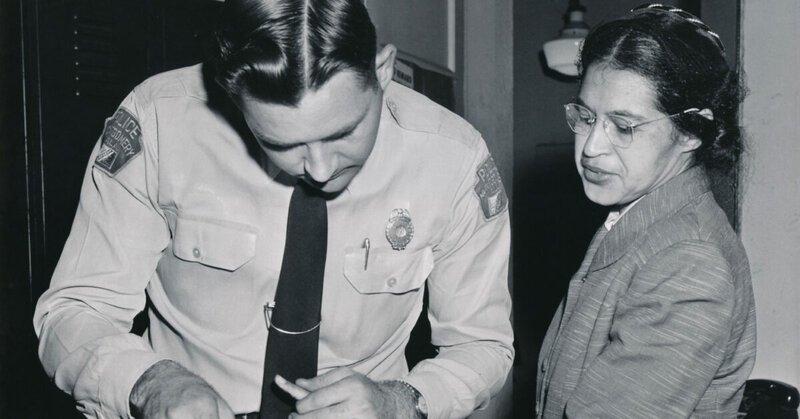
On the evening of December 1, 1955, a Montgomery city bus groaned to a stop on Cleveland Avenue, and a quiet woman in a dark coat settled into her seat with the particular stillness of someone who has already made up her mind.
The Seamstress Who Wasn’t Just Tired: A Thursday Evening in Montgomery

The bus was crowded, the winter air outside sharp and indifferent. When driver James Blake ordered Rosa Parks to surrender her seat to a white passenger, the other Black riders around her rose and moved. Parks did not. She felt no dramatic surge of defiance, she would later say — only a calm, bone-deep sense of rightness. Blake called the police. Parks folded her hands in her lap and waited.
For decades, the story sold to schoolchildren ran something like this: a tired seamstress, feet aching after a long day’s work, simply refused to give up her seat on impulse — and accidentally ignited the civil rights movement. It is a story almost perfectly designed to be harmless. It centers luck over logic, exhaustion over intention, accident over architecture. It is also, in its most important particulars, wrong.
Rosa Parks was not acting on impulse. She was the secretary of the Montgomery chapter of the NAACP. That very summer, she had traveled to the Highlander Folk School in Monteagle, Tennessee — an interracial training ground for labor and civil rights organizers — where activists had discussed, in frank and practical terms, how bus segregation could be used as a legal and political lever. The woman sitting on that bus on December 1, 1955, was not simply tired. She was prepared. And the community waiting for her call from jail was ready.
The real history of the civil rights movement is more audacious, more intelligent, and ultimately more inspiring than the sanitized legend allows. It is the story of a people who did not wait for history to happen to them — who studied, organized, selected their moments, and struck with precision.
A Movement Built on Blueprints: The NAACP’s Long Game

To understand December 1, 1955, you have to rewind at least a decade. The American civil rights movement — which historians broadly trace from the early 1940s through 1968 — was not a series of spontaneous eruptions. It was a sustained, multigenerational campaign built on legal scaffolding, organizational discipline, and a sophisticated understanding of how power actually works.
The NAACP, in particular, had spent years developing what might be called a plaintiff strategy. Winning in court required more than a righteous grievance — it required a plaintiff whose character, personal history, and legal circumstances could survive the brutal scrutiny of a hostile white judiciary and an even more hostile white press. One moment of vulnerability, one detail that could be weaponized, and a case could be poisoned before it reached a courtroom.
Montgomery’s Black community had already watched this calculus play out in painful detail. In March 1955, nine months before Parks’s arrest, a fifteen-year-old named Claudette Colvin was arrested for refusing to yield her bus seat — nearly the same offense, nearly the same bus line. Colvin was courageous and her anger entirely justified. But NAACP leaders, weighing the brutal pragmatics of a legal campaign, determined that her circumstances at the time made her case a more complicated vehicle for the constitutional challenge they were building. They held their position and waited.
This was not cynicism. It was the logic of a movement that had been shaped by thinkers like W.E.B. Du Bois — intellectuals who understood that righteous indignation, unguided by strategy, tends to exhaust itself against the walls of entrenched power. The civil rights leaders who came before Martin Luther King Jr. had built a tradition that King would inherit and extend: combining moral force with legal precision, street pressure with courtroom argument.
Why Rosa Parks — and Not Someone Else

When Montgomery NAACP leaders looked at Rosa Parks, they saw what their opponents would eventually see too: someone almost impossible to smear. She was in her forties, composed, churchgoing, employed. Her dignity was not a performance — it was simply who she was. She had served the NAACP faithfully for years, handling the unglamorous organizational work that movements run on: records, correspondence, coordination. She had sought justice on behalf of others long before she sought it for herself.
Her attendance at the Highlander Folk School that summer of 1955 matters not because it proves some conspiracy, but because it reveals the opposite of the tired-seamstress myth. Parks went to Highlander because she was already an active, thinking organizer who wanted tools. The school, founded by Myles Horton, brought together labor activists, civil rights workers, and community organizers to study nonviolent resistance and movement strategy. Participants explicitly discussed how segregated transit systems might be targeted through coordinated legal and economic action. Parks returned to Montgomery not transformed by the experience but sharpened by it.
None of this diminishes her courage — it deepens it. Sitting still on that bus while a police officer approached required a quality of nerve that no workshop can manufacture. Strategy and bravery were not in tension that December evening. They were the same thing, wearing the same dark coat.
The Night the Plan Clicked Into Motion

Word of Parks’s arrest moved through Montgomery’s Black community with the speed of something long anticipated. Within hours, the telephone network that civil rights organizers had spent years cultivating was alive with calls. E.D. Nixon, a Pullman porter and NAACP leader, posted bond and began working the phones. The question on every call was the same: is this the moment?
Jo Ann Robinson of the Women’s Political Council had already decided it was. That same night, Robinson and her colleagues cut a mimeograph stencil and produced flyers calling for a one-day boycott of Montgomery’s buses on December 5, the day of Parks’s trial. By dawn, students were distributing them across the city. The organizational infrastructure, built quietly over years, deployed in a single night.
Into the center of this rapidly accelerating moment stepped a young Baptist minister, new to Montgomery and relatively unknown outside his congregation: Martin Luther King Jr. He was twenty-six years old. The ministers and community leaders who gathered at Dexter Avenue Baptist Church needed someone to lead what was forming into the Montgomery Improvement Association — someone articulate enough to speak for the movement publicly, new enough to the city to carry fewer local political liabilities. King, uncertain but willing, said yes.
On December 5, 1955, Montgomery’s Black residents — most of them working people who depended on those buses to reach their jobs, their groceries, their doctors — walked. They shared rides in private cars. Some rode mules. They walked miles through Alabama’s December cold. The buses rolled nearly empty. One day of protest stretched into another, and then another, and then it became clear that no one was going back.
381 Days: The Montgomery Bus Boycott as Strategic Masterpiece

The Montgomery Bus Boycott lasted 381 days — from December 5, 1955, through December 20, 1956. That duration alone should reframe how we think about it. This was not a protest. It was a siege, sustained by a community of ordinary people making extraordinary sacrifices day after day, week after week, through cold and heat and fear and violence.
The strategy was deliberately two-tracked. On the streets, the boycott was crushing the bus company economically — Black riders had constituted the majority of its fare revenue, and that revenue was evaporating. On the legal front, NAACP lawyers were simultaneously pursuing Browder v. Gayle, a federal lawsuit directly challenging the constitutionality of Alabama’s bus segregation laws. Economic pressure and legal argument worked in tandem, each reinforcing the other. Neither alone would have been sufficient.
The opposition responded with the tools it had always used. Carpool organizers were arrested on spurious charges. King’s home was bombed. Threatening calls came at all hours. Each act of violence was intended to break morale and scatter the movement back into compliance. Each act of violence instead hardened resolve, generating national press coverage that made Montgomery’s Black citizens sympathetic figures to audiences far beyond Alabama’s borders.
The human cost was real and relentless. Feet blistered on asphalt. Working people lost jobs for participating. Families absorbed the financial strain of longer commutes and coordinated carpools. And yet the community held. The civil rights movement’s real history pivots here — not on a single act of defiance, but on the extraordinary endurance of ordinary people who understood, perhaps better than any historian would later explain, exactly what they were doing and why.
The Victory and What It Really Meant

In November 1956, the United States Supreme Court affirmed a lower court ruling in Browder v. Gayle, declaring Alabama’s bus segregation laws unconstitutional. The legal result the NAACP had been building toward — through plaintiff selection, through careful legal argument, through 381 days of sustained community sacrifice — had arrived. On December 20, 1956, the boycott officially ended. Rosa Parks boarded a desegregated Montgomery city bus.
But Montgomery was one domino in a much longer line. The broader civil rights movement — spanning roughly from the early 1940s through 1968 — was systematically dismantling the architecture of legalized racial segregation, discrimination, and disenfranchisement that had governed Black American life for generations. It would take the Civil Rights Act of 1964, the Voting Rights Act of 1965, and years of additional struggle before the framework of legal apartheid across the American South was fully demolished. Montgomery, however, had done something perhaps even more important than winning one legal case: it had demonstrated a method.
Nonviolent economic pressure, combined with legal strategy and mass community solidarity, could crack systems that had seemed immovable. That combination — the boycott as prototype — became a template replicated across the South and eventually far beyond it. A movement that its opponents had hoped to portray as random and leaderless had revealed itself to be disciplined, intelligent, and formidably patient.
What the Real Story Teaches Us — and Why the Myth Persisted
The tired-seamstress story took hold for reasons worth examining honestly. It was easier to absorb — a single heroic individual acting on feeling, rather than a coordinated community acting on strategy. It required no uncomfortable reckoning with the depth of organizational sophistication that Black Americans had developed in the face of violent suppression. And, perhaps most usefully for those who preferred not to learn from it, it offered no replicable lessons. Accidents cannot be repeated. Strategies can.
The myth also, in a quieter way, diminishes the very people it claims to honor. It replaces Rosa Parks’s intelligence, preparation, and conscious moral agency with sentiment. It replaces her community’s discipline with luck. It converts a masterwork of civil rights strategy into a fairy tale about the right person being in the wrong seat on the right evening — as though history occasionally does people favors, rather than people making history through relentless, unglamorous work.
There is a further cost to the sanitized version that rarely gets named: it flattens the supporting cast into a backdrop. Jo Ann Robinson ran a mimeograph through the night. E.D. Nixon worked the phones and posted bond. The Women’s Political Council had drafted boycott plans months before Parks’s arrest, holding them in readiness for exactly this kind of moment. Claudette Colvin went to jail nine months earlier and was quietly set aside. Every one of these people exercised judgment, took risks, and made sacrifices that the legend of the accidental heroine has largely erased.
The true version is harder. It demands more of those who hear it. It insists that the Montgomery Bus Boycott was not a gift from circumstance but a victory earned through years of organizing, legal preparation, community solidarity, and the willingness to endure — day after freezing day — whatever cost the opposition chose to impose. That story, honestly told, remains a living playbook, not a museum piece.
Rosa Parks understood exactly what she was doing on that bus on December 1, 1955. She had studied. She had organized. She had trained. She had watched other women arrested before her and understood what the moment required. When the driver told her to move and she sat still, it was not the stillness of exhaustion. It was the stillness of someone who had been walking toward this seat for years — and who sat down, with full knowledge and full courage, so that an entire people could, at long last, rise.

 English
 Arabic
 French
 Spanish
 Portuguese
 Deutsch
 Turkish
 Dutch
Dutch
 Italiano
 Russian
 Romaian
 Portuguese (Brazil)