


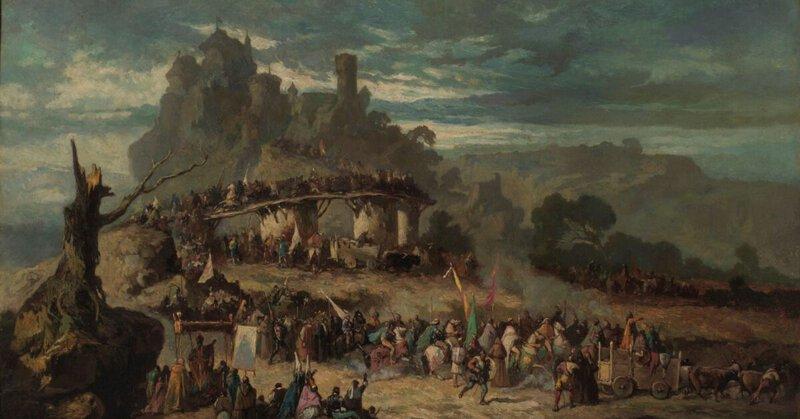
When Pope Urban II rose to speak at Clermont in the autumn of 1095, he almost certainly did not imagine he was about to redirect the intellectual history of Western civilization. Yet that is precisely what happened — the Crusades, launched as a military and spiritual enterprise, produced consequences so far removed from their original purpose that historians still argue over which legacy matters most.
A Pope’s Sermon That Set Two Centuries of War in Motion

On November 27, 1095, Pope Urban II addressed a crowd at Clermont, France, and delivered what may be the most consequential sermon in medieval history. His call to arms invited Western Christians to march to Jerusalem and wrest it from Seljuk Turkish control — and the response spread across Europe with a speed that stunned even the papacy itself. The campaigns he ignited lasted from 1095 to 1291, nearly two hundred years of organized holy war waged under the banner of the Latin Church.
What made Urban’s appeal so potent was its fusion of duty and reward. Participants were promised remission of the penalties for sin — a spiritual guarantee that bound religion and violence together in a way medieval Europe had never quite formalized before. A soldier who died on crusade was not merely a killer; he was, in the Church’s framing, a pilgrim bearing arms. That theological framework would underpin crusading ideology for generations and would be refined, debated, and ultimately questioned by later medieval thinkers who struggled to reconcile sanctified violence with Christian teaching.
Jerusalem: The Sacred Prize Both Faiths Refused to Surrender

To understand why the Crusades burned so long and so fiercely, it helps to consider Jerusalem’s unique position in the geography of faith. The Church of the Holy Sepulchre, venerated by Christians as the site of Christ’s death and resurrection, stands within walking distance of the Dome of the Rock, which crowns the Noble Sanctuary — the third holiest site in Islam. For Jews, the same ground holds the remnants of the ancient Temple. No boundary could be drawn through that city that would satisfy every claimant.
This concentration of sacred geography made compromise nearly impossible and turned Jerusalem into the era’s most fought-over patch of earth. The primary stated goal of the Crusades was control of these holy sites, and that goal gave the wars a moral intensity that outlasted any single military campaign. Armies could be defeated; the conviction that Jerusalem must be held or recovered proved far harder to extinguish — on either side of the conflict.
The Crusades Were a Response, Not a Bolt From the Blue

Popular imagination sometimes pictures the Crusades as an unprovoked European aggression launched against a peaceful Islamic world, but the history is considerably more tangled. Western European Christians organized these expeditions partly in response to centuries of Muslim military expansion that had swept across the Middle East, North Africa, and deep into Spain and Sicily. By the late eleventh century, the Seljuk Turks had dealt the Byzantine Empire a devastating blow at the Battle of Manzikert in 1071, shattering a Christian power that had long served as a buffer on Europe’s eastern frontier.
It was the Byzantine emperor Alexios I Komnenos who appealed to Pope Urban II for military assistance, and that appeal gave Urban his opening. The First Crusade was therefore partly a geopolitical response to a collapsing Christian empire, not purely a spontaneous eruption of religious frenzy. Understanding that context does not excuse the violence that followed, but it does explain why Urban’s sermon landed on such fertile ground — significant portions of European Christendom genuinely believed something important was crumbling at its eastern edge, and the papacy saw both a duty and an opportunity to act.
The Papacy as Commander-in-Chief: How the Church Ran a War Machine

The Crusades were not simply blessed by the Church and then handed off to secular rulers — they were initiated, organized, funded, and at times directly directed by the papacy in a manner that had no real precedent. Popes issued papal bulls authorizing specific campaigns, granted tax exemptions and spiritual privileges to those who took the cross, and did not hesitate to excommunicate rulers who refused to participate or who abandoned their vows mid-campaign. The Church, in other words, held genuine coercive authority over the kings and knights it was supposedly only advising.
This made the medieval papacy something genuinely unprecedented: a religious institution exercising coordinated strategic authority across multiple kingdoms simultaneously. A king might command his own army, but the pope could delegitimize him, strip his territories of ecclesiastical protection, and mobilize other Christian rulers against him. The Crusades were, among other things, the moment when the papacy tested just how far that authority could reach — and discovered both its impressive extent and its very real limits, particularly when campaigns failed and blame had to be assigned.
Not Just the Holy Land: The Church Turned the Crusading Weapon Inward on Europe

Once the machinery of crusading had been assembled, it proved too useful to reserve for distant campaigns. The papacy also sanctioned military expeditions aimed at suppressing heresy and extending Latin Christian authority within Europe itself — and the results were devastating for those in the crosshairs. The Albigensian Crusade, launched in 1209 and continuing until 1229, targeted the Cathar movement of southern France. The massacres that followed — including the notorious sack of Béziers — nearly destroyed the rich Occitan culture of the region, and the campaign introduced the Inquisition as a systematic follow-up instrument of religious conformity.
Further north, the Northern Crusades pushed into the Baltic, where pagan Lithuanians, Latvians, Estonians, and others were subjected to forced conversion by the Teutonic Knights and other military orders acting on papal authority. By the time this broader pattern is accounted for, it becomes clear that “crusade” had evolved into a flexible papal instrument — one that could be directed at almost anyone the Church defined as an enemy, regardless of geography or faith. The full history of the Crusades is therefore far wider than Jerusalem alone, and any account that focuses solely on the Holy Land campaigns misses a substantial portion of the story.
The Unintended Curriculum: Islamic Scholarship Floods Into Medieval Europe

Here is the development that no one in Urban II’s audience at Clermont could have anticipated. As crusaders occupied parts of the Levant and established themselves in its port cities, they came into sustained contact with a world where Arab and Persian scholars had spent centuries preserving, translating, and dramatically advancing Greek philosophy, mathematics, astronomy, and medicine — disciplines that had largely atrophied in Western Europe during the early medieval period.
Works by Ibn Sina, known in the West as Avicenna, on medicine and philosophy, and by Ibn al-Haytham on optics, began filtering westward through crusader ports and the great translation centers of Sicily and Toledo, reshaping European universities from the ground up. This transfer of knowledge unfolded gradually over the twelfth and thirteenth centuries and is now widely regarded by historians as among the Crusades’ most consequential legacies. The Church launched holy war and inadvertently imported the intellectual materials that would help build the foundations of the European Renaissance — one of history’s most spectacular cases of unintended consequences.
Crusader States: Medieval Europe’s Unexpected Colonial Experiment

When the First Crusade captured Jerusalem in July 1099, the victorious knights faced a question no one had fully planned for: what now? Rather than return home to their estates in France, Normandy, and Flanders, many stayed and built. Four semi-permanent Crusader States emerged — the Kingdom of Jerusalem, the County of Tripoli, the Principality of Antioch, and the County of Edessa — each requiring its rulers to govern multicultural populations of Eastern Christians, Muslims, and Jews who had no particular interest in being governed by Western European newcomers.
The day-to-day reality of administering these states forced a degree of pragmatism that frequently clashed with crusading ideology. Local legal customs were sometimes tolerated, alliances were struck with Muslim neighbors when strategic circumstances demanded it, and trade flourished because all parties needed it to. The existence of these states for nearly two centuries created durable commercial and cultural connections between Western Europe and the Islamic world — connections that no purely military campaign, however spectacular, could have produced on its own. The Crusader States were, in their messy way, laboratories of cross-cultural contact operating under permanent military pressure.
The Military Orders: Warrior-Monks Who Outlasted the Crusades Themselves

Among the most remarkable institutions the Crusades produced were the military orders — the Knights Templar, the Knights Hospitaller, and the Teutonic Knights — religious brotherhoods that fused monastic vows of poverty, chastity, and obedience with rigorous professional military training. They functioned, in effect, as the medieval world’s first standing professional armies with an international organizational structure, and they became enormously powerful as a result.
The Templars in particular grew so financially formidable — developing an early system of letters of credit that made them indispensable to pilgrims and rulers who needed to move wealth safely across long distances — that King Philip IV of France eventually moved against them. Seeking to cancel debts and seize assets, he engineered the order’s suppression; following trials widely regarded as politically motivated, the last Grand Master, Jacques de Molay, was burned in 1314. The Hospitallers proved more durable, evolving and adapting over the following centuries. They survived the loss of the Holy Land, then Cyprus, then Rhodes, and eventually established themselves on Malta. The legacy of the Crusades lives on in the Sovereign Military Order of Malta, which continues to operate today as one of the oldest continuously functioning institutions in the Western world — a direct living thread connecting the present back to the crusading era.
1291: The Fall of Acre and the End of an Era

The end, when it came, was neither quiet nor merciful for those inside the walls. In May 1291, the Mamluk Sultanate under Sultan al-Ashraf Khalil captured Acre, the last major Crusader stronghold in the Holy Land, after a siege of weeks. The fall was followed by the death or enslavement of much of the city’s population — scenes that shocked contemporaries across the Christian world. With Acre gone, Western Christian military presence in the Levant effectively ceased.
The fall of Acre did not immediately extinguish crusading ideology — popes continued to issue calls for new campaigns well into the fifteenth century, and projects were drawn up and discussed — but it marked the point at which those calls became increasingly theoretical, overtaken by the political realities of a Europe preoccupied with its own dynastic conflicts and, eventually, its own religious ruptures. After nearly two centuries of organized effort, enormous expenditure, and incalculable human suffering, the primary goal of the Crusades — permanent Christian control of Jerusalem — had failed. Historians assessing the Crusades’ long-term impact have consistently found that the campaigns’ accidental legacies — transformed universities, new trade networks, enduring institutions, and deep and lasting grievances in the Islamic world — have proven far more consequential than anything their architects ever planned.
Why the Crusades Still Matter

The Crusades are not merely a chapter in medieval history — they are a case study in how large-scale ideological projects generate consequences their designers cannot foresee or control. The knowledge transfers that helped spark the Renaissance, the financial innovations pioneered by military orders, the commercial networks built by Crusader States, and the political wounds that shaped Islamic memory of the West all trace their origins to a single sermon delivered on a French hillside in November 1095. From that sermon to the fall of a port city nearly two centuries later, the Crusades reshaped Europe and the wider world not primarily through the victories their organizers intended, but through the knowledge, institutions, and entanglements they never anticipated — a reminder that history’s most consequential turning points are often its least predicted ones.

 English
 Arabic
 French
 Spanish
 Portuguese
 Deutsch
 Turkish
 Dutch
Dutch
 Italiano
 Russian
 Romaian
 Portuguese (Brazil)