


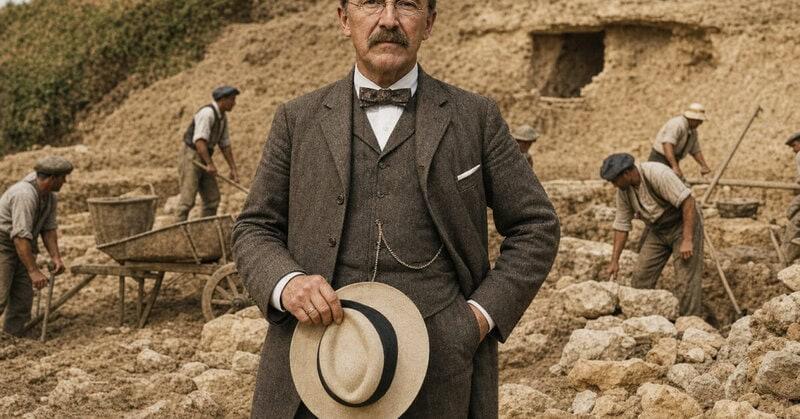
In the summer of 1873, a self-made German millionaire stood on a wind-scoured hill in northwest Turkey and ordered his workers to dig faster, blast harder, go deeper — because somewhere beneath his boots, he was absolutely certain, lay the golden city of Homer’s Iliad. He was right that Troy was there. He was catastrophically wrong about which Troy he was looking for, and in his furious, magnificent impatience, he destroyed the very evidence that might have answered history’s most tantalizing question.
The Man Who Blew Up History to Find It

Heinrich Schliemann was not an archaeologist by training. He was a grocer’s son who taught himself more than a dozen languages, made a fortune through trade during the California Gold Rush era and the Crimean War, and spent his adult life in the grip of a single obsession: proving that Homer’s epics were not poetry but reportage. When he arrived at Hisarlık — a modest mound rising from the coastal plain near the Dardanelles strait — he brought hundreds of laborers, iron picks, and a certainty that bordered on religious conviction. He treated the mound not as a fragile archive of human civilization but as an obstacle between himself and glory.
The industrial-scale trench he drove through the center of Hisarlık was, by the standards of any era, an act of extraordinary violence against the past. Schliemann wanted the oldest, deepest, most Homeric layer, and everything above it was, to him, rubble to be shifted. What he did not understand — what almost no one yet fully understood in the 1870s — was that the mound was not one city. It was nine cities, stacked on top of one another like the pages of a book he was tearing through from the back.
The bitter irony is irreducible: the man who proved that Troy was a real place, and not merely a poet’s dream, also destroyed the best evidence of what really happened there. His obsession validated him and damned him in the same stroke.
Nine Cities Stacked on the Same Ground

Archaeologists now label the successive settlements at Hisarlık as Troy I through Troy IX, spanning roughly three thousand years of continuous habitation. Each layer represents a different civilization, a different era, different people building their lives on the ruins of whoever came before. It is one of the most extraordinary stratigraphic records in the ancient world — or rather, it was, before Schliemann’s trench cut through much of it like a saw through a tree ring.
Schliemann targeted Troy II, a burned and treasure-laden level that he dramatically proclaimed the city of King Priam, besieged by Agamemnon’s armies. In 1873, he unearthed a cache of golden objects — diadems, earrings, vessels — and called it Priam’s Treasure. He photographed his young wife Sophia wearing the golden diadems, the images rippling across newspapers across Europe. The world was electrified.
There was one serious problem. Troy II dates to roughly 2400-2200 BCE. The traditional dating of the Trojan War period — the Late Bronze Age era that Homer’s story would plausibly reflect — is around 1300-1180 BCE. Schliemann had found something real and spectacular, but he had found it in entirely the wrong millennium, approximately a thousand years too early. The layers that actually correspond to the Late Bronze Age, labeled Troy VIh and Troy VIIa by later scholars, were the ones his workers had been shoveling through as inconvenient fill.
Priam’s Treasure Belonged to Someone Else Entirely

The golden objects themselves were genuine and genuinely extraordinary — Early Bronze Age craftsmanship of a high order, evidence of a sophisticated and wealthy society at Hisarlık thousands of years before the classical world. But contextual analysis and subsequent dating placed the hoard firmly in the Early Bronze Age, predating any plausible Trojan War by well over a thousand years. The objects were emphatically not Priam’s. They belonged to a people whose names we do not even know.
The story of the treasure immediately became entangled in a separate scandal. Schliemann smuggled the entire hoard out of Ottoman territory in violation of his excavation agreement, triggering a diplomatic crisis and earning himself a permanent ban from further digging at the site. The recklessness of the act — sacrificing years of future access to a place he claimed to revere — reveals something essential about his character: the find mattered more to him than what the find could teach.
The treasure’s subsequent journey is its own geopolitical saga. It passed to Berlin, was seized by Soviet forces at the end of World War II, and today sits in Moscow’s Pushkin Museum — claimed simultaneously by Russia, Germany, Turkey, and Greece, a flashpoint of competing national narratives more than a century and a half after it was pulled from the ground. The objects that were supposed to resolve the question of Troy’s reality became, instead, a symbol of how history can be appropriated, distorted, and contested long after it is discovered.
The Layers He Bulldozed: What Troy VIh and VIIa Actually Tell Us

Troy VIh, dating to approximately 1700-1300 BCE, was by any measure a grand city. It had massive limestone defensive walls — sections of which still stand today, still impressive after three millennia — and a large, prosperous urban footprint far exceeding anything in Troy II. This was a place of real regional power, positioned at the strategic crossroads where Europe and Asia nearly touch across the narrow water of the Dardanelles. If you were going to compose an epic about a city worth a ten-year siege, this is the city you would write about.
Troy VIIa, immediately above it and dating to roughly 1300-1180 BCE, tells an even more pointed story. Excavators working the site after Schliemann found burned structures, large storage jars buried hastily in floors as if people were preparing for a prolonged siege, and unburied human skeletal remains suggesting sudden, catastrophic violence. These are not the traces of an orderly abandonment. Something terrible happened here, at almost precisely the period when a Trojan War might plausibly have occurred.
It was the American archaeologist Carl Blegen’s meticulous re-excavation in the 1930s that first made the case clearly: Troy VIIa, not Troy II, was the most plausible candidate for the Homeric city. But Blegen was working in the long shadow of Schliemann’s central trench, which had already punched an irreversible wound through the mound’s heart, disturbing or destroying significant portions of the very layers that mattered most.
Was There Even a Trojan War? The Evidence Is Murkier Than the Myth

No ancient document outside the Greek literary tradition explicitly describes a prolonged Greek siege of Troy. Hittite records — which survive in significant quantity from this period — mention a place in the western Anatolian region called Wilusa, which many scholars believe corresponds to Ilios, Homer’s other name for Troy. Hittite diplomatic correspondence includes references to disputes involving Wilusa. The connections are suggestive, tantalizing, and maddeningly inconclusive.
The destruction of Troy VIIa coincides broadly with the Late Bronze Age collapse, one of history’s great unsolved catastrophes — a period around 1200-1180 BCE when dozens of Eastern Mediterranean civilizations, including the Mycenaeans, the Hittites, and the Ugaritic kingdom, were burned, abandoned, or transformed beyond recognition within a few generations. The cause or causes of this collapse remain actively debated: drought, earthquake, internal rebellion, the movements of peoples the Egyptians called the Sea Peoples, or some cascading combination of all of these. Troy VIIa’s destruction may be one episode in that vast, systemic unraveling, not necessarily the result of a decade-long Greek siege at all.
Homer’s Iliad, composed centuries after any events it might reflect, passed through generations of oral tradition before it was written down. It almost certainly blends real geographical memory, genuine Bronze Age conflict, and layers of mythological elaboration that accumulated over hundreds of years. The honest position, which responsible scholars hold, is this: something violent happened at Hisarlık around 1180 BCE. People lived and died within those limestone walls. Whether anyone named Achilles drove a chariot across that plain, or whether a face launched those thousand ships, remains beautifully and permanently beyond proof.
Modern Archaeology’s Redemption — and What Remains Lost

From the 1980s onward, the Tübingen-Cincinnati Project — led initially by Manfred Korfmann and later continued by Brian Rose — brought genuinely modern archaeological methods to Hisarlık: ground-penetrating radar, careful stratigraphic analysis, and non-invasive survey techniques that Schliemann could not have imagined. What they found transformed scholarly understanding of the site’s true scale. The Troy of the Late Bronze Age was not limited to the modest citadel mound visible above ground. A substantial lower city extended well beyond it, suggesting a total population that may have reached several thousand people — a genuine regional power, not the small hilltop settlement that skeptics had long used to dismiss the Homeric account as fantasy.
Advanced dating techniques, analysis of human remains, and digital reconstruction have recovered something of what was lost. But the central trench Schliemann cut remains an open wound in the historical record, a permanent gap in the stratigraphic sequence that no technology can fully repair. What archaeologists mourn most is not the missing treasure — it is the missing context. The spatial relationships between structures, the organic material that would have yielded climate and diet data, the architecture of ordinary daily life: these are the things dynamite erased, and they are gone permanently.
The site is now a UNESCO World Heritage Site, and ongoing excavations continue with the patience and precision that Schliemann never possessed. Modern scholars work around and through his damage, finding that the real story of Troy — a prosperous Bronze Age city at a strategic crossroads, destroyed during an era of Mediterranean-wide catastrophe — is stranger, richer, and more historically significant than any tale of wooden horses and divine intervention.
Why the Story of Troy Still Matters
Schliemann’s excavation is a parable about confirmation bias — about the danger of wanting so badly to find something that you stop being able to see what is actually in front of you. He arrived at Hisarlık with his conclusion already formed, found evidence to fit it, and called it victory. The intellectual error was compounded by the physical destruction, which meant that correcting him required not just better thinking but a kind of archaeological forensics performed on a crime scene he had created.
And yet the verdict on Schliemann cannot be simple condemnation. He was the person who demonstrated, against the entrenched skepticism of his era’s academic establishment, that Homer’s world had a geographical reality. There was a powerful, walled city at Hisarlık. It had been there for thousands of years. It had been burned. People had fought over it. That insight — that myth and memory could preserve genuine echoes of the ancient world — was genuinely revolutionary and opened the door to an entire tradition of archaeological inquiry into the Bronze Age.
For readers whose imagination was captured by the epic drama of Troy — whether through the 2004 film starring Brad Pitt, whose troubled production history reflects the enduring difficulty of translating this myth to screen, or the more recent Netflix series Troy: Fall of a City — the real history beneath the legend is more unsettling and more fascinating than any dramatization. The walls were real. The burning was real. Whether the heroes were real is the question that a hundred and fifty years of archaeology, and one man’s magnificent, catastrophic impatience, have left beautifully unresolved.
Somewhere beneath the hill at Hisarlık, beneath Schliemann’s trench and Blegen’s careful soundings and Korfmann’s radar surveys, there may yet be evidence that changes the story again. The earth gives up its secrets slowly. Troy, as ever, yields itself only in fragments — enough to tantalize, never quite enough to confirm.

 English
 Arabic
 French
 Spanish
 Portuguese
 Deutsch
 Turkish
 Dutch
Dutch
 Italiano
 Russian
 Romaian
 Portuguese (Brazil)