


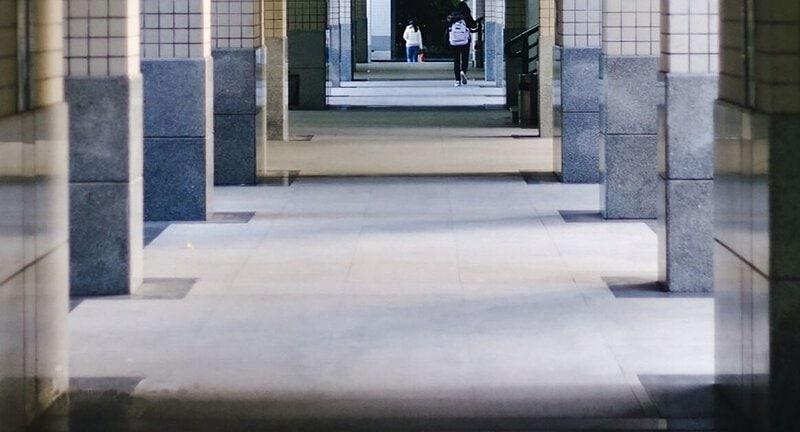
In May 2019, a single anonymous photograph posted to a paranormal imageboard unleashed one of the fastest-growing horror mythologies in internet history — yet the dread it conjures is anything but new. From ancient Roman sacred groves to Mesopotamian threshold rituals, the Backrooms taps into fears that have followed humanity across millennia, simply wearing a new coat of moist yellow carpet.
A Single 2019 4chan Post That Started Everything

Sometime in the early 2000s, someone pointed a camera at an empty commercial interior and snapped a photograph for reasons nobody now remembers — routine documentation of an unremarkable space. Nearly two decades later, that image surfaced on 4chan’s /x/ paranormal board in May 2019, paired with a caption describing it as a place you end up if you “noclip out of reality.” The caption was spare and matter-of-fact, which made it worse. No monster. No blood. Just the suggestion that the room was waiting.
Within days, other anonymous users began layering on rules, creatures, and survival lore, building what would become one of the fastest community-constructed creepypasta mythologies on record. What had been a throwaway post became a collaborative act of collective dread — proof that the right image dropped into the right cultural moment can seed an entire cosmology overnight.
The ‘Noclipping’ Concept Borrowed from Video Game Glitch Culture

“Noclipping” has a precise and mundane origin: it is a cheat or debug mode in video games that disables collision detection, allowing a player’s character to walk straight through walls as though solid geometry does not exist. The Backrooms mythology lifted this term and turned it into something genuinely unsettling — a metaphor for the possibility that the physical world runs on rules, and that those rules can, under rare and terrifying conditions, silently fail. Step wrong, think wrong, and you slip through the floor of consensual reality into whatever lies underneath.
This framing gave the horror a distinctly digital-age flavor, but the underlying idea is ancient. Threshold mythology — the belief that ordinary spaces can become doors to otherworldly ones — appears in cultures across recorded history. The Backrooms translated that primal anxiety into the language of game engines, making it newly legible to a generation that grew up understanding the world through screens.
The Moist Yellow Carpet and Buzzing Fluorescent Lights as Deliberate Sensory Horror

The canonical Backrooms description is almost clinical in its specificity: wet-looking, mono-yellow stained carpet; a persistent smell of dampness; the unvarying hum of fluorescent tubes overhead. There are no bodies, no weapons, no obvious threat. The horror lives entirely in the wrongness of the sensory combination — an office stripped of every human purpose, preserved like a space that forgot it was supposed to be vacated.
Commentators on digital horror have connected this to what might be called the uncanny valley applied to environments rather than faces: a space that resembles somewhere familiar but has been hollowed of all social meaning triggers a deep, instinctive unease. The sensory specificity also explains why the original photograph worked as well as it did. It did not look like a movie set or an artist’s rendering. It looked like a place someone had actually been, documented in the flat, affectless way people photograph spaces for insurance claims or real estate listings. That documentary quality transformed an image into apparent evidence.
Kane Pixels’ 2022 Fan Film Transformed It into a Global Phenomenon

In January 2022, a teenager named Kane Parsons — posting under the name Kane Pixels — uploaded a found-footage short film to YouTube that depicted the Backrooms using visual effects sophisticated enough to make many viewers genuinely uncertain whether they were watching real archival footage. The film’s grain, its awkward camera movement, its cold institutional palette: all of it was crafted with a precision that belied the creator’s age. Tens of millions of views followed, and with them a surge of mainstream attention that carried the Backrooms mythology far beyond the niche communities that had incubated it.
Parsons was subsequently reported to have attracted interest from Hollywood producers — a trajectory that illustrates how quickly collaborative internet folklore can translate into commercial property. What began as a caption on an anonymous imageboard had, in three years, become a viable film pitch. The speed of that journey is itself a marker of how differently mythology propagates in the digital age.
A Collaboratively Authored Mythology with Hundreds of ‘Levels’

The original post described one room. The community decided that was not nearly enough. Through wiki pages, forum threads, and collaborative documents, contributors expanded the single yellow office into a taxonomy of hundreds of numbered levels, each governed by its own physics, populated by its own entities, and accompanied by survival guides written in the deadpan register of official documentation. Level 0 is the original room. Deeper levels include flooded hotel corridors, endless open meadows, and spaces whose threat is atmospheric rather than physical — wrongness without a visible source.
The structure mirrors something very old. Ancient cosmologies such as the Norse nine realms of Yggdrasil, or the Egyptian Duat — the layered underworld through which the dead traveled — were also built by many hands across many generations, each contributor adding detail to a shared architecture of dread. The Backrooms wiki compressed that generational process into years, but the impulse — to map the unmappable, to give the terrifying a taxonomy — is the same one that produced the world’s oldest mythologies.
The Backrooms as a Textbook Example of Internet-Age Ostension

Folklorists use the term “ostension” to describe the moment when people begin treating a fictional legend as real — acting it out, generating first-person testimony, producing artifacts that claim to document what the legend describes. The Backrooms has generated thousands of posts purporting to be genuine survival accounts, recovered photographs, and earnest how-to guides for escaping various levels. The boundary between knowing something is fiction and behaving as though it is not has become productively blurred, which is exactly how ostension works.
This mechanism is not new. Ancient beliefs about liminal spaces — the crossroads at midnight, the ground just beyond the village boundary, the threshold between one room and the next — were also maintained through repeated personal testimony rather than canonical texts. Scholars of digital folklore have cited the Backrooms as a case study in how ostension now operates at internet speed, collapsing into months a process that once took generations.
The Ancient Concept of Liminal Space That Pre-Dates the Internet by Millennia
The word “liminal” descends from the Latin limen, meaning threshold — the physical strip of wood or stone at the bottom of a doorway, the literal line between inside and outside. Anthropologist Arnold van Gennep formalized the concept in his 1909 work The Rites of Passage, using it to describe transitional states between defined social positions: the period between childhood and adulthood, between life and death, between one identity and the next. In that transitional zone, he observed, the normal rules of society are suspended. The person in passage is neither what they were nor what they will become.
Cultures from ancient Mesopotamia to pre-Columbian Mesoamerica understood threshold spaces — doorways, crossroads, caves, the ambiguous ground at the edge of settled land — as genuinely dangerous, places where protective social structures thinned and other forces became possible. The Backrooms is a digital-native restatement of this universal anxiety: the terror of occupying a space that is between purposes, between people, between meaning. Van Gennep’s threshold and the noclipped office are, at their core, the same place.
The ‘Nothing Visible’ Dread and Its Echo in Roman Genius Loci

Some of the most discussed entries in Backrooms lore insist that the worst moments are not when you see something but when you are certain something is present despite seeing nothing — a sound from the next corridor, the sense of being observed across an empty room, the feeling that the stillness is actively watching. Romans formalized a version of this feeling as the genius loci, the spirit of a place: a presence understood to inhabit particular locations independently of any visible form. Certain temples, groves, and open spaces were considered dangerous not because of what lived in them but because of what they intrinsically were — an ambient quality that could be offended or provoked.
The behavioral codes that Backrooms communities have developed around entity encounters — do not run, control your noise, never acknowledge what you hear — are strikingly parallel to ancient folk rules governing conduct in sacred or liminal spaces. Both sets of rules share the same underlying logic: the dangerous presence is sensitive to human behavior, and the wrong action can convert a survivable encounter into a fatal one. Thousands of years separate the Roman grove from the yellow-carpeted corridor, but the etiquette is nearly identical.
The Original Image’s Real-World Origin Was Investigated and Roughly Traced

The anonymous nature of the original post meant that the photograph’s provenance became its own mystery, and online communities investigated accordingly. Through reverse-image searches and architectural analysis, researchers traced the image to what appears to be a commercial or retail interior in the United States, likely photographed in the early 2000s for entirely ordinary purposes — perhaps a property listing, perhaps a contractor’s record. Nobody set out to make something frightening. The horror was latent in the mundanity, waiting for the right context to activate it.
That mundane origin is now considered part of the legend’s power rather than a deflation of it. It reinforces the central premise of the Backrooms mythology: that existential dread does not require a haunted house or a cursed object. Any unremarkable, functional space — the kind photographed every day for insurance records or property listings — can become the site of genuine horror under the right conditions. The threshold is already there. You just have to step across it wrong.
From an anonymous retail space to the pages of academic folklore journals, the Backrooms traces a path that is genuinely new in its speed and medium but ancient in its emotional grammar — a reminder that the fear of empty, in-between spaces is not a glitch in human psychology, but one of its oldest and most persistent features.

 Arabic
 French
 Spanish
 Portuguese
 Deutsch
 Turkish
 Dutch
Dutch
 Italiano
 Russian
 Romaian
 Portuguese (Brazil)
 Greek
Greek