


Richie Faulkner Names Band That Influenced Song About 'Rupture'
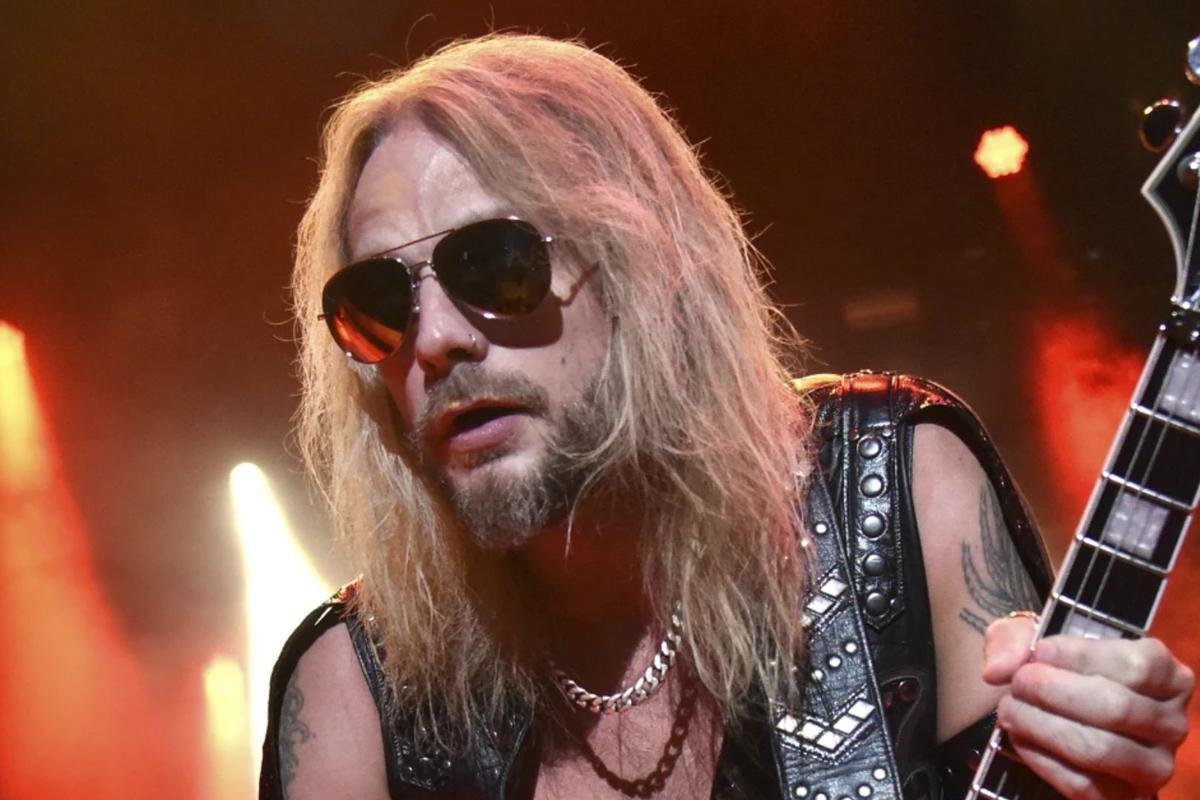
Elegant Weapons' Richie Faulkner Names Band That Influenced His Song About Life-Saving Experience
Richie Faulkner has penned the new song "Rupture" addressing the 2021 aortic rupture that threatened his life and during a chat with Full Metal Jackie, the Elegant Weapons leader shared band that partially influenced his writing on the track.
While appearing on Full Metal Jackie's weekend radio show, the guitarist shared his desire to get back into action after the surgery that saved his life. As he began his recovery, he came up with a guitar part for a potential song and that's when he got a call from Adam Jones of Tool. But almost immediately after he said yes, he realized he needed to learn how play the suggested song before taking part and he drove everyone mad trying to learn it. And apparently that experience carried over into continuing the music he was creating.
"So I was listening to Tool and it kind of inspired the riff. And I could hear like a heartbeat through it. It was like a rhythm through it. And I didn't wanna make it about me, but there was definitely a reference there," said Faulkner of the song "Rupture." "I could hear someone going through some sort of turmoil on a hospital bed with machines around them and tubes tied to them. I could hear the turmoil but I could also kind of hear hope in the song as well. So I made it kind of tumultuous and hopeful at the same time."
Elsewhere in the discussion, Faulkner explains why Evolution is truly a fitting name for his band's sophomore set. He discusses the working relationship with singer Ronnie Romero and how the band's sound is coming together.
Richie also shares his thoughts on The Ballad of Judas Priest documentary and names his favorite Judas Priest song to play live.
Check out more of the chat below.
It's Full Metal Jackie this week. Very excited to welcome guitarist extraordinaire Richie Faulkner to the show as we dig into the new Elegant Weapons album. Evolution. That seems like a fitting title for the record, given how things have progressed. Can you speak to now having a chance to write an album with all the elements in place and what having the input of Ronnie Romero and other bandmates had on making this record?
Absolutely. I'm grateful to be writing another record and putting another record out. I think these days the fact that there's so many things for people to do, so many distractions. The fact that there's enough interest that we can put another album out, we're incredibly grateful. And I'm grateful also to be in a band with those guys.
Davey, Christopher, Ronnie ... they make me sound better. You know what I mean? So surrounding yourself with people like that, not only good friends, but great musicians. And they've all had a part to play in it, really.
We recorded the drum tracks before the first record came out. So me, Davey, and Christopher got together in Nashville, recorded the drums together as a unit. So we played the songs together. And I think you get that cohesive spontaneity. If someone does something, if Davey plays something or if I play something on the guitar, Christopher picks up on that and matches it on the drums and vice versa, you know?
So you get like a cohesive thing, which is in itself an evolution over the first record. We didn't do it like that the first time around. And from a vocal point of view as well, same thing with Ronnie. Andy Sneap produced this record again and he wanted to do something more with the vocals than we did on the first record.
First record, there was another singer that had already sang the vocals. So we gave them to Ronnie and basically said, "This is the vocals," and he sang them like he does. But this one we produced him, so, albeit in different places.
WATCH MORE: Richie Faulkner Plays His Favorite Riffs
So Ronnie was at home in his studio. Sneap was in the U.K. and I was in Nashville. And we got on a Zoom call like this. And from the ground up, we had the lyrics and the melodies, but from the ground up we kind of said, "Let's try this vocal. Let's try this variant. Let's try this technique. Get up closer to the mic." And, Sneap was always cracking the whip, getting the best performance out of him and getting the best vocal performance we could get. So from that point of view, from a recording point of view, the whole thing was an evolution in terms of how we recorded it.
So the band was Scott Travis, Rex Brown, me, myself, and Ronnie on the first recording. Then we took it out on the road and I got Christopher and Davey in. So that's a evolution in itself. And we, we felt the songs were an evolution too in terms of what we were putting down on this record.
So it was appropriate really to call it that and we're sticking to it.
Elegant Weapons, "Bridges Burn"
Richie, let's talk about "Bridges Burn." It's a rare song about taking accountability and dealing with the consequences of a bad decision. And let's be honest, nobody lives a perfect life and it'd be a little boring if you did. What is one of the greatest lessons you learned from taking a wrong turn in your own life?
Oh, wow. There's loads of them. I mean, bloody hell. There's usually like some sort of alcoholic influence. You know what I mean? I hardly drink anymore. And I do like a drink, but I usually get myself into some silly scrapes. So there's been a ton of those which would be too long to mention.
But those sort of things where you think it's a good idea at the time and then wake up. We've all been there. Wake up the morning after and think, "Did I actually say that? Did I actually do that?" And then you realize, "Oh, if I didn't do that, I wouldn't have done that." So you know what I mean? Then you, you kind of curb it a bit. But we've all been there. We all kind of know what I'm talking about, those sort of things.
But that's being human though, isn't it? We all have to go through things to realize that's not the best thing to do sometimes.
Richie, you've received a lot of credit for Judas Priest's resurgence in the past decade plus. You've ventured out now with Elegant Weapons as well, showcasing more of your creative side. But it's a continual evolution, so to speak. Where do you feel you've made the greatest strides in your own career over the past two decades or so? Is it as a player, as a songwriter? And what steps do you take to continue evolving creatively?
It's a great question. It's hard to say, really. I think it's for the listeners to judge. But I'd like to think with an education and teachers like Priest, it's all about their uniqueness. Their unique qualities as players and as a unit is why they are who they are.
The way Glenn plays the guitar, the way Glenn writes songs is so unique. And coming from a covers background, I used to play covers. So I used to play different styles by lots of different artists, but didn't really have my own voice.
So it's all about taking those lessons on, like the uniqueness of Glenn and Rob and Scott and Ian and Ken and all the previous members of Priest. And what am I gonna say? What's gonna be my fingerprint on the guitar? What's gonna be my way of writing songs? And I don't think it ever ends, you know?
I don't think that journey is ever accomplished. You're always trying to write a better song or a better riff or better lyrics, you know? And it's those guys that keep you pushing. They keep the standard higher and I think they're still searching too.
I think that's what it is. If people can hear that in the Weapons stuff or in my stuff with Priest, then I'm really grateful. But I can hear [Michael] Schenker and Zakk Wylde and Dave Murray over everything. But hopefully that all kind of comes together and hopefully it has got my own voice in there somewhere. But as I said, I don't think that journey ever ends.
Elegant Weapons allowed you a bit of a clean slate musically. This new album with the core group all involved starts to shape a bit of the sound of what this band is. But working with this group of musicians, do you rule anything out? Like, when it comes to creating, do you see yourself continuing to push the barriers of what an Elegant Weapons song can be? Or are you going for a very specific vibe of what this band is?
I think at the moment everything's on the table. I think you're right. When you start a new band like that, there's complete freedom. There's no limits on it whatsoever. The great thing about Priest, I think, is that they've got such a wide gamut of styles, blues to hard rock to heavy metal in their DNA. It's quite creative in that sense too.
We've got a good song, we put it on the table and it becomes Priest, you know? I can imagine sometimes if you're AC/DC and you put something on the table that's Dream Theater sounding, yes that's not what we do. That's not AC/DC. But at the moment with Elegant Weapons, there's room for us [to build] identity to grow, you know? It might come to a point where, "Oh, no, that, doesn't sound like us," but at the moment it's still pretty free.
So we put some stuff on this record that wasn't on the first one. So we felt like we were able to put it on this one. There's a ballad ("Come Back to Me"), there's a more sentimental song on this record, and we thought it was appropriate to do so. Ronnie, he was great. Ronnie gave a great performance on it. And it's almost like a Deep Purple-type ballad, you know? It's sentimental, but it's got some sort of heavy meaning there.
If we get to that point where, "No, this doesn't sound like us," or we don't really wanna go there, then I guess we'll cross that bridge when we come to it.
Elegant Weapons, "Come Back to Me"
When Elegant Weapons formed, Ronnie Romero wasn't already in place. You eventually crossed paths well into the creative process. Can you speak to your journey in finding that voice for this band and what it's been like to see it put to use and now to write around it for the second record?
I remember initially when I was looking for a singer, I couldn't think of anyone. And I was talking to Damon Johnson, he's in Skynyrd now. At the time he was in Thin Lizzy and he was in Alice Cooper before that and he's a good friend of mine and I was talking to him.
And he said, "What about the guy that sings with Blackmore in in the latest version of Rainbow?" And a light bulb went off in my head and I said, "Of course, Ronnie Romero." And that was it. Luckily Ronnie said yes.
But I thought, "That's perfect." Ronnie was the guy that he sings in a classical way, but there's a modern, forward-thinking sound to his voice as well. And that's where we all are really. We come from classic bands, but we wanna take that DNA forward into the future.
And when I spoke to Ronnie, he got exactly where I was coming from. He was with Michael Schenker at the time, who was one of my favorite guitar players, and he totally got it. He said, "You know, these guys aren't gonna, they're not gonna be around forever. Maybe we can take that DNA and that, those opportunities that they gave us and take it into the future."
So it was brilliant when he said yeah. I was so happy 'cause I didn't have anyone else. I couldn't think of anyone else, you know? And as you said, working with him, he's great to work with. I say it all the time. He's not just a singer. He's like Rob [Halford], really. He's not just a singer. He performs the song. He fronts the band. He, he connects these songs with the audience, you know? That's a big thing. There's a lot of people that can sing, but these guys, they connect. I can sing sometimes when no one's around, but these people, they connect the songs and the emotion of the songs with the people listening and that's a big gift to have and Ronnie's got it.
And working with him in the studio, he's no trouble. His pitch is amazing. His delivery is great. So he's amazing to work with. There's nothing that's trouble, nothing that worries him. You, you say, "Can you sing this?" And he'll go, "Yeah," he'll do it. And he's like, "Bloody hell," like, you know what I mean?
One of those guys. So he's a joy to work with really. I think Ronnie will say this as well. I think there's more Ronnie Romero on this record than there was on the first one, so I think that's a great thing.
Richie, I can't help looking ahead at the track listing and seeing "Rupture" as the title of the instrumental track on here. One can only imagine the experience that you went through with your life-threatening emergency back in 2021, and there's the whole mental side of coming to terms that this could have gone much worse. But music is such a wonderful platform. What did it mean to you to find a way to express creatively through music something related to the most frightening experience of your life?
It's a really good question. I think we're all helped by music in some way or another, whether we're listeners or creators or however we consume music. The first thing I wanted to do when I got back home after all that was get back on the guitar and it wasn't easy. The way you sit, the chest cavity and all that. It wasn't easy, but that's the first thing that I wanted to do to get back to some kind of normality, you know. Get back on tour, get back on the road,
Your life has just been shaken up in a way that you'd never thought was gonna happen. So you wanna kinda get back on the horse as quickly as possible to get back to some sort of normality, you know. So I came up with this little guitar thing and I think around that time, Adam Jones from Tool called me.
They were playing Bridgestone Arena in Nashville, and he said, "Do you wanna come out and do a song?" And I said, "I would love to," and I immediately regretted it cause I thought, "Well, wait a minute. What have I done? I've gotta play a song with Tool. So I, took two weeks learning. I knew it was Jambi. I knew the song, but I didn't know how to play it, so I had to learn. I drove everyone mad trying to learn this song properly, but I did it.
So I was listening to Tool and it kind of inspired the riff. And I could hear like a heartbeat through it. It was like a rhythm through it. And I didn't wanna make it about me, but there was definitely a reference there.
I could hear someone going through some sort of turmoil on a hospital bed with machines around them and tubes tied to them. I could hear the turmoil but I could also kind of hear hope in the song as well. So I made it kind of tumultuous and hopeful at the same time.
But in the song, it flat lines at the end, so the heart stops and it flat lines, which fortunately it didn't in my case. It was pretty crazy. But on the record it, obviously it flat lines and then the next song, it kind of wakes it up and explodes into the next song. So that was the dynamic on the record. But it was it's just funny the way that life influences music, and then music influences life and, and art you know.
So that, that's how it came about, really. So that's what the heartbeat is in that song.
Elegant Weapons, "Rupture"
Outside of Elegant Weapons, this past year has seen the creation of The Ballad of Judas Priest, the new documentary on the band's career. As someone who has been both a fan at first and later lived the life, how was it to view this documentary? What did you think of the film and its representation of the group?
I thought it was brilliant. The first time they showed us, I thought was fantastic. We went for a viewing in Los Angeles. I thought it was brilliant. As you said, as a fan there was too much of me.
I'm not in it a lot anyway, but I said to them afterwards, "You don't need me in it. I don't, mind if you wanna put me in it, we want more." But I thought it was brilliant. There's some stuff in there that I'd never seen before.
Ian goes back to Aston Working Men's Club, where they used to play. And he's sitting in the hall, the stage is there. It's amazing. Those places are still around and they tell the stories of how they came up.
The amazing thing is there was nothing before them. Sabbath and Priest and Purple. There was nothing before them and they carved their own niche when there wasn't one. That's what blows me away. They made that when there wasn't anything there. We all wanna be like them, but they sort of made something out of nothing. I always find that amazing.
Jack Black's in it. Tom Morello was involved obviously. And Sam Dunn, who's great. He's done a lot of stuff with Banger Films and Sam's always great. He's great, not only because he's smart and knowledgeable, but he's a fan. He's like an actual real fan. He's great. It's everything a film should be.
We've got Richie Faulkner with us and this year sees you back on the road with Priest in the summer and early fall. I'm sure this changes for you depending on the day and the mood. But do you have a favorite Priest song that when it comes to the live experience, the challenge it provides you and the audience response you get in return?
You can't beat "Painkiller." You can't beat it, honestly. I think on the last tour, Rob would do a little bit of a speech and he'd go through each album and he'd go through from Rocka Rolla, Sad Wings, Sin After Sin. He'd go through each one chronologically, and there'd be a cheer after every one. But when you get to Painkiller, doesn't matter what city, what country you're in, the roof came off when, when they hit Painkiller.
When you play that song, it's a challenge. It's a masterclass in classic heavy metal and it's just brilliant to play, you know.
Yeah, I think that one's, both in challenge and the way the song is, I think it's just a joy to play. Some nights it's harder than others, as you can imagine. But there's so many great ones. You know, "Desert Plains," "Heading Out to the Highway." "Another Thing Coming's" always a great one.
We've been playing that towards the beginning of the set and it really kind of gets the party started. But yeah, then you get things like "Sentinel" and some of the deeper cuts that we're doing. But "Painkiller," I'd say, is always the one that raises the roof.
As we mentioned, there are Judas Priest dates coming up. But as far as what the year looks like for you, what's on the horizon? Will we see Elegant Weapons playing some shows? Are there any other things in the works for Priest? Are other things that you're working on?
Well, yeah. We're looking at doing some dates with the Weapons after the Priest stuff. So when we get done with Priest, we're looking into stuff in the U.S. actually. Last tour we did with Weapons was in Europe with Pantera, so we wanna come out here to the U.S. with the Weapons. So we're looking into that and we'll let you know as soon as we do.
Fantastic.
Thanks to Richie Faulkner for the interview. Get the 'Evolution' album now. Stay up to date with Elegant Weapons through their website, Facebook, X, Instagram and TikTok platforms. You can also follow Judas Priest through their website, Facebook, X and Instagram . Find out where you can hear Full Metal Jackie's weekend radio show here.
Below see 60 rockers who've found success in multiple bands.
60 Rockers Who've Been in Multiple Successful Bands
These rock and metal musicians have been official members of multiple successful bands.
Gallery Credit: Lauryn Schaffner

 English
 Arabic
 French
 Spanish
 Portuguese
 Deutsch
 Turkish
 Italiano
 Russian
 Romaian
 Portuguese (Brazil)
 Greek
Greek