


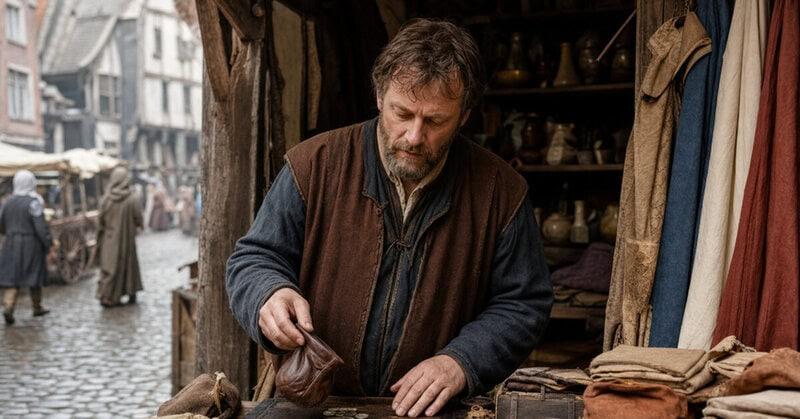
In a timber-framed shop on a cobbled street in thirteenth-century Bruges, a cloth merchant tips a leather purse and watches silver coins spread across his counting board. He is not a serf bent double over a frost-hardened field, and he is not a lord presiding over a candlelit feast. He is something else entirely — and for centuries, the historians who wrote the medieval history textbooks could barely agree on what to call him.
The Official Story — and Why It Was Always Too Neat

For generations, the standard diagram of medieval European social classes ran to exactly three tiers. Those who pray: the clergy. Those who fight: the nobility. Those who work: the peasants. It is a tidy model, elegantly memorable, and almost completely wrong as a description of how most medieval Europeans actually lived.
The three-orders framework was ideology dressed as sociology. It was articulated and promoted by churchmen and lords — the very people who benefited from a world that sorted neatly into those who commanded and those who obeyed. The peasant at the bottom was supposed to labor in gratitude; the knight at the top was supposed to protect in honor; the priest threaded the divine logic between them. Everyone had a place. Everyone stayed in it.
The problem is that even medieval writers were noting by the eleventh and twelfth centuries that the model was coming apart at the seams. As towns multiplied across Western Europe and long-distance trade revived after the stagnation of the early Middle Ages, a whole world of people emerged who fit none of the three slots. Tanners, spice merchants, master builders, notaries, apothecaries, goldsmiths, innkeepers — they were doing the most consequential economic work of their age while remaining, in the official social map, essentially invisible.
Who Were These People, Really?

The medieval middle stratum was not a single class in the modern sense but a constellation of occupations linked by a common condition: they owned capital, exercised skill, and possessed a degree of legal freedom that set them apart from the peasantry, while lacking the inherited land and blood that defined the nobility. Guild masters, prosperous freeholding farmers, parish priests with urban congregations, scribes and notaries who drafted the legal paperwork that kept commerce running — all of them occupied this awkward, lucrative, theoretically nonexistent middle ground.
The texture of daily life for these people was strikingly different from peasant subsistence. They owned their tools and often their premises. They ate varied diets that included spices, fresh meat, and imported wine. They sent sons to cathedral schools where Latin and arithmetic opened doors into law, medicine, and the church. A master goldsmith in fourteenth-century London might leave behind a will itemizing a furnished stone house, silver plate, the contracts of several apprentices, and donations to a chantry chapel for prayers after his death — assets that rivaled those of minor gentry, assembled entirely through trade.
The institutional backbone of this world was the guild. Guilds regulated quality standards, restricted competition, arbitrated disputes, cared for members’ widows and orphans, and — crucially — gave artisans collective standing in town governance. A weaver or a butcher operating within a guild was not simply an isolated craftsperson scrambling for survival; he was part of a recognized corporate body with political voice and economic muscle. The guild system was, in miniature, the kind of professional self-organization that the modern world would later call a trade association, a regulatory body, and a social safety net all at once.
The Towns Were the Engine

None of this could have happened without the great urban revival of the tenth through thirteenth centuries. New towns were chartered across England, France, the Holy Roman Empire, and northern Italy at a pace that transformed the physical and social landscape of the continent. These were not merely larger villages. They were legally distinct spaces where a new category of person — the burgher, or town-dwelling free citizen — held rights that neither feudal peasants nor nobles entirely shared: the right to hold and transfer property, to sue and be sued in a town court, to pass accumulated wealth down to heirs.
Stand in the center of a prosperous medieval market town and you could read the middle stratum written into the stones. A market square with a weighing house for honest measure. A guildhall where merchant associations met and argued. A parish church whose nave was rebuilt in the latest style, funded by donations from wool traders who wanted their names carved into the fabric of eternity. Rows of narrow-fronted shops whose owners lived directly above their work, sleeping over the same counters where they sold cloth or bread or ironwork each morning. This is what medieval Europe actually looked like for a substantial portion of its population — not castles and mud, but organized, literate, commercially sophisticated urban life.
Literacy itself crept upward in these environments not from any idealistic impulse but from sheer commercial necessity. Merchants needed to read contracts and keep accounts. Long-distance traders needed to correspond in writing across the distances that separated partners in Bruges, Venice, Champagne, and London. The towns became incubators of a practical, non-clerical literate culture decades and centuries before print made books cheap.
Wealth, Anxiety, and the Struggle for Respectability

Prosperity brought its own particular anxieties. Across medieval Europe, sumptuary laws — regulations governing what different social ranks were permitted to wear — repeatedly attempted to ban merchants and artisans from fur-lined robes, silk fabrics, and elaborate jewelry. The laws were not passed because merchants could not afford these things. They were passed precisely because merchants could afford them, and the nobility found that fact deeply unsettling. When a cloth trader’s wife appeared at Sunday Mass dressed better than a knight’s daughter, the visual language of hierarchy began to break down.
Wealthy merchants responded with predictable ingenuity. They purchased land — the one form of wealth that medieval culture acknowledged as genuinely respectable. They arranged marriages that embedded their daughters into minor noble families and their sons into the law or the church. They endowed chantry chapels and funded hospitals, converting commercial silver into spiritual prestige in a transaction the church was happy to facilitate, whatever it officially said about the dangers of mercantile life.
That official position was, in any case, riddled with contradiction. Usury — lending money at interest — was condemned as sinful from pulpits across Europe. Yet Italian banking families were financing papal military campaigns and lending to kings from England to Sicily, and bishops borrowed regularly from the prosperous merchants they theoretically ranked beneath themselves. The church’s relationship with mercantile wealth was less a principled rejection than an elaborate negotiation.
Vernacular literature confirmed what official ideology denied. Geoffrey Chaucer’s Canterbury Tales, written in the late fourteenth century, teems with a recognizable middling world. The Franklin — a wealthy freeholder of prosperous but non-noble status. The Merchant — defined entirely by commerce and credit. The Wife of Bath — a skilled cloth-maker of independent means and forthright opinions. These are people defined by occupation, aspiration, and personality rather than inherited blood. Chaucer’s audience recognized them because they were them.
Plague, Revolt, and Upward Pressure

If the medieval middle stratum had always existed in the shadows of official ideology, the Black Death of the mid-fourteenth century blew the shadows away. When plague killed between a third and half of Europe’s population in a few devastating years, the survivors found themselves in a transformed labor market. Skilled artisans and agricultural workers were suddenly scarce. Wages rose whether lords liked it or not. Many peasants who had previously been bound to the land found that their labor was now valuable enough to bargain with, and they moved — into towns, into wage work, into trade. Serfdom did not end overnight, but the Black Death accelerated its erosion across much of Western Europe.
The decades after the plague saw wave after wave of urban and semi-urban revolt: the Ciompi uprising of wool-workers in Florence in 1378, the English Peasants’ Revolt of 1381, the Parisian Maillotins of 1382. Whatever their specific causes and outcomes, these movements shared a common feature that pure subsistence peasants rarely display — a political self-consciousness, an ability to organize across occupational lines, and a set of demands framed in terms of rights and dignity rather than mere survival. That kind of collective political imagination does not emerge from nowhere. It is the product of exactly the middling civic culture that had been building in European towns for two centuries.
Post-plague wills and estate records confirm the picture in quieter ways. Ordinary townspeople — not just great merchants but journeymen, widows who continued their husbands’ trades, minor craftspeople — left behind household goods, small libraries, and modest capital investments that the official three-orders model would never have predicted they possessed. The evidence hidden in probate registers and coroners’ rolls paints a far more complex social world than any textbook diagram captures.
Why It Matters That We Get This Right

The image of medieval Europe as a binary world of castles and mud is not just historically inaccurate — it is a form of erasure. It writes out of the story the millions of people who actually drove economic and cultural change across five centuries: the merchant who funded the hospital, the guild widow who kept her husband’s weaving operation running after his death and trained the next generation of apprentices, the notary who drafted the land contracts that made orderly commerce possible. These were not background figures. They were the protagonists of their own age.
Recovering them also corrects a common misconception about where the modern world came from. The institutions that shaped civic life as we know it — enforceable contracts, property law, professional standards, urban self-governance — were not invented in the Renaissance or the Enlightenment. They were tested, argued over, refined, and made habitual across centuries of medieval daily life, in guildhalls and market squares and town courts that predate the printing press by generations.
For students and educators looking to engage seriously with this world, resources like IEW’s Medieval History-Based Writing Lessons teacher and student combo offer a structured way to read primary sources and craft arguments about the period — a combination that moves learners past the myth and into the texture of the actual past. The Medieval History-Based Writing Lessons student edition draws on exactly the kind of documentary evidence — chronicles, charters, and guild records — that reveals a society far more layered than the three-orders model admits. Curriculum planners can find supporting schedules through the Well Planned Gal curriculum schedule for IEW Medieval History, and for an online classroom context, IEW Medieval History-Based Writing classes on Outschool bring the material to life for middle school students through guided discussion and structured writing practice.
The next time you encounter a medieval history overview, pay attention to who is missing from the frame. The people who quarried and cut the stone for the cathedrals, stitched the illuminated manuscripts, dyed the wool and shipped it across the Channel, kept the accounts that made crusading armies logistically possible — they were never as invisible as the history books made them. They were just waiting for someone to look in the right places, which turns out to be exactly where ordinary people always leave their traces: in wills, in guild records, in property deeds, and in the enduring shape of the towns they built and never entirely got credit for building.

 English
 French
 Spanish
 Portuguese
 Deutsch
 Turkish
 Dutch
Dutch
 Italiano
 Russian
 Romaian
 Portuguese (Brazil)
 Greek
Greek