


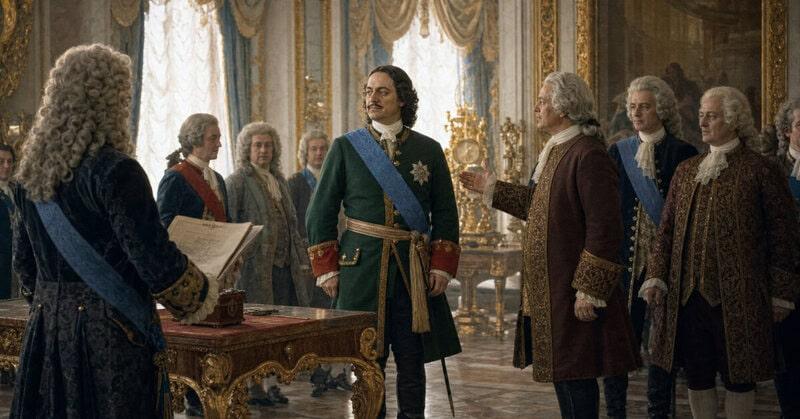
One October morning in 1721, a group of Russian senators rose in a hall in St. Petersburg and did something unprecedented: they handed their ruler a brand-new identity — and in doing so, conjured an empire. What followed was nearly two centuries of relentless expansion, brutal transformation, and geopolitical theater that turned a snow-locked medieval principality into one of the largest empires the world had ever seen. Here are nine essential facts that trace that extraordinary journey through Russian Empire history.
1. A Senate Proclamation, Not a Conquest, Made Russia an Empire

On November 2, 1721 — October 22 by the Julian calendar still in use in Russia at the time — it was the Russian Senate, not a battlefield triumph or a tsar’s solitary decree, that formally conferred the title of imperator on Peter the Great. The occasion followed Russia’s hard-won victory in the Great Northern War against Sweden, and the Senate’s role was deeply deliberate: by routing the proclamation through an institution rather than through royal will alone, Russia signaled that it was becoming something more structured, more European, more modern.
That single afternoon of legislative ceremony marks the precise opening of the Russian Empire’s nearly two-century run, stretching from 1721 to the revolution of 1917. It is one of history’s stranger births — an empire announced not from the back of a horse but from behind a writing desk.
2. Peter the Great Retired the Title of Tsar to Claim Something Grander

Before that autumn day in 1721, Russia’s rulers had carried the title of tsar — a word derived from Caesar, but one that, by the early eighteenth century, felt provincial compared to the imperial vocabulary of Western Europe. Peter the Great, born in 1672 and possessed of a reforming energy that bordered on the volcanic, became the first ruler officially proclaimed Emperor of All Russia, formally retiring the older designation that had defined the state since Ivan the Terrible adopted it in 1547.
The upgrade was far more than a change of letterhead. By adopting the Latin-rooted imperator, Peter repositioned Russia as a peer — at least in its own telling — of the great European powers. Understanding this pivot from Tsardom to Empire is the master key to understanding how Russia became an empire at all: it was an act of political will as much as a territorial fact.
3. Nearly 14 Million Square Miles — Among the Largest Empires in History

The numbers, even stated plainly, are staggering. At its territorial peak in the nineteenth century, the Russian Empire stretched across roughly 14 million square miles — approximately 36 million square kilometers — making it one of the largest empires in all of recorded human history. It sprawled across two continents, covering most of northern Eurasia from the Baltic Sea in the west to the Pacific coast in the east, a landmass so vast that the sun never fully set on it.
That sheer scale transformed every problem of governance — taxation, defense, communication, cultural cohesion — into something almost impossibly complex. Distance alone was a permanent enemy of effective central control, a structural problem no tsar ever fully solved.
4. Serfdom Underpinned the Empire for Most of Its Existence

Long before St. Petersburg gleamed on the Baltic as Russia’s self-styled window onto the West, the society that would become the Russian Empire was rooted in dark, frozen soil. Its economy was deeply agrarian, and bonded serfs — not merchants, not manufacturers, not a bourgeoisie — formed the backbone of production. Towns existed and trade moved along river routes, but they played a secondary role in an economy that made the later leap to European great-power status all the more startling to outside observers.
Serfdom was not some quickly discarded relic of the founding era; it persisted, legally enforced, until Tsar Alexander II formally abolished it in 1861. That means the empire built its colossal territory and projected military power across most of its existence while resting on essentially medieval labor arrangements. The drama of the rise of the Russian Empire is inseparable from that uncomfortable foundation, and the social tensions serfdom created did not simply dissolve when the law changed.
5. The Empire Was Home to Dozens of Distinct Peoples and Faiths

The image of Russia as a monolithic Orthodox Christian Slavic nation was always more myth than reality. The Russian Empire encompassed Orthodox Christians, Muslims, Buddhists, Jews, Lutherans, Catholics, and numerous indigenous belief systems spread across its enormous reach. Tatars, Ukrainians, Poles, Finns, Caucasian mountain peoples, Siberian indigenous communities, and Central Asian nomadic populations all found themselves, willingly or otherwise, within the empire’s borders at various points in its history.
This multi-ethnic, multi-confessional character was the direct consequence of expansion across Eurasia — every new territory absorbed a new population with its own language, customary law, and religious tradition. Managing that diversity, and more often suppressing it through Russification policies that imposed the Russian language and Orthodox culture on non-Russian subjects, constituted one of the central political pressures running through the entire arc of imperial history. The tensions those policies generated never fully resolved before 1917 brought everything down.
6. The Empire’s Geography Spanned What We Now Call Eleven Time Zones

When standardized time zones were formally proposed in the 1880s, Russia’s territory already covered what we now count as eleven of them — and the empire had existed in that sprawling condition for well over a century before anyone had a name for the problem. A courier traveling from the western border to the Kamchatka Peninsula would cover a distance comparable to crossing the Atlantic Ocean twice, passing through tundra, taiga, steppe, and mountain range along the way.
This was not merely a curiosity of geography; it shaped everything about how the empire functioned and, crucially, how it failed. Military logistics were nightmarish — troops and supplies moved at the pace of horse and river across a country the width of a hemisphere. The same distances that made Russia difficult to conquer from outside made it genuinely difficult to govern from within, a structural vulnerability that would haunt the Romanovs from their first decade to their last.
7. Nearly Two Centuries of Continuous Rule — Then Sudden, Total Collapse

The Russian Empire endured without interruption from its formal proclamation in 1721 right through to the February Revolution of 1917 — nearly two full centuries under the Romanov dynasty. Across that span, Russia fought in virtually every major European conflict, absorbed territory across three continents, abolished serfdom, completed the Trans-Siberian Railway, and survived Napoleon’s invasion of 1812. It had the texture of permanence, the kind of institution that seems as though it will simply continue forever.
And then, within a matter of days in February 1917, it did not. Tsar Nicholas II abdicated on March 2, 1917, and the institution collapsed so completely that no constitutional monarchy, no negotiated settlement, nothing recognizable remained in its place. The speed and totality of that disappearance — after nearly two hundred years — remains one of the most striking political collapses in modern history.
8. From a Landlocked Principality to Access Across Twelve Seas

The Moscow principality that gave birth to the future empire had no coastline whatsoever. It was as landlocked as modern-day Mongolia, hemmed in by rivals and entirely without the maritime access that was, in the early modern world, the essential currency of great-power commerce and military reach. Through relentless expansion across the Russian Empire timeline, Russia eventually gained access to the Baltic, Black, Caspian, White, Barents, and Pacific seas, among others — a strategic revolution driven by the chronic need for viable trade routes and warm-water ports that would not freeze shut for half the year.
The decisive early breakthrough was Peter the Great’s seizure of Baltic territory in the Great Northern War — the very conflict whose conclusion directly preceded the imperial proclamation of 1721. Winning those Baltic shores was not merely a military achievement; it was the moment Russia stopped being a continental backwater and began projecting ambitions that could reach the wider world. The search for reliable warm-water access would continue driving Russian foreign policy for the entire life of the empire and beyond.
9. The Imperial Title Was a Calculated Piece of European Diplomacy

When Peter adopted imperator, the choice of that Latin-rooted word was anything but accidental. In eighteenth-century European politics, the title carried enormous symbolic weight, linking its bearer to the legacy of Rome and placing him in theoretical league with the Holy Roman Emperor and other Western sovereigns. It was a declaration written in vocabulary rather than gunpowder — that Russia intended to be taken seriously at the highest table of European power.
Several European powers initially refused to recognize the new title, viewing it as a presumptuous claim from a state many in the West still regarded as half-Asiatic and peripheral; acceptance came only gradually, through treaties and shifting alliances over the following decades. Sweden recognized it in 1723, the Ottoman Empire in 1739, and Britain and Austria only later still. That resistance — and Russia’s patient, calculated effort to overcome it — illustrates something essential about the rise of the Russian Empire: it was as much a propaganda and diplomatic project as a military one, an empire constructed on image and insistence as much as on conquest.
From a snow-bound, landlocked principality with no access to any sea, Russia assembled across nearly two centuries one of the largest empires the earth had ever contained — through war, diplomacy, coerced labor, and relentless geographic ambition. The story of how it rose, and how suddenly and completely it fell, remains one of history’s most instructive and sobering dramas.

 English
 Arabic
 Spanish
 Portuguese
 Deutsch
 Turkish
 Dutch
Dutch
 Italiano
 Russian
 Romaian
 Portuguese (Brazil)
 Greek
Greek