


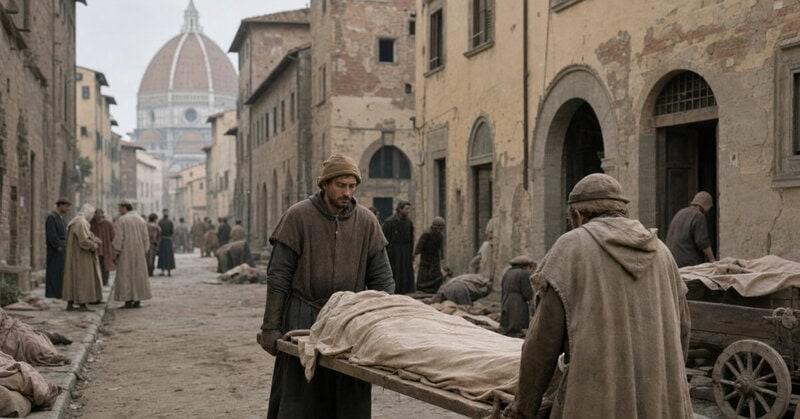
In the autumn of 1348, the city of Florence smelled of death. Gravediggers worked without rest, churches had abandoned the rituals of burial, and the streets that had once buzzed with wool merchants and goldsmiths fell so quiet that survivors described walking through a city that had forgotten how to breathe. Within months, roughly half of Florence’s population — somewhere between 60,000 and 100,000 people by some historians’ estimates — had been swallowed by the Black Death. And yet, within two generations, that same shattered city would raise Brunelleschi’s impossible dome above its cathedral, fill its workshops with painters mixing pigments of unearthly beauty, and ignite a transformation of human thought so complete that we are still living inside it. The paradox at the heart of the Renaissance is this: history’s most celebrated explosion of art, science, and human possibility was not born from comfort. It was born from catastrophe.
What the Word Actually Means — And Who First Said It

The question of why we call it “the Renaissance” is more interesting than it first appears. The word is French, drawn from the Old French renaistre — to be born again — which itself roots back to the Latin renasci. For the 14th-century Italians at the center of this upheaval, that Latin root would have carried an almost theological charge: the Church spoke constantly of spiritual rebirth, of souls renewed in grace. To apply the same language to a civilization was to make an enormous claim.
Strikingly, the people living through the Renaissance did not call it that. Italian scholars like Petrarch spoke instead of renovatio — renewal — a sense that something ancient and glorious was being recovered from beneath the rubble of centuries. The label “Renaissance” was largely codified by the French historian Jules Michelet in 1855 and then given its modern scholarly shape by Swiss historian Jacob Burckhardt’s landmark 1860 work The Civilization of the Renaissance in Italy. Burckhardt gave a name to something that had been building, quietly and then explosively, across the preceding generations.
But here is why the naming matters: to call an era a rebirth is to insist that something died first. And in Italy in the mid-14th century, something enormous did die — not just hundreds of thousands of people, but an entire framework for understanding what human life was worth and what it was for. The vacuum that death created was precisely the space into which new ideas rushed. This is why the word “renaissance” has become the English language’s most powerful shorthand for any profound second act — a musician’s career renaissance, a neighborhood’s renaissance, and the kind of renewed purpose that a retirement community devoted to older adults might want to promise its residents. The original event was so definitively a story of life reclaimed from devastation that the word now carries that weight wherever it travels.
The Crisis That Made It Possible — The Black Death and the Collapse of the Medieval World

The Black Death arrived in Europe through Sicily in October 1347, carried on Genoese trading ships whose crews were already dying when they made port. Within a few years, the plague killed an estimated 30 to 60 percent of Europe’s entire population — a scale of loss that strains the imagination. The Florentine chronicler Giovanni Villani was in the middle of writing his history of the city when the plague took him in 1348, leaving his account unfinished, a detail so perfectly grim it reads like fiction.
The structural consequences were seismic. When priests, guild masters, landlords, and their heirs died by the tens of thousands in a matter of months, the rigid hierarchies of medieval European society — which had kept social mobility almost unthinkable for generations — simply buckled. Surviving workers found they could demand higher wages from desperate employers. Surviving merchants inherited consolidated wealth from families wiped out in a single season. And the Church, which had offered the medieval world its entire explanatory framework for suffering and death, emerged from the plague visibly shaken: it had neither predicted nor prevented a catastrophe of biblical proportion, and for many educated Italians, that failure was impossible to ignore.
What the plague produced, beyond grief and economic disruption, was a new psychological condition. Confronted with death that was arbitrary, swift, and entirely indifferent to rank or piety, thoughtful survivors began to ask a question that medieval Christianity had quietly discouraged: what could and should a human life be, right now, on this earth, in this body? That question became the intellectual engine of the Renaissance. Scholars call the movement it generated humanism — a rediscovery of classical Greek and Roman texts that placed human dignity, reason, and earthly achievement at the center of inquiry. Humanism did not deny the divine. But it insisted that the human was also worth serious attention, and that insistence changed everything.
Italy’s Unique Recipe — Why the Rebirth Happened There First

The Renaissance could have ignited anywhere in a devastated Europe. That it ignited first in northern Italy was not accidental. The city-states of Florence, Venice, and Milan were already the continent’s wealthiest commercial centers, home to banking dynasties — the Medici foremost among them — with the surplus capital and the political ambition to spend lavishly on art and architecture as visible proof of civic greatness. Patronage was power, and in Renaissance Florence, commissioning a magnificent altarpiece or funding a public sculpture was as much a political statement as a religious one.
Geography added another advantage. Italy sat at the crossroads of trade routes connecting Europe to Byzantium and the Arab world, which meant Italian merchants and scholars had earlier and richer access to the ancient manuscripts — works by Aristotle, Plato, Cicero, and Vitruvius — that had been preserved in Constantinople and Islamic libraries while much of western Europe’s intellectual life had contracted. When Constantinople fell to the Ottomans in 1453, Greek scholars fled westward carrying manuscripts with them, and Italy was the natural destination.
There was also something harder to quantify but impossible to dismiss: Italians literally lived among the ruins of Rome. Unlike the English or the French, they walked past aqueducts and amphitheaters daily, read ancient inscriptions carved into the walls of buildings they used for storage, and stepped over mosaic floors that had once gleamed in Roman baths. Looking back to antiquity was not, for them, an abstract scholarly exercise. It was almost archaeological — a constant reminder that a greater civilization had once stood on this exact ground and might stand again.
No figure captures this sensibility more precisely than Petrarch (1304-1374), often called the first humanist of the Renaissance. In 1336, he climbed Mont Ventoux in southern France partly for the sheer experience of the view — a gesture that seems unremarkable now but was genuinely unusual for a medieval European, who would have been more likely to see such an impulse as a vain distraction from spiritual duties. Afterward, Petrarch wrote about the climb with careful self-consciousness, examining his own inner states with the analytical curiosity he brought to everything. In his letters, he addressed Cicero and Virgil directly, as though they were living friends rather than dead authors — and in doing so, he showed exactly how the Renaissance mind worked: collapsing the distance between ancient glory and present hunger, refusing to accept that the best of human achievement lay irretrievably in the past.
The Rebirth in Action — What Actually Changed and Why It Still Matters

By the early 15th century, the new spirit had moved from philosophy into stone, pigment, and engineering. In 1420, Filippo Brunelleschi began work on the dome of Florence’s cathedral, solving an engineering problem that had stumped builders for over a century by studying the proportions of the Roman Pantheon and devising construction techniques that had no medieval precedent. The result — still the largest masonry dome ever built — was not merely a beautiful object. It was a declaration that human ingenuity, applied with rigor and ambition, could accomplish what had seemed impossible.
Between roughly 1480 and 1510, Leonardo da Vinci filled his famous notebooks with anatomical drawings made from direct dissection, designs for flying machines, hydraulic studies, and observations about light that would not be formalized by science for centuries. These were not the marginal curiosities of an eccentric; they were the systematic output of a mind trained by Renaissance humanism to believe that the world could be understood, measured, and improved by human effort. When Gutenberg’s printing press began operating in the 1440s, Renaissance ideas gained a velocity of transmission the medieval world could never have imagined, spreading across Europe within decades rather than centuries.
What unified all of these achievements was a philosophical shift that is easy to understate. The Renaissance did not simply copy antiquity — it used the classical past as a mirror in which to see a new self. It asserted, against centuries of theological caution, that humans were not merely passive passengers awaiting divine judgment but makers, inventors, and authors of their own lives. That assertion is the foundation of the modern world, and it was built, brick by brick, on the grief of the plague years.
Because the original Renaissance was so transformative — so clearly a before-and-after moment — the word itself became a kind of cultural inheritance. Writers, architects, and institution-builders ever since have reached for it deliberately, invoking that specific historical weight: the idea that after crisis, contraction, or loss, something richer and more intentional can emerge. This is not casual metaphor-borrowing. It is an appeal to a proven record.
A Name With Intention — The Renaissance Retirement Campus and the Weight of That Word

In Olmsted Township, Ohio, the Renaissance Retirement Campus, operated by Eliza Jennings, sits on more than 50 acres of manicured grounds. The name above the door is not decorative. For a community devoted to older adults, “renaissance” makes a specific and historically freighted claim: that the years ahead are not a diminishment but a distinct and vital chapter of becoming, as full of possibility as any earlier season of life.
The promise behind that name is backed by more than aesthetics. US News Health rates The Renaissance Retirement Campus as High Performing in short-term rehabilitation, a recognition earned through measurable clinical outcomes rather than branding alone. The National Council of Certified Dementia Practitioners has also welcomed the campus into its Memory Care Excellence Network, a credential that reflects standards-driven commitment to residents for whom the quality of each day depends entirely on the care surrounding them. For those exploring options, independent living details are available through Kithward, and the campus is easily reached via Olmsted Falls.
Whether a resident arrives for short-term rehabilitation after surgery, for long-term skilled nursing, or for independent living, the word “renaissance” is making the same argument the Florentines made in the generation after the plague: that the human capacity for renewal is not extinguished by hardship, and that a life can find new form and meaning at any stage. The original Renaissance proved this at civilizational scale. A retirement community reaching for that name applies the same logic at a human one — and the logic holds.
Why “Rebirth” Remains the Most Powerful Word in the Language of New Beginnings

The Renaissance endures as history’s most compelling rebirth story precisely because it was not comfortable. It was not a prosperous society deciding to reinvent itself out of boredom or ambition. It was a civilization that had lost half its people, watched its explanatory frameworks fail in real time, and then — slowly, stubbornly, against every reasonable expectation — chose to make something extraordinary from what remained. That is why the word carries gravity that lighter synonyms like “renewal” or “refresh” simply cannot match. Renewal suggests tidying up. Renaissance suggests rebuilding from ruin.
When any institution — a retirement campus, a city neighborhood, a cultural initiative — chooses the name “renaissance,” it is consciously invoking this specific historical DNA. It is saying: we know what difficulty looks like, and we know that it is not the end of the story. It is saying that what comes after hardship can be richer, more intentional, and more meaningful than what came before — not despite the difficulty, but partly because of it.
Knowing that the original Renaissance was forged in grief and scarcity makes the concept more powerful, not less. It means “rebirth” is not naive optimism but a historically tested claim about human resilience, backed by Brunelleschi’s dome, Petrarch’s letters, and Leonardo’s notebooks — and by every life that has found new purpose on the far side of loss. Somewhere in 15th-century Florence, a painter’s apprentice mixed pigments in a workshop that had stood empty for a decade, a musician tuned a lute in a hall where mourners had gathered just a generation before, and the city — slowly, improbably, beautifully — began to make art again. The Renaissance was not a gift handed down from favorable circumstances. It was a choice made under the worst ones. And that is precisely why, six centuries later, the word still means something.

 English
 Arabic
 French
 Spanish
 Portuguese
 Deutsch
 Turkish
 Dutch
Dutch
 Italiano
 Russian
 Romaian
 Greek
Greek