


Control Resonant might be a new direction for the studio, but it still feels like a Remedy game at heart

Control Resonant might be a new direction for the studio, but it still feels like a Remedy game at heart
I'm lost in a maze of apartments, room after room stretching out in all directions - suspended high in the air, yet somehow hundreds of feet under the streets of Manhattan. An unfortunate resident named Anne floats high above me, twisted into a reality-warping threat by the malicious Hiss. I'm playing Control Resonant, and unlike in its predecessor, I can't rely on guns here - so instead I leap up to the ceiling and flip gravity on its head, bringing Hiss-Anne within reach of my dual-wielded blades. Remedy might be stepping outside its comfort zone for this sequel, but from minute one it's unmistakably still Control, and that's all I needed to know.
Having spent three hours experimenting with the core mechanics and combat systems of Control Resonant, my biggest takeaway is that this is a new Control game that branches out into a melee-first action RPG, rather than a stylish slasher that's been draped in a Remedy coating. That might seem like a small distinction, but it's a tremendously important one; Remedy's games all have an unmistakable flavor to them, and any concerns that might have been lost with this gameplay shift away from the staples the studio is known for are quickly washed away.
During my preview time, I also had the opportunity to speak with Lead Gameplay Designer Sergey Mohov, who was previously a Senior Gameplay Designer on the original Control. He tells me those big, dramatic shifts - from prior protagonist Jesse Faden to her brother Dylan, from ranged to melee combat, and from the brilliantly bizarre Oldest House out onto the streets of Manhattan - were all part of Control Resonant's first pitch.

"The first game is Jesse, who is an outsider coming into the FBC, and the player discovering what's going on beyond the veil - it's this Alice in Wonderland sort of story," Mohov tells me. "Now everybody knows what's going on in there." Control Resonant inverts that setup, instead pushing you out into the world as Dylan, who has spent basically his entire life trapped inside the FBC headquarters and has no real understanding of what the 'real world' is.
Mohov remarks that one benefit of this is being able to show what the FBC actually looks like when it moves into action. "How do they contain something of this magnitude? How do they go out and deal with Altered World Events? How do they try to cover things up?" I would have been quite content for a Control sequel to play things safe - the first installment is my favorite of Remedy's entire catalog - but after this initial glimpse, I've realized that, yes, this new perspective is actually the correct way to handle a second game.
Taking control of Dylan also gives Remedy an excuse to present information to players without assuming knowledge of the first game, or of other closely connected Remedy stories like Alan Wake 2. This works in both directions - one of your first points of contact is an FBC special agent called Zoe de Vera, and while she comes across as very competent, it's immediately clear that she doesn't know what's been going on inside the Oldest House for potentially several years.

"The philosophy of it is that it should enrich your experience if you do know these things, but you should also be able to just come in fresh and discover things on your own," Mohov remarks. "To play Control Resonance, I don't think you need to play Control - you can just be a completely new player, and this game serves as a really good introduction to this world."
One element of the original I will certainly miss are the Objects of Power that defined key points in Jesse's story. They're not completely absent, but Mohov tells me the focus is now instead on 'People of Power' - and rather than binding them as Jesse did, Dylan is actually putting a stop to these monsters, and gathering his abilities that way. The good news is that the enemy variety here is far greater, and there are some spectacular designs, such as the floating bus filled with passengers clawing at you from the windows.
Between experiencing the opening and closing missions of my demo, I'm let loose in a wide section of the map, with most of the side activities stripped out, to experiment with the combat and traversal. Mohov notes that, while the team has certainly played many action RPGs over the years, it never set out to make 'game X with a twist.' The result, as I mentioned earlier, feels unmistakably like a melee-driven Control, much more so than an adaptation of any familiar genre staples such as Devil May Cry or Ninja Gaiden.

Perhaps unsurprisingly, Mohov reveals that Remedy came close to including a melee form for the Service Weapon in Control, but decided "it would be too different of a game." Now, it has put all of its effort into that design to ensure it shines to its fullest. "We had to figure out: 'What does it mean to make a Control game?'" The answer, he says, is "Dynamic interplay between weapons and supernatural abilities, and that you are aggressive and constantly on the move - offense is the best defense."
That mantra was certainly true in the first game, and it's even more so here. The enemy count in most encounters is high, and the smaller fodder creatures will keep respawning until you've cleared out the bigger threats. You have to be on the front foot, and Dylan's abilities are almost universally designed for aggression - even his 'shield' is mostly used as a battering ram to dash through enemies. There's no manual lock-on, but for the most part this was rarely an issue, with targeting surprisingly reliable even when I was in the air, or standing on an altogether different plane from my target.
Heavy weapon attacks and abilities build up a 'falter' meter, causing opponents to be staggered once it's filled. This opens them up to an execution, delivered (even from some range) with a single key tap, and doing this puts Dylan into a 'bloodlust' state where he grows stronger and earns more health drops from kills for a short while. The resulting flow actually reminds me most of modern Doom, and that rhythm of perpetual aggression and scoring glory kills to keep your resources topped up. It worked superbly there, and it feels good here.

It's certainly not perfect - indeed, it can be clunky at times in a similar fashion to the first Control. Dylan's combination of two jumps, two dashes, a float, and the ability to zip to pre-designated 'grapple' points in the environment still aren't enough to keep some of the platforming and combat from feeling a little awkward. There were multiple moments where I had to take several attempts at a climb, or fell because I mistimed holding the button to hover, but these are issues that should fade away once I've had more time to play.
The bumpy platforming is doubly troublesome when using the gravity-shifting ability - it's limited to specific areas, which should keep the novelty fresh enough to distract from how many times I ended up unsure of where I actually was in the space. "We don't want you to feel sick from it, we don't want you to lose your point of reference completely," Mohov remarks, "but I think it is supposed to be a bit disorienting - otherwise it wouldn't be very fun." I think I can get on board with that sentiment.
There's also no getting around the fact that the open-world sections (Remedy is keen to stress these are limited in size and it's not a full map), while absolutely gorgeous, simply aren't as interesting as the stunning and calculated brutalism of the Oldest House. Ultimately, that's an unavoidable trade-off for stepping outside, but the good news is that many of the story set-pieces will take you into specific, authored environments, and these are where Remedy can work its familiar magic.
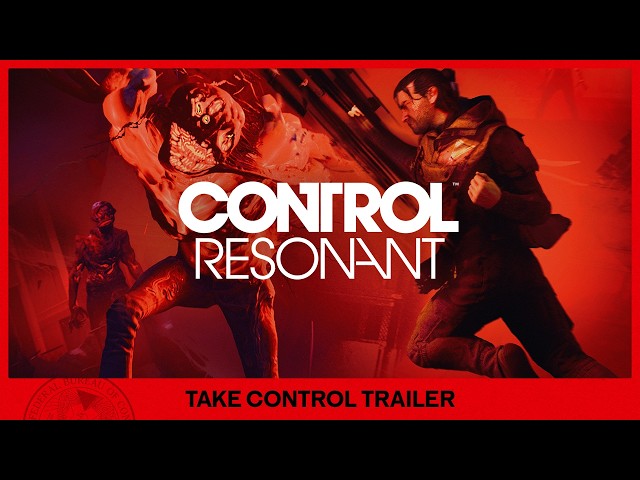
My time with Control Resonant concludes with one such mission - riding a drill down into a giant sinkhole. This notable AWE has appeared in the place of an apartment building, and as Dylan descends, he's met with swirling crowds of floating furniture and that twisted, gravity-defying complex of rooms that I described up top. For as lost as I get, I'll give the developer credit - it never takes me long to find my way back to the lift, and keep pushing downwards. At the bottom, there's a little puzzle-platforming to deploy some probes, and a short combat encounter; enjoyable, but unremarkable.
Finally, however, the mission climaxes with an escape sequence. This is peak Remedy - a perfect fusion of audio and visual design - and I'm distraught when the end-of-demo screen tears me away at the last moment. I suspect this section is just an early taste; I highly doubt the team would be so eager to spoil the equivalent of Control's Ashtray Maze, or Alan Wake 2's Herald of Darkness scene. If there's more like this to come, we're in for a treat.
I ended up really enjoying the act of playing Control, but it isn't why the game holds such a special place in my heart. I suspect I'll feel much the same way about Control Resonant. Providing Remedy sticks the landing, it'll be the mysteries, character work, and set pieces that pull me through its tale - but I came away from my preview feeling rather confident that I'll have a good time hacking its denizens to pieces along the way too.

 English
 Arabic
 French
 Spanish
 Deutsch
 Turkish
 Dutch
Dutch
 Italiano
 Russian
 Romaian
 Portuguese (Brazil)
 Greek
Greek