


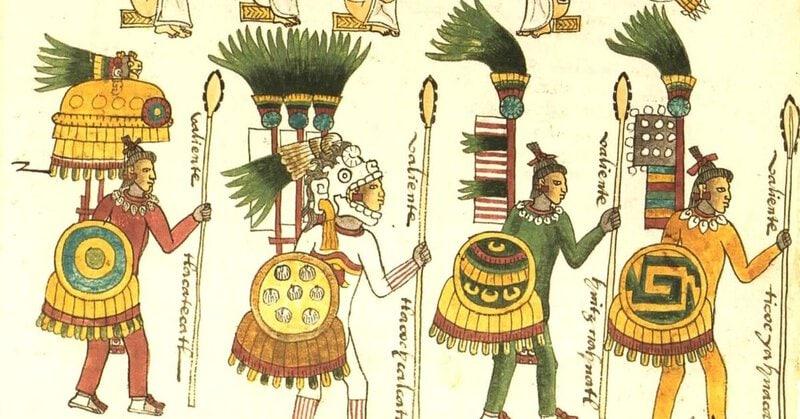
In 1325, a ragged band of wanderers waded into the marshy shallows of Lake Texcoco in the Valley of Mexico and saw what their priests had promised: an eagle perched on a cactus, devouring a serpent. After two centuries of homelessness, they had found their sign. Within two hundred years, the island they built on that marsh would become the capital of the most powerful empire the Americas had ever seen — and then, in the span of roughly eighty days of siege, it would be gone.
Wanderers No More: The Long Road from Aztlan (c. 1100-1325)

The people who would become the Aztecs called themselves the Mexica, and their story begins not in glory but in hunger. Around 1100, they began migrating south from a semi-mythical homeland in northwestern Mexico known as Aztlan — a name that would eventually give the empire its familiar label. The Valley of Mexico they were walking toward was already crowded with older, more sophisticated civilizations, and none of them were pleased to see the Mexica coming.
For roughly two centuries, the Mexica wandered the fringes of Mesoamerican society, derided as barbarians and routinely pushed off whatever land they managed to occupy. They survived by doing what the unwanted have always done: making themselves useful. They hired out as mercenaries, fighting other people’s wars while quietly absorbing the lessons those people had spent generations learning — irrigation, statecraft, religious ceremony, and the political art of alliance-building. The irony is almost too neat: the group that would eventually build the hemisphere’s mightiest pre-Columbian empire spent its formative centuries as refugees that nobody wanted.
The eagle omen of 1325 ended the wandering. The island the Mexica claimed in Lake Texcoco was a swampy, unpromising patch of reeds and mud, and the more powerful kingdoms ringing the lake were content to let the troublesome newcomers have it. It was not yet a triumph. It was merely a foothold — but it was theirs.
One clarification worth making early: the terms “Aztec” and “Mexica” are often used interchangeably, but “Mexica” was the people’s own name for themselves. “Aztec” is a broader scholarly label derived from “Aztlan” and was popularized largely after the conquest. Throughout this article, both terms appear — but the people themselves would have said Mexica.
From Island Outpost to Imperial Power (1325-1428)

What the Mexica did with that mud island ranks among the great engineering achievements of the ancient world. They built chinampas — artificial garden-islands constructed from layered mud, reeds, and vegetation, anchored to the lakebed and extraordinarily fertile. They raised causeways across the water connecting their island to the shore. They engineered an aqueduct system that later Spanish observers, men who had seen Rome, would describe with genuine astonishment. The city they called Tenochtitlan grew from a reed settlement into a structured urban center with temples, markets, and neighborhoods organized by trade and craft.
Politically, the Mexica played a longer game. For decades after the founding, they served as junior partners and soldiers-for-hire under the Tepanec kingdom, the dominant regional power based at Azcapotzalco. They fought Tepanec wars, collected Tepanec tribute, and maintained the appearance of submission — all while mastering how an empire actually functions. Then, in 1426, the powerful Tepanec ruler Tezozomoc died, and the succession crisis that followed gave the Mexica their opening.
They took it without hesitation. In 1428, Tenochtitlan forged the Triple Alliance with the neighboring city-states of Texcoco and Tlacopan. Texcoco, under the philosopher-king Nezahualcoyotl, brought military strength and sophisticated administrative traditions; Tlacopan served as the junior partner, receiving a smaller share of tribute. Together, the three cities dismantled Tepanec dominance and redistributed power across the valley. That alliance — a military and political pact designed to dominate the region — is the moment historians mark as the formal beginning of the Aztec Empire. According to the Britannica Aztec Empire Timeline, it was this coalition that transformed a regional power into a continental one within a single generation.
The Imperial Century: War, Tribute, and a World Remade (1428-Early 1500s)

Under the ruler Itzcoatl and his chief minister Tlacaelel — arguably the true architect of Aztec imperial ideology — the empire rapidly recast its own history and religious identity to justify expansion. Tlacaelel reportedly ordered the burning of older historical records and the creation of a revised origin narrative that placed the Mexica at the center of a cosmic mission: sustaining the sun itself through ritual sacrifice. Whether or not the record-burning happened exactly as described in later sources, the ideological shift was real and consequential. The empire was not merely conquering territory; it was, in its own telling, holding the universe together.
Under Itzcoatl and then Moctezuma I, Aztec warriors proved almost impossible to stop. The empire expanded across the central Mexican highlands and pushed outward across much of Mesoamerica. At its greatest extent, the Aztec Empire controlled roughly 80,000 square miles of territory and extracted tribute from hundreds of subject peoples. You can trace the full sweep of that expansion in the World History Encyclopedia’s Aztec Civilization timeline, which maps how rapidly the conquests accumulated city by city and decade by decade.
The tribute system was the empire’s heartbeat. Conquered peoples were rarely occupied in the modern sense — there were no permanent Aztec garrisons stationed in every subject city. Instead, they received an annual bill. Cacao, textiles, obsidian, feathers, gold, and human captives for ritual sacrifice flowed into Tenochtitlan from across the empire, keeping the capital supplied, its temples fed, and its military funded. The Mexica maintained detailed tribute records, some of which survive today in documents like the Codex Mendoza, giving historians a precise accounting of exactly what was demanded and from whom. It was a system both efficient and ruthless.
At its peak, Tenochtitlan was home to somewhere between 200,000 and 300,000 people — larger than any city in contemporary Europe. It had bustling markets where goods from across the continent changed hands, schools (calmecac for the nobility, telpochcalli for commoners) that educated children of different social ranks, a complex religious calendar governing daily life, and monumental architecture that proclaimed, to anyone who doubted it, that this was a civilization at the height of its powers.
But cracks were forming beneath the spectacle. The Mexica practiced what they called xochiyaoyotl — conventionally translated as “flowery war” — ritualized combat with neighboring states designed primarily to capture prisoners for sacrifice rather than to annihilate and absorb enemies outright. The result was a landscape of peoples kept weak enough to be exploited but alive enough to nurse grievances. The Tlaxcalans, who successfully resisted Aztec conquest and maintained their independence, the Totonacs on the Gulf Coast, and dozens of other groups paid tribute year after year and hated Tenochtitlan with a focused, patient intensity that would eventually prove fatal to the empire. For broader context on how the empire functioned day to day, the History on the Net overview of the Aztec Empire provides a useful survey.
The World the Spanish Walked Into (1519)

When Hernán Cortés landed on the Gulf Coast in April 1519, he arrived in a world that looked, from the outside, like a monolith. Moctezuma II sat at the center of a magnificent imperial court, surrounded by thousands of attendants and advised by priests who interpreted comets, temple fires, and other omens as divine messages. Indigenous accounts compiled after the conquest describe a series of dark portents in the years before the Spanish arrived — a comet, a temple fire, a weeping woman heard crying through the streets at night. Whether these omens were genuinely observed before the conquest or were shaped in retrospect by the trauma of what followed, they reflect the profound rupture that contemporaries felt they were living through.
What Cortés grasped immediately, and what Moctezuma could not fully reckon with, was that the empire’s strength was also its deepest vulnerability. Every people who had bent under Aztec tribute demands was a potential ally for anyone willing to offer them relief. Cortés offered exactly that. The Tlaxcalans — who had repelled Aztec conquest and maintained fierce independence — allied with the Spanish after initial fighting, providing not just thousands of warriors but strategic intelligence, supply lines, and local knowledge that no small band of European adventurers could have survived without.
By the time Cortés marched toward Tenochtitlan in the autumn of 1519, he commanded not a few hundred Spaniards but a massive coalition force. Indigenous allies — Tlaxcalans, Totonacs, and others — numbered in the thousands and arguably decided the outcome of the conquest. The strangers from across the water were instruments not of liberation for everyone, but certainly of revenge for those who had suffered most under Aztec rule. The full details of how that coalition formed and functioned are documented in sources including the Aztec History timeline and the Wikipedia entry on the Aztec Empire.
The 80-Day Collapse: Siege, Smallpox, and the End of an Empire (1520-1521)

The conquest was not a foregone conclusion. In June 1520, on a night the Spanish would call La Noche Triste — the Night of Sorrows — Aztec warriors nearly destroyed Cortés’s entire force as it attempted to flee Tenochtitlan across one of the lake causeways. Hundreds of Spanish soldiers drowned under the weight of their own looted gold, and Cortés himself reportedly wept at the scale of his losses. The Aztec counterattack was ferocious, and for a moment it appeared the empire would survive after all.
Then the invisible weapon arrived. A smallpox epidemic swept through Tenochtitlan in late 1520, tearing through a population that carried no immunity to the disease. Moctezuma’s successor, Cuitláhuac — the commander who had organized the devastating Noche Triste counterattack — died of smallpox within roughly eighty days of taking power. Thousands of warriors, farmers, priests, and administrators perished alongside him. Epidemiologists estimate that the epidemic may have killed a third or more of the city’s population before the final siege even began. The disease did more to break Aztec military capacity than any Spanish weapon had managed.
Cortés returned in the spring of 1521 with a rebuilt coalition army and a fleet of small warships — brigantines designed to be dismantled, carried overland in sections across mountain passes, and reassembled on the lakeshore. It was an extraordinary logistical achievement, and it gave him control of the water surrounding Tenochtitlan. He used that control to sever the island city’s causeways and cut off its supplies of food and fresh water, then pressed inward through roughly eighty days of brutal, block-by-block fighting that left much of the city in rubble.
On August 13, 1521, the last Aztec emperor, Cuauhtémoc, was captured while attempting to escape across the lake by canoe. The siege was over. The empire — which had formally begun with the Triple Alliance of 1428 and traced its city’s founding to 1325 — was finished. Measured from the Triple Alliance to the fall of Tenochtitlan, the Aztec Empire lasted approximately ninety-three years of formal imperial rule. Measured from the founding of the city itself, it is closer to two centuries. Either way, what was built in that time staggers comprehension — and what was destroyed in those final eighty days still echoes through Mexican history and identity.
What the Aztec Timeline Leaves Behind

The arc of the Aztec Empire’s rise and fall — from wandering refugees around 1100, to a continental power by the mid-1400s, to rubble by 1521 — mirrors patterns of imperial overreach that recur throughout world history. Rapid expansion built on tribute extraction, the accumulation of resentful subjects, fatal dependence on military intimidation rather than political integration, and the underestimation of internal dissent: these are not uniquely Aztec problems. They are the recurring grammar of empires from Rome to the present.
But the Aztecs were not erased. Their descendants survived, and so did their influence. The Nahuatl language contributed hundreds of words to modern Spanish and, through Spanish, to English — chocolate, tomato, avocado, chili, coyote. The crops the Mexica cultivated — maize above all, but also tomatoes, cacao, and squash — crossed the Atlantic after 1521 and remade global agriculture and diet in ways that are still unfolding. Tens of millions of Mexicans today claim indigenous heritage that connects directly to the Mexica and their neighbors. A civilization does not simply vanish because its political structure is destroyed.
And then there is the eagle. The image the priests claimed to have seen in 1325 — the eagle on a cactus, devouring a serpent — sits at the center of the Mexican flag today. It is the national seal of a country that is, in no small part, the Aztec Empire’s living and complicated aftermath: built from the same valley, shaped by the same crops, carrying the same memory forward through centuries of colonization, independence, and transformation. The wanderers who waded into Lake Texcoco looking for a sign found more than they could possibly have imagined. What they built still stands, transformed, in the world their empire helped create.
For a detailed chronological breakdown of events from the migration period through the Spanish conquest, the Digital Maps of the Ancient World timeline of the Aztecs offers an event-by-event map of the full span of Aztec history. Younger readers can also find an accessible introduction through the Twinkl Aztec timeline for kids, which covers the essential milestones clearly and without jargon.

 English
 Arabic
 French
 Spanish
 Deutsch
 Turkish
 Dutch
Dutch
 Italiano
 Russian
 Romaian
 Portuguese (Brazil)
 Greek
Greek