


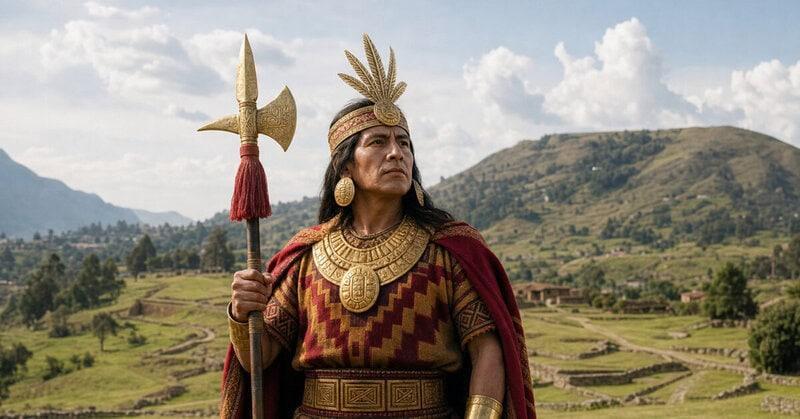
In the grand sweep of world history, few empires rose so fast, stretched so far, and fell so suddenly as the Inca Empire — a civilization that went from anonymous highland tribe to continental superpower in barely two centuries, only to be shattered in two catastrophic years. Here are nine essential points on the Inca civilization timeline that reveal just how extraordinary, and how precarious, that journey truly was.
1. Two Centuries of Obscurity Before Anyone Called Them an Empire

Around 1150-1200 AD, the Inca people migrated into the Cusco highlands — and then, for roughly 200 years, barely anyone outside the region noticed them. From approximately 1200 to 1438 AD, they were one local power among dozens of competing Andean chiefdoms, trading, skirmishing, and consolidating at a modest regional scale. The Incas were not yet the continent-shaking force they would become; they were neighbors, rivals, and occasional nuisances to the peoples around them.
That long, slow build — nearly two and a half centuries of relative quiet — makes the explosion of empire that followed all the more startling. Crucially, those generations were not wasted: the Incas were quietly refining the agricultural techniques, kinship alliances, and military habits that would later underpin a continental state. When the transformation finally came, it arrived with breathtaking speed, as though all those generations of preparation had been coiling a spring.
2. Fourteen Thousand Years of Andean Civilization Came Before the Incas

The Incas did not invent Andean greatness; they inherited it. Fourteen thousand years of distinct cultures preceded them in the region, each laying down knowledge, technology, and tradition that the Incas would eventually absorb and amplify. Four civilizations in particular — Chavín, Tiwanaku, Wari, and Chimú — each left clear fingerprints on Inca religion, architecture, road-building, and statecraft. The sacred geography of the Andes, the technique of terraced hillside agriculture, and the administrative habit of integrating conquered peoples through labor obligations all had deep roots stretching back long before any Sapa Inca sat on a throne in Cusco.
Understanding this inheritance is essential to reading the deeper history of the Central Andes accurately. The Incas were the culmination of a profound Andean tradition rather than a sudden miracle — the last and loudest chapter in a story that had been building for millennia. They were brilliant synthesizers as much as original inventors.
3. One Man, One Year — 1438 Changes Everything

In 1438, a prince named Cusi Yupanqui seized the throne after defeating the rival Chanka confederation in a war his own father, Viracocha Inca, had considered unwinnable and had fled. The victory was so complete and so unexpected that it seemed to demand a new name for the man who achieved it. He renamed himself Pachacuti — meaning “Earthshaker” or “He who transforms the world” — and became the ninth Sapa Inca, the title reserved for the supreme ruler of the Inca people.
Historians credit Pachacuti with almost single-handedly launching the imperial expansion that would eventually stretch across western South America. He reorganized the military into a disciplined standing force, redesigned Cusco as a monumental capital laid out in the shape of a puma, and initiated construction of Machu Picchu as a royal estate. He set in motion a machinery of conquest that his successors would inherit and accelerate. One man, in one pivotal year, changed the trajectory of an entire continent.
4. A 95-Year Sprint to Become the Largest Pre-Columbian Empire in the Americas

The Inca Empire as a formal political entity lasted from 1438 to 1533 — just 95 years. In that narrow window it grew to become the largest empire in the pre-Columbian Americas, covering roughly 2.5 million square kilometers at its height and home to an estimated population of between 10 and 12 million people. It was built without the wheel for transport, without iron tools for construction, and without a phonetic writing system to coordinate administration across thousands of miles of mountain, desert, and jungle. In place of writing, Inca administrators used quipus — knotted cord devices that encoded numerical and possibly narrative information with remarkable sophistication.
No other empire in the Western Hemisphere, before or since, matched that territorial scale in so compressed a timeframe. The speed and ambition of Inca expansion remains one of the most astonishing organizational feats in pre-Columbian history, a reminder that literacy and iron metallurgy are not prerequisites for administrative genius.
5. The Empire Stretched Across Six Modern Nations

At its peak, the Inca Empire — known as Tawantinsuyu, meaning “The Four Regions Together” — covered territory in what is now Peru, Ecuador, Bolivia, Chile, Argentina, and Colombia. The empire ran roughly 4,000 miles from its northern frontier near the present-day Colombia-Ecuador border to its southern extreme in central Chile, a distance roughly equivalent to traveling from New York City to Los Angeles and back again. It encompassed some of the world’s most punishing terrain: soaring Andean passes above 15,000 feet, the hyper-arid Atacama coastal desert, tropical rainforest edges — all of it knitted together by an extraordinary network of stone-paved roads spanning approximately 40,000 kilometers.
That six-nation span gives modern travelers a visceral sense of just how audacious the Inca project was. The Inca territorial milestones mapped across time show a state that expanded not in one direction but in all directions simultaneously, absorbing radically different peoples, climates, and ecosystems under a single imperial administration centered in Cusco.
6. The Empire Flourished for Barely a Century Before Spanish Steel Arrived

The period historians describe as the Inca civilization’s true flourishing runs from approximately 1438 to 1533 CE — barely 95 years of peak power and achievement. Francisco Pizarro landed on the coast of South America with fewer than 200 soldiers, and by 1533 had captured the Sapa Inca Atahualpa at Cajamarca, collected a room-sized ransom in gold and silver, and then executed Atahualpa regardless — effectively shattering imperial command at a single stroke. The psychological and political effect was catastrophic: a system built around the divine, unchallengeable authority of a single ruler could not easily survive the public humiliation and killing of that ruler by a tiny foreign force.
The speed of the collapse shocked even the Spanish. A structure that had taken generations to build came apart in roughly two years of active conquest — a brutal lesson in how the very strengths of a centralized empire become its most devastating vulnerabilities when the center is struck.
7. Resistance Burned for Nearly Four More Decades After the ‘Fall’

The standard date given for the fall of the Inca Empire is 1533, but that marks the fall of the capital and the execution of the emperor — not the end of Inca resistance. A remnant Inca state, known to historians as the Neo-Inca State, retreated to the jungle stronghold of Vilcabamba deep in the eastern Andes and held out for nearly four more decades. It was not until 1572 that Spanish forces finally captured and executed the last ruler in the royal line, Túpac Amaru I, bringing the political existence of the Inca state to its true close.
That persistence is a remarkable coda to the main story of the last days of the Inca Empire. From first conquest to the final extinguishing of the royal line, the death of the empire took nearly four full decades — a drawn-out ending that speaks to both the tenacity of Inca resistance and the sheer difficulty of eliminating a state that had once administered millions of people across an entire continent.
8. Pizarro, the Man Who Toppled an Empire, Was Murdered by His Own Allies Nine Years Later

Francisco Pizarro did not enjoy his triumph for long. In 1541, just nine years after engineering the conquest of the Inca Empire, he was assassinated in his own palace in Lima. His killers were not Inca warriors exacting revenge, but fellow Spanish conquistadors — the faction loyal to his former partner Diego de Almagro’s son — consumed by a bitter civil war over the division of the empire’s wealth. The same ruthlessness and political maneuvering that had made the conquest possible turned inward with lethal consequences.
There is a grim historical symmetry in the fact that the conqueror of the largest pre-Columbian empire in the Americas was brought down not by the civilization he crushed, but by his own countrymen fighting over the wreckage. Power, the Inca timeline suggests again and again, is far easier to seize than it is to hold.
9. The Inca Timeline Is Essentially the Story of Three Extraordinary Rulers

Step back from the full sweep of the Inca Empire’s history and timeline, and a striking pattern emerges: virtually all of the expansion was driven by just three rulers across roughly 90 years. Pachacuti began his conquests in 1438; his son Túpac Inca Yupanqui pushed the borders dramatically north into Ecuador and south into Chile and Argentina; his grandson Huayna Capac carried the empire to its maximum geographic extent before dying of what was likely a European epidemic disease — probably smallpox — around 1527, years before Pizarro even arrived in force.
That epidemic detail matters enormously. Huayna Capac’s death without a clearly designated heir triggered a devastating civil war between his two sons, Huáscar and Atahualpa, which lasted from approximately 1529 to 1532. Atahualpa had only just emerged victorious — and his forces were still dispersed across a fractured, war-exhausted empire — when Pizarro arrived at Cajamarca. What three generations had built across nine decades collapsed in a matter of years, a reminder that in history, the forces of creation and destruction are rarely separated by as much time as we might imagine.
The Inca Empire timeline is, at its heart, a story about the breathtaking speed of human ambition — and about how fragile even the most formidable structures of power can be when disease, succession crises, and determined outsiders strike simultaneously. A forgotten highland tribe transformed an entire continent; that transformation, so long in the making, proved shockingly vulnerable when the world it had mastered suddenly changed around it.

 English
 Arabic
 French
 Spanish
 Portuguese
 Deutsch
 Turkish
 Italiano
 Russian
 Romaian
 Portuguese (Brazil)
 Greek
Greek