


The fires burned for seventeen days. Standing on a hill above the ruins of Carthage in 146 BC, the Roman general Scipio Aemilianus watched a civilization turn to ash and — according to the historian Polybius, who was present — wept openly, quoting Homer’s lines about the fall of Troy, seized by the terrible knowledge that all great cities eventually meet this same end. It was a strange, almost unbearable moment of humanity from the man who had just ordered the destruction.
Two Worlds on a Collision Course

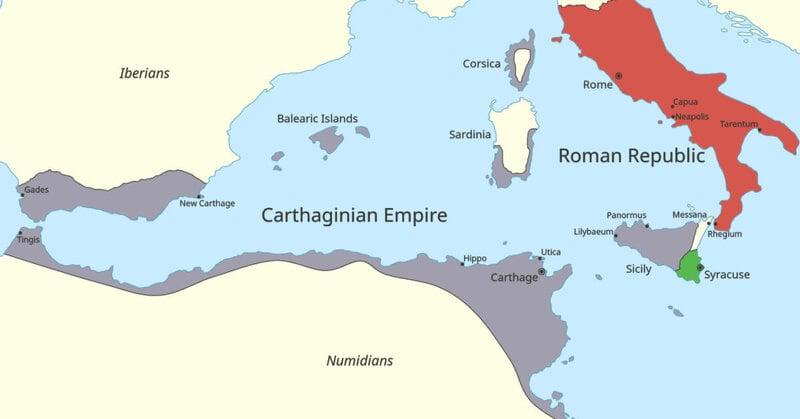
To understand why that fire was lit, you have to go back more than a century and meet two powers who seemed, at first glance, to have little reason to collide. Carthage in 264 BC was a Phoenician merchant empire sprawled across the North African coast in what is now Tunisia — opulent, cosmopolitan, and commanding. Its navy ruled the western Mediterranean’s sea lanes with the confidence of a power that has collected tolls on the world’s most valuable trade routes for generations. Carthaginian merchants dealt in tin, silver, purple dye, and grain. Its harbors hummed. Its treasury swelled. For centuries it had organized the western Mediterranean’s most profitable commercial network, and it wore that wealth with the easy assurance of a civilization that has never truly been challenged on its home waters.
Rome was something else entirely. Still an earthy, land-obsessed Italian republic in the slow process of hammering the peninsula’s quarrelsome peoples into something like unity, Rome in 264 BC did not own a single warship capable of fleet warfare. It was a society that glorified the farmer-soldier — the man who left his plow to fight and returned to it when the fighting was done. Ambitious, certainly. Ferociously disciplined, without question. But a naval power? Not remotely. Not yet.
What brought these two mismatched giants into their first collision was, improbably, a gang of unemployed mercenaries. In the 280s BC, a band of Italian soldiers of fortune known as the Mamertines — they called themselves the “Sons of Mars” — seized the Sicilian city of Messana by treachery, killing its male inhabitants and taking their wives. When their grip on the city was threatened by Syracuse, they did what desperate men do: they appealed simultaneously to both Rome and Carthage for protection. Both powers answered. Both landed forces. Neither was willing to let the other control Messana, because Messana was the key to Sicily, and Sicily was the key to everything.
Sicily was the inevitable flashpoint. It was Carthage’s breadbasket, the island that fed its ambitions and crowned its western Mediterranean dominance. For Rome, it was something even more visceral — visible from the Italian mainland on a clear day, a threshold that a hostile power could step across at any moment. Whoever held Sicily held the strategic future of the western world. Both sides understood this, even if neither could have articulated exactly what that future would look like.
The First Punic War: Rome Learns to Sail

What followed was twenty-three years of grinding, brutal conflict — the First Punic War, from 264 to 241 BC — that forced Rome to do something genuinely audacious: build a war fleet from scratch and then use it to defeat a civilization that had been mastering the sea for centuries. Roman engineers reportedly used a wrecked Carthaginian warship as a template, reverse-engineering the design and constructing a fleet of more than a hundred vessels in a remarkably short time. It was the ancient world’s equivalent of a landlocked nation building an aircraft carrier fleet after studying a single salvaged hull.
But Rome, being Rome, did not try to out-sail the Carthaginians. Instead, Roman engineers invented a device called the corvus — a spiked boarding bridge that could be dropped onto an enemy deck, locking the ships together and transforming a naval engagement into the kind of close-quarters infantry battle Romans had spent generations perfecting. At the Battle of Mylae in 260 BC, this innovation delivered a staggering Roman victory. Rome had taken naval warfare and remade it: a land battle that happened to be surrounded by water.
But the sea is not a forgiving teacher. Rome’s fleet-building audacity was matched by catastrophic losses to storms. Ancient sources describe entire Roman fleets swallowed by the Mediterranean in ferocious weather, with losses of sailors numbering in the tens of thousands — staggering tolls that the Roman state somehow absorbed and kept fighting through. The war was paid for not just in treasure but in ordinary Roman and Carthaginian lives on a scale almost impossible to comprehend from this distance.
It ended with the Treaty of Lutatius in 241 BC. Carthage surrendered Sicily and agreed to pay substantial reparations over ten years. On paper, Rome had won. In reality, both powers were exhausted and humiliated in their own ways, and the treaty settled nothing deeper than the immediate question of who controlled an island. The rivalry was not extinguished. It was pressurized, like steam in a sealed chamber, waiting for the next crack.
The Interwar Years and the Making of Hannibal
Rome, sensing weakness, went further. While Carthage was preoccupied with a brutal uprising by unpaid mercenaries — a vicious conflict that ancient sources called the Truceless War — Rome seized Sardinia and Corsica, demanding them as a condition for staying out of that domestic crisis. The humiliation in Carthage was total. Stripped of its islands and its treasury drained by reparations, the once-dominant naval empire was forced to look elsewhere to rebuild its power and wealth. It looked to Spain.
Into this wounded, furious Carthage stepped Hamilcar Barca, a general of fierce intelligence and fiercer ambition. The story that has come down to us — and it carries the quality of legend even if its core is historically attested — is that when his young son Hannibal begged to accompany him on the Spanish campaign, Hamilcar agreed only after making the boy swear an oath of eternal enmity toward Rome at the altar of the gods. Whether that oath was sworn in exactly those terms, the result was real enough: Hannibal Barca would become the most dangerous enemy Rome ever faced in the field.
In Spain, Carthage rebuilt methodically. The silver mines of the Iberian Peninsula poured wealth into Carthaginian coffers. A new army took shape, hardened by years of campaigning against fierce local resistance across difficult terrain. Hannibal, rising through the ranks under his father and then his brother-in-law Hasdrubal, learned war in the most demanding school available. By 221 BC he commanded Carthage’s forces in Spain, and he was brilliant, charismatic, and driven by something that went beyond personal ambition into something closer to a inherited mission.
Rome had defined a boundary — the Ebro River — as a rough limit on Carthaginian expansion, enshrined in a treaty with Hasdrubal. Hannibal pushed against that boundary when he besieged Saguntum, a city south of the Ebro that Rome nonetheless considered an ally under its protection, in 219 BC. The siege lasted eight months. When Saguntum fell, Rome declared war. The second — and most consequential — chapter of the Punic Wars had begun.
The Second Punic War: Hannibal at the Gates

What Hannibal did next remains one of the most audacious strategic gambits in recorded history. Rather than wait for Rome to bring the war to Spain or North Africa, he seized the initiative entirely. He marched roughly 40,000 troops, a substantial cavalry force, and a contingent of war elephants across southern Gaul and over the Alps in late autumn. The crossing was murderous. Ambushes from mountain tribes, freezing temperatures, and sheer treacherous terrain stripped away roughly half his fighting strength and most of the elephants before he even reached the Po Valley. Yet he descended from the mountains like a thunderclap onto an Italy that had expected the war to be fought somewhere else — somewhere far away — and Rome suddenly found a Carthaginian army operating freely on Italian soil.
Hannibal spent fifteen years in Italy and never lost a major set-piece battle. His masterpiece was Cannae in 216 BC, where he enveloped a Roman army estimated at somewhere between 50,000 and 70,000 men using a smaller force through a double-envelopment maneuver of such geometrical precision that military academies still study it today as the defining model of the battle of annihilation. He drew the Roman center forward, let his flanks fold inward, and destroyed a consular army in a single afternoon. The Roman Republic suffered losses on that day that would have ended almost any other state in the ancient world.
But Rome was not any other state. The Senate refused to negotiate. New armies were raised with extraordinary speed. The general Quintus Fabius Maximus, nicknamed the Delayer, adopted a strategy of harassment and attrition — refusing pitched battles, cutting off foraging parties, exhausting the invader without giving him another Cannae to harvest. It was an unpopular strategy, mocked as timidity by a population burning for revenge, but it worked. And critically, Rome’s network of Italian allies — despite Hannibal’s persistent and skillful efforts to court them with offers of freedom from Roman domination — mostly held firm. Without a secure base of supply in Italy and without the reinforcements from Carthage that never arrived in adequate numbers, Hannibal could win battles but could not translate those victories into strategic decision.
The reversal came when a young Roman commander named Publius Cornelius Scipio — later granted the honorific Africanus — carried the war to Spain, methodically dismantling Carthaginian power there, and then made the boldest move available: he took the fight to Africa itself. The threat to Carthage’s home territory finally forced Hannibal to abandon Italy and return to defend it. At Zama in 202 BC, on Carthaginian soil, Scipio defeated Hannibal in a battle that settled the question of Mediterranean supremacy for the next several centuries. Carthage was stripped of its overseas empire, its war fleet, and its army. It was reduced to a client state, forbidden from making war even in its own defense without Roman permission. The second war was over. The third would be a formality dressed up as a conflict.
The Third Punic War: ‘Carthage Must Be Destroyed’

For roughly fifty years after Zama, Carthage did something Rome found deeply unsettling: it recovered. Stripped of military power and territorial empire, the city threw itself back into commerce with the energy of a people who had nothing else left. By around 150 BC, Carthage was prosperous again — not dangerous, not imperial, but commercially vital and visibly, defiantly alive.
This recovery alarmed a powerful faction in Rome, led most vocally by the senator Marcus Porcius Cato — Cato the Elder — who reportedly appended the phrase Carthago delenda est, “Carthage must be destroyed,” to every speech he delivered in the Senate, regardless of the speech’s nominal subject. Cato understood, or feared, that a wealthy Carthage was an eventual rival Carthage. The logic was paranoid but not entirely irrational given Roman strategic experience, and it found sufficient support to carry the day.
Rome’s demands escalated deliberately toward the impossible. Carthage first surrendered its remaining weapons and hostages. Then Rome demanded that the entire population relocate inland, away from the coast — an order that would have meant the extinction of a merchant civilization entirely dependent on the sea. Carthage refused, and a three-year siege began. The city’s resistance was extraordinary in its desperation. Citizens melted down gold and bronze to cast new weapons. Women, according to ancient accounts, cut their hair to twist into rope for catapult mechanisms. An entire civilization improvised with the fierce ingenuity of people who understand they are fighting not for territory but for existence.
It was not enough. Scipio Aemilianus, the adopted grandson of Scipio Africanus, finally breached the walls in 146 BC. The fighting moved street by street, building by building, into the city’s heart — close, grinding, brutal urban combat that the ancient sources describe with unusual specificity. When it was over, the surviving population — ancient sources suggest perhaps 50,000 people — was enslaved. Carthage was razed to its foundations. The physical city was so thoroughly demolished that later Roman colonists building on the site were not always certain where the old streets had run.
Why the Punic Wars Still Matter

The roughly 118 years of conflict that began with mercenaries squabbling over a Sicilian city and ended with a general weeping above flames transformed Rome from an Italian republic into a Mediterranean empire. After the Punic Wars, Rome held not just Sicily but Spain, coastal North Africa, and a demonstrated capacity for projecting military and administrative power across the entire known western world. The professional legions that would go on to conquer Gaul, Egypt, and eventually most of Europe were forged, institutionally and tactically, in these wars. The administrative machinery of empire — provinces, governors, tribute systems — was first assembled to manage the territories that the Punic Wars delivered.
But the transformation carried its own slow poison. War profits flowed disproportionately to Rome’s elite landowners. Small farmers, displaced by years of military service and unable to compete with the slave-worked latifundia that wartime plunder made possible, drifted into the cities and became the volatile, landless urban poor. The economic inequality seeded during the Punic Wars deepened across the following century until it tore the Republic apart in civil conflict and produced, eventually, the emperors. The wars that made Rome great also planted the seeds of the Republic’s eventual collapse.
Carthage, meanwhile, deserves a reclamation that history has been slow to provide. Almost everything we know about Punic civilization comes filtered through Roman and Greek sources — rivals and enemies who had powerful reasons to portray Carthaginians as barbaric and cruel. The charges of child sacrifice that appear in those sources are genuinely contested by modern archaeology, which has not found unambiguous physical confirmation of the practice at the scale ancient authors describe. What is not in dispute is that Carthage was a literate, architecturally sophisticated, commercially inventive civilization whose libraries, records, and physical culture were so thoroughly destroyed in 146 BC that we are left with little more than the victors’ caricature. We are judging a civilization almost entirely through the eyes of the people who erased it.
Which brings us back to Scipio, standing on his hill, watching the fire. Polybius, who was present, recorded that Scipio turned to him and said he feared that one day someone would give the same verdict on Rome. It is the most honest moment in the entire story — a man at the absolute apex of military triumph understanding, in his bones, that dominance is not permanence, that the arc of empires bends always, eventually, toward ash. Rome would last another six centuries in the west before its structures gave way. Carthage lasted not a day longer than Scipio permitted it to. The fires burned for seventeen days, and the light they cast reaches all the way to the present.

 English
 Arabic
 French
 Portuguese
 Deutsch
 Turkish
 Dutch
Dutch
 Italiano
 Russian
 Romaian
 Portuguese (Brazil)
 Greek
Greek