


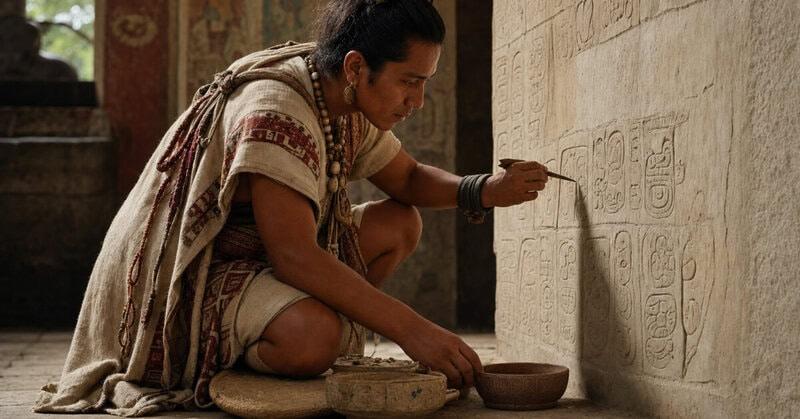
Somewhere in the lowland jungles of what is now Guatemala, around 900 CE, a Maya scribe pressed a sharpened stylus into wet plaster and carved another glyph — a curl of breath, a sign for a royal name, a date in a calendar system so precise it could track Venus across the sky for centuries. He was not fleeing. He was not desperate. He was doing what his teachers had done, and what their teachers had done before them: recording the world with devotion and mathematical care. Future historians, peering at the silence that followed, would call what happened next a collapse. They would be wrong — or at least, they would be telling the wrong story.
Who the Maya Actually Were: A Civilization of City-States, Not a Single Empire

The first mistake most people make about Maya civilization is imagining it as a single unified empire — a Maya Rome that rose, ruled, and fell. It was nothing of the sort. The Maya were a constellation of competing, collaborating, and occasionally warring city-states, each with its own dynasty, its own artistic identity, and its own political ambitions. Tikal and Calakmul were bitter rivals for dominance over the southern lowlands. Palenque, in what is now the Mexican state of Chiapas, produced some of the most exquisite sculptural relief the ancient Americas ever saw. Copán, near the modern Honduras-Guatemala border, became a center of astronomical and scribal learning so sophisticated it staggers the modern mind. Chichén Itzá, on the limestone plains of the Yucatán Peninsula, would eventually outlast them all in terms of political prominence.
What bound these cities together was not a single king but something more durable: shared language roots, a common cosmological vision, interlocking calendar systems, and a fully developed writing system — one of only a handful ever invented independently in all of human history. Maya territory ran through present-day southern México (including the Yucatán Peninsula and the highlands of Chiapas), the jungle lowlands and volcanic highlands of Guatemala, the coastal forests of Belize, and portions of Honduras and El Salvador. This was not one landscape but many — limestone plains, tropical rainforest, cloud-draped mountain valleys — and the Maya shaped their agriculture, architecture, and religion around every contour of it.
Maya society was layered and complex. At the top stood a hereditary noble class alongside a powerful priestly order who controlled astronomical knowledge and the ritual calendar. Below them, skilled artisans, merchants, and administrators formed a substantial middle tier. At the base — building the temples, tending the fields, sustaining the cities — was a large agricultural population whose knowledge of the land was as sophisticated as anything the nobles carved in stone. The Maya astronomers of the priestly class, using nothing but naked-eye observation and mathematical reasoning recorded in bark-paper books called codices, calculated the length of the solar year to within minutes of modern measurements. That is not the achievement of a civilization fumbling toward greatness. That is the achievement of a civilization already there.
The Long Arc: From Ancient Villages to the Classic Peak

The Maya story does not begin in the dramatic pyramid-building centuries most people picture. Its roots reach back to roughly 2000 BCE, when early farming villages began forming along the Pacific coastal lowlands and in the highlands of what is now Guatemala. Over the following millennia, those villages grew into towns, the towns grew into cities, and the cities grew into something extraordinary. By the Classic period — roughly 250 to 900 CE — the Maya world was operating at a level that few civilizations anywhere on earth could match.
Tikal alone may have housed as many as 100,000 people at its peak, its great limestone pyramids thrusting above the jungle canopy like declarations of permanence. Raised stone causeways called sacbeob connected city centers and ceremonial precincts across the lowland landscape. Elaborate reservoir systems captured and stored rainwater through dry seasons, sustaining populations that the seasonally arid terrain would otherwise have struggled to feed. An elite scribal class produced histories, star charts, ritual almanacs, and dynastic records in that remarkable writing system, filling the walls of temples and the pages of codices with a record made by a civilization acutely aware of its own significance. As the Smithsonian’s Living Maya Time project documents, this was a living intellectual tradition — not a collection of inert monuments, but a continuously evolving body of knowledge passed between generations with great deliberateness.
What Actually Happened in the 9th Century — and What Did Not

Here is what is true: over roughly 100 to 150 years in the 9th century CE, the great southern lowland cities went quiet. New stone monuments stopped being erected at Tikal. The royal court at Palenque dissolved. At Copán, the last recorded Long Count date was inscribed and then — silence. Populations dispersed, moving north toward the Yucatán Peninsula or into smaller, less architecturally ambitious settlements. This was real, and it was disruptive on a significant scale.
Scholars point to a convergence of causes. Prolonged drought — or a series of droughts — stressed agricultural systems already straining under the weight of dense urban populations. Political fragmentation between rival city-states drained resources and severed the trade networks that kept cities viable. The Classic Maya power structure, built on the divine authority of individual kings who were expected to guarantee rain and harvests, proved brittle when those kings could no longer deliver. When royal legitimacy cracked, it cracked fast, and the populations that had built the pyramids found better prospects elsewhere.
But here is what is equally true, and what the word collapse conceals: the people moved, reorganized, and rebuilt. Northern Yucatán cities like Chichén Itzá and later Mayapán rose to prominence during and after the supposed collapse of the south, demonstrating clearly that Maya civilization was not dying — it was shifting its center of gravity. And when Spanish conquistadors arrived in the 16th century, they did not find ruins haunted by ghosts. They found populous, sophisticated, and fiercely resistant Maya kingdoms. It took the Spanish nearly 170 years of grinding, brutal warfare to subdue them. The last fully independent Maya state — Tayasal, in the Petén lowlands of Guatemala — did not fall until 1697. That is not the timeline of a civilization that collapsed in 900 CE. That is the timeline of a civilization that refused to.
Colonization: The Catastrophe That Textbooks Underplay

If the word collapse belongs anywhere in Maya history, it belongs in the 16th and 17th centuries — and the agent is not drought or political fragmentation, but invasion. Spanish conquest brought with it the encomienda system of forced Indigenous labor, the systematic destruction of Maya political leadership, and above all, epidemic disease. Smallpox, measles, and typhus swept through populations with no prior immunity to these pathogens. Estimates of the death toll across Mesoamerica within a century of first contact range from 50 to 90 percent of the pre-contact population. That is a demographic catastrophe of almost incomprehensible scale — and it is the real rupture in Maya history, not the dispersal of the 9th century.
The cultural destruction was equally deliberate. In 1562, Franciscan friar Diego de Landa ordered the burning of Maya books in the town of Maní in the Yucatán, condemning them as instruments of the devil. An unknown but potentially large number of codices — centuries of accumulated astronomical observation, historical record, and ritual knowledge — were reduced to ash in a single act of ideological violence. Today, only four pre-Columbian Maya codices are known to survive. Four books from a civilization that once maintained libraries and scribal schools. The scale of the loss is incalculable.
And yet survival persisted within catastrophe. Under colonial suppression, Maya communities maintained oral traditions across generations with extraordinary fidelity. Weavers encoded cosmological and community meaning in the patterns of their textiles — huipiles, the traditional blouses worn by Maya women and still produced today — embedding sacred symbolism in a visual language that colonial authorities could not easily read or legislate against. Calendar knowledge survived within hybrid ritual practices that blended outward Catholic forms with interior Maya meaning. The tradition did not vanish. It went underground, and it waited.
The Maya Today: Millions of People, Dozens of Languages, One Continuing Story

This is the fact that the collapse narrative most dramatically obscures: today, an estimated six to seven million Maya people live across southern México, Guatemala, Belize, Honduras, and El Salvador. In Guatemala alone, Maya people constitute roughly 40 percent of the national population, belonging to 22 officially recognized Maya linguistic communities — K’iche’, Kaqchikel, Mam, Q’eqchi’, and many more — each a distinct language with its own grammar, literature, and speaker community, not merely a regional dialect of some imagined unified tongue. As Britannica’s overview of Maya people makes clear, this is not a heritage population in the sentimental sense. This is a demographic and cultural reality of enormous scale, present and active across multiple modern nation-states.
In the highlands of Chiapas and Guatemala, traditional woven textiles still carry community identity encoded in their patterns — specific color combinations and geometric motifs that identify not just broad ethnicity but the precise home village of the wearer. Maya-language radio stations broadcast news, music, and cultural programming across rural Guatemala. Maya scholars, working alongside community linguists and cultural organizations, developed a unified alphabet for Maya languages in the 1980s and have since used it to produce literature, academic scholarship, and digital content in K’iche’, Yucatec Maya, and other languages. The script has changed form over the centuries, but the underlying impulse is the same one that drove that scribe in 900 CE: to record the world in your own language, on your own terms, for the generations that follow.
The struggle is real and unresolved. Many Maya communities face land dispossession, poverty, and systematic political exclusion. In Guatemala, the legacy of a 36-year civil war that ended in 1996 and killed an estimated 200,000 people — the majority of them Maya, in what a UN-backed truth commission characterized as including acts of genocide — remains an open wound in the national fabric. Yet Maya political and cultural movements are among the most organized and articulate Indigenous rights movements in the Western Hemisphere, pressing land claims, demanding educational reform in Maya languages, and building institutions on their own terms and timelines.
In the Guatemalan highlands, Maya farmers still practice milpa agriculture — planting corn, beans, and squash together in the same polyculture system that fed the great Classic cities. This combination, sometimes called the Three Sisters, has been cultivated in that same volcanic soil for more than two thousand years. That is not archaeology. That is lunch. The continuity of Maya cultural practice across millennia is one of the most remarkable stories in human history — and it is still unfolding in real time.
Why the Collapse Myth Matters — and What We Lose by Believing It

The collapse narrative is not merely historically inaccurate. It carries material consequences. When a civilization is treated as past-tense — as something to be excavated and admired rather than encountered and respected — its living descendants become invisible in the present. Their land rights seem less urgent. Their languages seem like relics rather than living systems worth institutional support. Their political demands can be dismissed as romanticism rather than recognized as the legitimate claims of peoples who never went anywhere.
This pattern extends well beyond Maya history. Western historiography has long had a tendency to locate the greatness of non-European civilizations safely in the ancient past — allowing them to be celebrated as archaeology while their living heirs are overlooked or actively marginalized in the present. The ruined pyramid is picturesque and politically inert. The Maya scholar demanding university instruction in K’iche’ is inconvenient and requires a response. The collapse narrative quietly performs the work of keeping that inconvenience at a distance.
The corrective requires a genuine shift in frame, not just a softening of terminology. Maya civilization is not a story with an ending. It is a story of adaptation, survival, and reinvention across more than three thousand years — a story that encompasses drought and dispersal, conquest and catastrophe, suppression and resistance — and it continues today in every K’iche’ classroom, every Yucatec Maya podcast, every milpa field turned by a wooden digging stick in the volcanic highlands of Guatemala. The more honest question is not what killed the Maya? It is how have the Maya continued to survive, organize, and create through everything thrown at them across three millennia?
That scribe working in 900 CE — pressing meaning into wet plaster against the gathering silence of a city beginning to empty — has living descendants who are pressing keys on laptops today, writing in their own languages, uploading their own histories, correcting the record on their own terms. The story was never over. It just moved, the way great rivers move: underground sometimes, invisible to those who stopped looking, but flowing all the same, and finding its way back to the surface when the conditions are right.

 English
 Arabic
 French
 Spanish
 Portuguese
 Deutsch
 Turkish
 Dutch
Dutch
 Italiano
 Romaian
 Portuguese (Brazil)
 Greek
Greek