


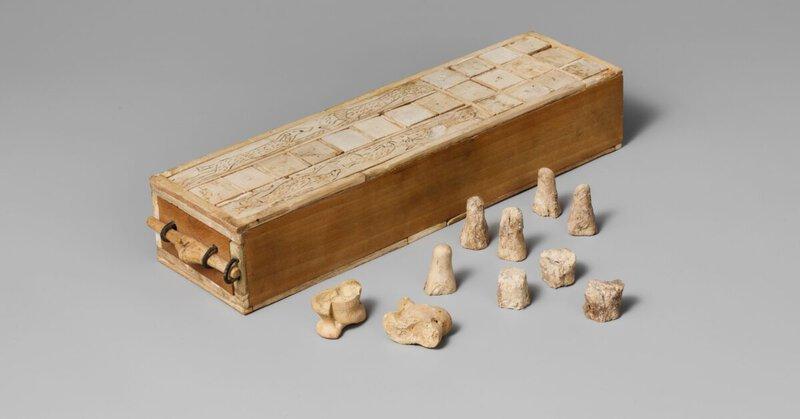
The archaeologists didn’t expect the game board. Among the gilded furniture, the linen wrappings, and the careful provisions for eternity, there it sat — a worn senet board, its cone and spool pieces arranged mid-play, as though the owner had simply stepped out of the room and would be back any moment. Except the owner had been dead for three and a half thousand years.
A Game Board in the Tomb: The Detail That Changes Everything

Across dozens of excavated Egyptian tombs, game boards have turned up with striking regularity — not as decorations, not as symbols, but as practical equipment. The ancient Egyptians were buried with their senet sets because they genuinely believed they would need to play in the afterlife. Death, in their view, was no reason to quit. If anything, the stakes got higher.
That single detail — a civilization packing its favorite games for the journey into eternity — tells you something profound about what games meant to the people who lived along the Nile five millennia ago. And it opens a thread you can pull all the way from a mud-brick workshop in 3000 BCE to a solitaire game glowing on your phone during a lunch break today. The competitive, luck-testing, fate-wrestling instinct that drove Egyptian pharaohs and laborers alike to play is the same one that keeps us tapping cards into sequence on a Tuesday afternoon. It hasn’t gone anywhere. It just changed costumes.
What follows is a journey through thousands of years of board game history — and it is wilder, stranger, and more human than any textbook version you’ve encountered.
Senet: The Oldest Board Game You’ve Never Heard Of (But Should)

Senet is almost certainly the most important game most people have never heard of. Evidence for it stretches back to at least 3100 BCE — before the Great Pyramid, before a unified Egyptian state had fully solidified, before most of the ancient world’s civilizations had worked out writing. It predates chess by roughly three thousand years. It was not a primitive curiosity. It was the defining game of an entire civilization.
The board itself is deceptively elegant: thirty squares arranged in three rows of ten, played with two sets of pieces — traditionally cone-shaped for one player, spool-shaped for the other. Movement was determined not by dice as we know them but by throw sticks, flat on one side and rounded on the other, tossed in a bundle and read by how many flat faces landed upward. Chance was built into the game’s bones from the very beginning.
What makes senet particularly fascinating — and particularly maddening for historians — is that the exact original rules remain unknown. Scholars have reconstructed plausible versions of gameplay from contextual evidence, comparative analysis, and surviving artifacts, but no ancient rulebook exists. Some squares appear to have been safe havens; others acted as traps or penalties. The board was a gauntlet, and the goal was to get your pieces off it first.
By the New Kingdom era — roughly 1550 to 1070 BCE — senet had undergone a remarkable transformation. What had begun as a leisure game became a spiritual technology. The thirty squares came to represent the soul’s journey through the Duat, the Egyptian underworld, each square carrying divine significance, each throw of the sticks reflecting the will of the gods. Playing senet was no longer just entertainment. It was a rehearsal for death.
Not Just Senet: Egypt’s Surprisingly Rich Game Culture

Senet gets most of the historical attention, but ancient Egypt’s gaming culture ran considerably deeper. Mehen — played on a board coiled in the shape of a snake, named for the serpent deity associated with the sun god Ra — may be among the earliest known board games, with evidence placing it around 3000 BCE or earlier. It eventually vanished from the historical record almost entirely, which is itself a haunting detail: an entire game, once beloved enough to carve into stone, lost so completely that modern scholars cannot reconstruct its rules.
The Royal Game of Ur emerged in ancient Mesopotamia but spread across the ancient Near East and into Egypt — a reminder that games, like spices and textiles, traveled ancient trade routes. People have always exchanged not just goods but ways of playing.
Knucklebones — an early dice-like game using the small ankle bones of sheep or goats — was popular across Egyptian society, from children to adults, appearing in archaeological finds throughout the region. Wall paintings in tombs at Luxor depict Egyptians playing games socially and competitively, sometimes with visible spectators clustered around. This was not solitary hobby-tinkering. Ancient Egypt had a gaming culture: loud, social, contested, and fully integrated into daily life.
Fiercely Competitive: What the Evidence Reveals About Ancient Egyptian Players

The picture that emerges from the artifacts is of a society that played hard across every social stratum. Queen Nefertari, the beloved wife of Ramesses II, is depicted in a famous tomb painting playing senet — a scene that operates simultaneously as a portrait of leisure and an image of spiritual aspiration, the queen navigating the game-board-as-underworld with serene focus. Games had penetrated elite life so thoroughly that they appeared on tomb walls alongside images of the gods.
Tutankhamun — the boy pharaoh whose tomb yielded some of the most spectacular archaeological discoveries of the twentieth century — was buried with at least four senet boards of varying quality. One was an ornate gilded set mounted on a carved lion-legged stand; another was a simpler, portable travel version. The range suggests he didn’t just own senet as a status object. He played it regularly, in different contexts, the way a modern person might own both a quality chess set and a travel version.
But some of the most striking evidence of Egypt’s competitive spirit comes not from royal tombs but from the floors of temples and worker settlements. Scratched into stone pavements, carved into the steps of monuments, are informal game boards — grids and tracks gouged by laborers during breaks, by guards during long shifts, by anyone who had a few spare minutes and the human need to play.
The role of chance in all of these games is worth pausing on. Throw sticks and knucklebones weren’t just randomizers — in the Egyptian worldview, they were understood as windows into divine intention. When the sticks fell badly, it wasn’t purely bad luck; it was information about your standing with the gods. Every game was a small conversation with fate.
The Long Road: How Ancient Games Evolved Toward Solitaire

The line from senet to modern solitaire is not straight, but it is traceable. As Egyptian civilization traded and warred and influenced its neighbors, games traveled. The Romans were obsessive gamers — tabula, an ancestor of backgammon, was played in taverns across the empire. Medieval Europe inherited a rich mix of race games, strategy games, and early card games arriving from the East, each carrying structural echoes of ancient prototypes.
Solitaire as a distinct genre — a patience game for one player, pitting the individual against a shuffled deck and a fixed set of rules — appears in the historical record in Northern Europe in the late eighteenth century, most likely in Scandinavia or France. The word “patience,” still used for solitaire across much of Europe, carries its own quiet meaning: the game tests not just skill but endurance, the willingness to sit with uncertainty and see it through.
The philosophical distance from senet to solitaire is smaller than it first appears. Both games leave the player alone with chance and a system of rules. Both ask: can you navigate what fate deals you? Both reward pattern recognition, patience, and the ability to hold competing possibilities in mind at once. Senet began as a social game and acquired spiritual dimensions; solitaire began as a social pastime — played at court, watched by others — and eventually turned inward, becoming the most private form of play. The game moved from the communal tomb to the solitary mind.
Ancient Egypt Solitaire: Where History Meets the Modern Screen

Today, an entire genre of digital games wraps classic solitaire mechanics in Egyptian visual language — pyramids looming in the background, hieroglyphs decorating the card backs, golden sands stretching behind the tableau. These games are enormously popular, and they are tapping into something older than their designers probably realize.
The most common format is Pyramid Solitaire, in which cards are arranged in a triangular pyramid shape and players remove pairs that add up to thirteen. The Egyptian setting is not purely decorative — the pyramid structure itself mirrors the visual iconography of ancient Egypt in a way that feels earned rather than arbitrary. If you want to experience the genre for yourself, Pyramid Solitaire Ancient Egypt at Solitaire Paradise offers a polished browser version with well-implemented rules and clean Egyptian-themed visuals. The mobile version, Pyramid Solitaire Egypt on the Apple App Store, brings the same experience to your phone. For a quick no-friction browser session, Egypt Pyramid Solitaire from HTMLGames loads instantly. You can also find a well-regarded version at Pyramid Solitaire Ancient Egypt on CrazyGames, or try the clean interface at Egypt Pyramid Solitaire on CardGame.com.
The appeal of these games runs deeper than visual dressing. Egypt’s cultural aura — mystery, antiquity, the drama of life and death and what lies beyond — maps almost perfectly onto the psychological texture of solitaire: a lone player, an uncertain outcome, the sense that something is genuinely at stake even when nothing literally is. The genre accidentally honors something true. Egypt really was a cradle of gaming culture. And the lone-player patience game really does share conceptual ancestry with the ancient world’s obsession with luck, fate, and human skill.
There is something else at work too. In an era of relentless multiplayer competition and always-on social gaming, the quiet popularity of single-player Egyptian-themed games reflects a different kind of hunger — the desire to feel connected to something ancient and enduring, even during the smallest stolen moments of a modern day.
Why It Matters: Games Are How Humans Process Being Alive
The deepest thing the archaeological record tells us about ancient Egyptian board games is not a date or a ruleset. It is a disposition. These were people who understood, instinctively and profoundly, that games are not trivial. Games are how humans rehearse fate. They are how we compete for status, practice losing with dignity, sit with uncertainty, and imagine what comes next — including what comes after everything. The Egyptians packed their game boards into tombs not because they were sentimental about hobbies, but because play was serious enough to carry into eternity.
Thousands of years later, every solitaire hand dealt, every calculated move, every streak of bad luck quietly cursed at a glowing screen connects us — absurdly, beautifully, and more directly than we usually acknowledge — to a stoneworker scratching a game grid into a temple floor in 1200 BCE. They were killing time between shifts. They were wrestling with chance. They were doing exactly what we do.
Somewhere in a museum case, a worn senet board sits with its pieces mid-play, waiting. We picked up where they left off. We never really stopped.

 English
 Arabic
 French
 Spanish
 Portuguese
 Deutsch
 Turkish
 Italiano
 Russian
 Romaian
 Portuguese (Brazil)
 Greek
Greek