


Are We In An Enormous Void? It Could Explain What’s Wrong With Our Model Of The Universe
Are We In An Enormous Void? It Could Explain What’s Wrong With Our Model Of The Universe
The universe is undergoing an accelerated expansion, but the rate of that expansion has been a very controversial topic over the last few years. Different methods suggest slightly different numbers. It is possible that our model of the universe is wrong, or that one or both of the main methods are underestimating their uncertainty. A group of researchers has a bolder proposal. Maybe our galaxy is in a special place in the universe: a cosmic void.
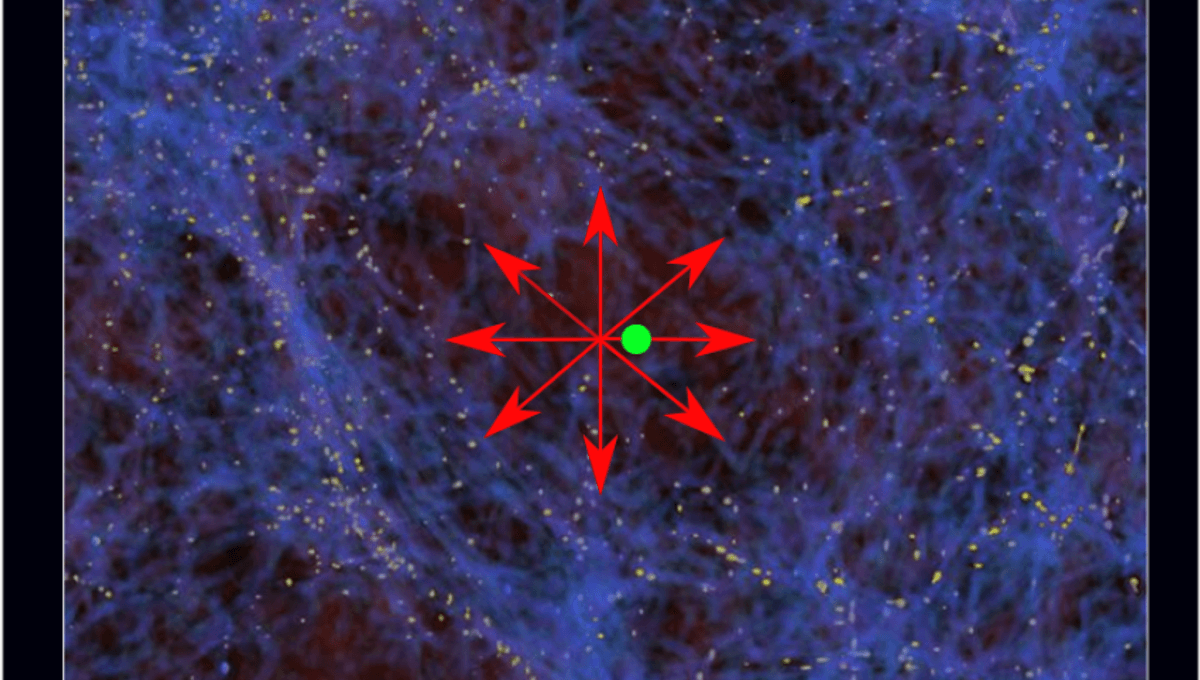
One of the expectations from the standard model of cosmology is that on a large scale, the universe is uniform and homogenous; this means it is all the same. But on smaller scales, under the action of gravity, the galaxies organize themselves in clusters and groups, and those created the cosmic web, a three-dimensional structure made of nodes, strands, and voids. Voids are not exactly empty (actually, the missing matter of the universe is spread there), and lonely galaxies and small groups might end up in one of those. But those galaxies would be pulled out of the void towards the strands and nodes of the web, which would give them an extra acceleration. This is the crux of the argument. Imagine our galaxy, the Milky Way, sitting close to the center of one of these voids. One of the methods to measure the expansion rate tracks the motion of nearby galaxies. If they were indeed being affected by local acceleration, it might explain why and how this value is different from the other expansion rate calculated using the cosmic microwave background. "A potential solution to this inconsistency is that our galaxy is close to the centre of a large, local void," Dr Indranil Banik, from the University of Portsmouth, said in a statement sent to IFLScience. "It would cause matter to be pulled by gravity towards the higher density exterior of the void, leading to the void becoming emptier with time. As the void is emptying out, the velocity of objects away from us would be larger than if the void were not there. This, therefore, gives the appearance of a faster local expansion rate." The proposal is intriguing, but in a way, it also puts the standard model of cosmology at risk. If this was indeed the reason for the discrepancy, this local void would have a density 20 percent below the universe's average – well below what is expected from the model. In the research presented today at the National Astronomy Meeting in Durham, UK, Dr Banik showed that there are observations that are consistent with the idea of such a deep void; namely, the number of galaxies around us and the peculiar Baryonic Acoustic Oscillation, the “sound” of the Big Bang. As the universe expanded and cooled, the vibrations present in the primordial plasma got frozen in time. These oscillations can now be seen in the density of regular matter in the universe, and according to the research, the measurements are consistent with our local group of galaxies being in a void. The team is planning to independently verify these observations using alternative methods, such as galaxies that stopped forming stars. These can be used as a stopwatch for the expansion of the universe. If these too suggest that a void scenario is possible, it would be a very interesting finding. The research was presented today at the National Astronomy Meeting 2025.

 English
 Arabic
 Spanish
 Portuguese
 Deutsch
 Turkish
 Dutch
Dutch
 Italiano
 Russian
 Romaian
 Portuguese (Brazil)
 Greek
Greek