


Seventyfour/Getty Images
When you eat a donut from a bakery or a dedicated donut shop, there's no denying the deliciousness. Sadly, that's not always the case for store-bought versions, which might be perfectly fine but not amazing. Even homemade donuts, when made by anyone with limited experience, don't always live up to those lofty standards.
So, why are donuts better from a bakery? I spoke with three experts to find out. Kaitlyn Venable is executive chef at Shipley Do-Nuts, so has extensive experience with these sweet treats. Mindy Crosato is a professional baker and owner of Decadent Creations, with donuts sitting among her specialties. Jürgen Davis is the director of pastry research and development at the Institute of Culinary Education, so not only does he know how to make great donuts, but he also teaches others to do so. Thanks to their years of experience and impressive knowledge, I got to the bottom of the differences between bakery donuts and others, and why that matters.
Sure, this is going to go into why donuts from a bakery taste better, and it's never a bad idea to pick up one made by a professional. However, if you're looking to improve your own homemade donuts, you'll also get some practical expert advice. So, if you're wondering why your homemade or store-bought donuts never stack up to bakery versions, here's why.
Professionals understand the importance of ingredient quality
Addictive Stock/Getty Images
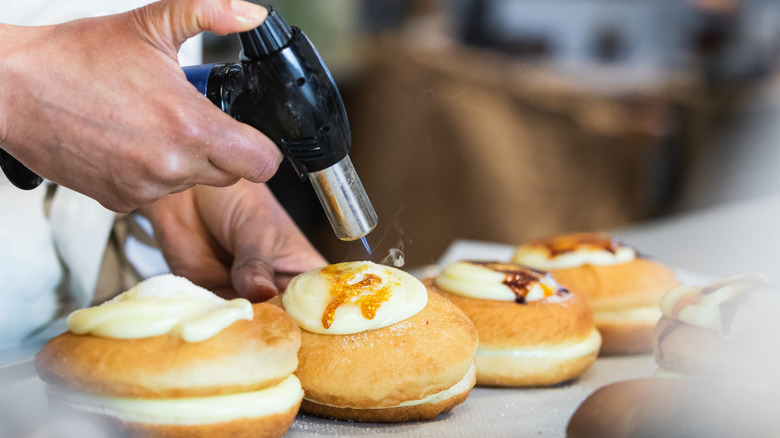
When you buy from a donut shop or a bakery, the folks producing your donuts are likely to be serious about ingredient quality. Bakers know that even basic ingredients make a difference to the finished product, and these are people dedicated to their craft. Grocery store donuts, on the other hand, are often produced as cheaply as possible, with little thought to the quality of ingredients, while those baking at home might just use whatever they have to hand.
"There are relatively few ingredients in donuts, which leaves little room for poor quality ingredients and stresses the importance of high quality ones," says chef Kaitlyn Venable. Jürgen Davis agrees. "Get good eggs, get good butter, get good flour," advises the Institute of Culinary Education's Jürgen Davis. These might seem like the kind of basics that don't make a difference, but high-quality butter and locally sourced free-range eggs may make a big difference to the flavor compared to cheaper, lower-quality versions. Davis notes that unbleached flour is a better choice than bleached flour, while Mindy Crosato of Decadent Creations specifically recommends Caputo 00 red label flour.
You should also be mindful of the quality of anything you add for extra flavor. "Instead of buying a fake vanilla extract, use real vanilla bean or buy a fancy vanilla extract that is not imitation stuff," says Davis. He also recommends using lemon zest in place of lemon oil and, for filled donuts, make your own jam to take them to the next level.
Bakers know about the different types of donuts
Tamer A Soliman/Shutterstock
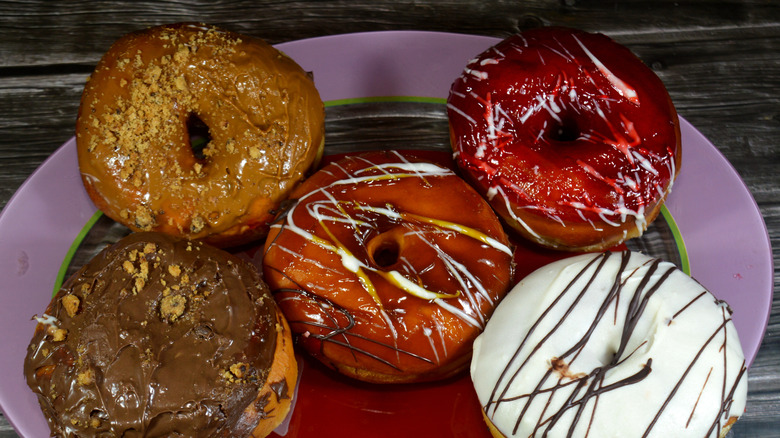
When you go to a bakery, there'll be no confusion over the types of donuts. Bakers know the difference between cake donuts and yeasted donuts and will choose the best one to achieve the desired flavor or texture. When people make donuts at home, some don't realize there's a difference and end up with a donut style different from the one they were aiming for. Store-bought donuts are often made for longevity, and details like yeasted versus cake come second to that consideration.
Jürgen Davis explains that there are two main types of donut: cake and yeast-risen. As the name suggests, yeasted donuts are risen using, well, yeast, similar to bread. Meanwhile, cake donuts use chemical leaveners, such as baking powder and soda. Davis uses a brioche-like dough for yeasted donuts, while in a cake donut, he notes that there is usually egg and sour cream or another kind of dairy, and the mixture is higher in sugar and fat.
So, what difference does this make to the finished donuts? Well, cake donuts have a denser texture than yeasted ones and tend to be sweeter and more flavorful. If you're a fan of an old-fashioned donut, this is a variety of cake donut. Yeasted donuts are lighter and fluffier, with less flavor in the dough, so they rely more on toppings and fillings for flavor. While some people consider cake donuts inferior, they're just two different varieties, and good bakers know how to do each justice.
Donuts from a bakery are made with proper temperature control
Nyaaka/Shutterstock
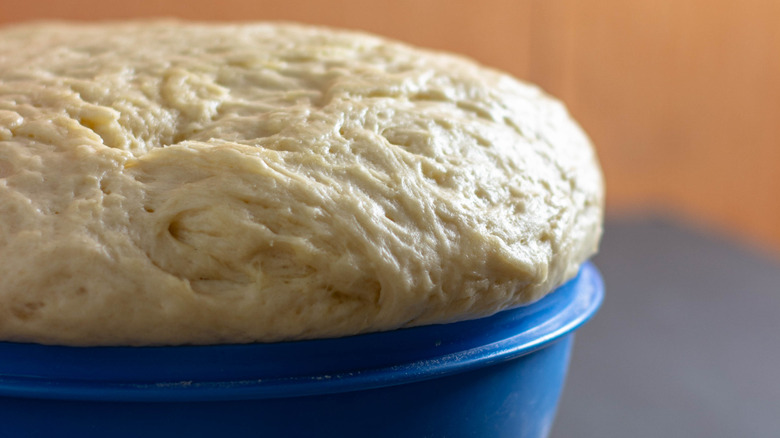
When you're making donuts at home, you might not realize how important temperature control is from the start of the process, particularly with yeasted varieties. This can really make or break a recipe, and is a common reason why homemade donuts don't turn out as expected. The professionals have it covered, though, and this is part of why they consistently get great results.
Kaitlyn Venable tells us that "proper water temperature, frying temperature, [and] dough temperature" are all important. The water temperature is where it starts for yeasted donuts. If it's too hot, it will kill the yeast, and your dough won't rise. If it's too cold, this affects the dough temperature, and it will take longer to proof.
A longer proofing time isn't necessarily a bad thing for anyone who knows the signs to look for to tell when the dough has finished proofing, but it does mean you can't rely on the recipe's timing. If you use cold water and follow the recipe's proofing time precisely without using your own judgment, your donuts will be underproofed, leaving them dense rather than light and fluffy. This will also be the case if you leave the dough somewhere cool to rise; the whole process will just take longer. On the other hand, warm water and a very warm proofing spot speed things up, and this can give you overproofed dough. You might think this would just give you even puffier, fluffier donuts, but eventually overproofed dough collapses in on itself, which, again, can lead to denseness.
Bakery donuts are given plenty of time to rise and develop
YF Hakim/Shutterstock
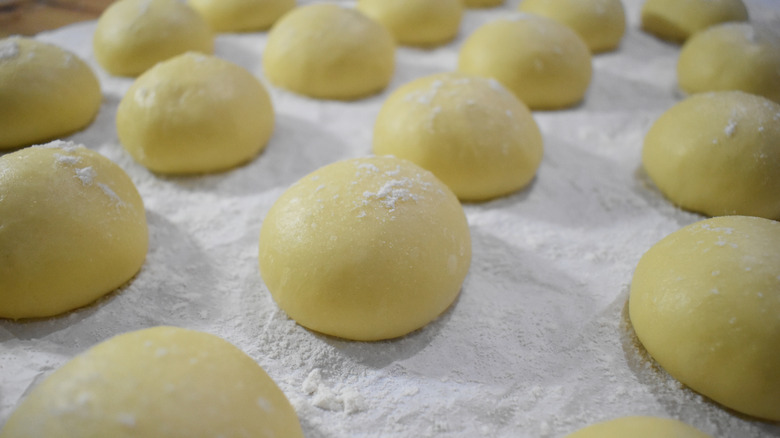
When you're following a homemade donut recipe, you might end up rushing things. After all, who doesn't want their donuts sooner? Grocery store donuts are also made as quickly and efficiently as possible. But hurrying donuts along doesn't do them any favors. Bakers know how important it is to give them the proper time they need, and this makes their donuts better.
According to Jürgen Davis, donut dough needs to "ferment slowly." He recommends making it a day in advance so that it has time to rest. Sure, this means that you need to plan ahead, particularly for yeast-raised donuts, but it's worth the effort. You're probably not whipping up a batch of donuts on a whim, anyway, so you can factor this time into your plans.
A couple of things happen when donut dough is given the time it needs. One is that the dough can rise properly. Without this time, you won't get the air pockets trapped throughout the dough, meaning your donuts will end up unpleasantly dense. We're not talking cakey dense, but more like a brick of dough. The time also affects how they taste. As Kaitlyn Venable puts it, "Small-batch bakeries use natural fermentation to build flavor." During slow proofing, a more nuanced, almost sourdough-like flavor develops, and you end up with a more complex donut, not just a sweet, bready one.
Professionals are dedicated to the craft and have their own tips and tricks for perfect donuts
Seventyfour/Getty Images
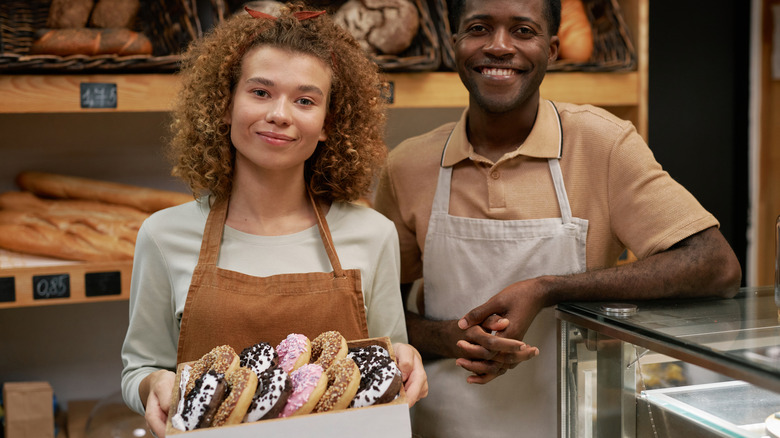
A big part of why bakery donuts are better is that professional bakers just care more. This is a profession that calls for early mornings and hard work — and, in many cases, not particularly high pay — so the people who do it tend to be doing it for the love of the craft, and it shows. They have made thousands of donuts and developed their own methods and special ingredients to make theirs stand out. Home bakers might be interested in making something tasty, but they don't have the same level of dedication.
As Jürgen Davis notes, professionals in small bakeries "take the time to probably play around with the recipe, to get the formula correct, to get the proportions correct." Kaitlyn Venable agrees, saying it comes down to dedication to the craft. "A dedicated donut shop optimizes every single variable — from water temperature during the mix, to the exact humidity of the proofer, to the second the donut is flipped in the oil," she explains.
While perfecting their recipes, bakers can come up with interesting tips and tricks you wouldn't think to use at home. For instance, Mindy Crosato adds mashed potatoes to her dough to help keep it soft. "Potato creates extra moisture and this wonderful bouncy, kinda squishy texture that holds better throughout the day than standard donuts," she tells us.
Bakeries have equipment that home bakers don't have access to
PeopleImages/Shutterstock
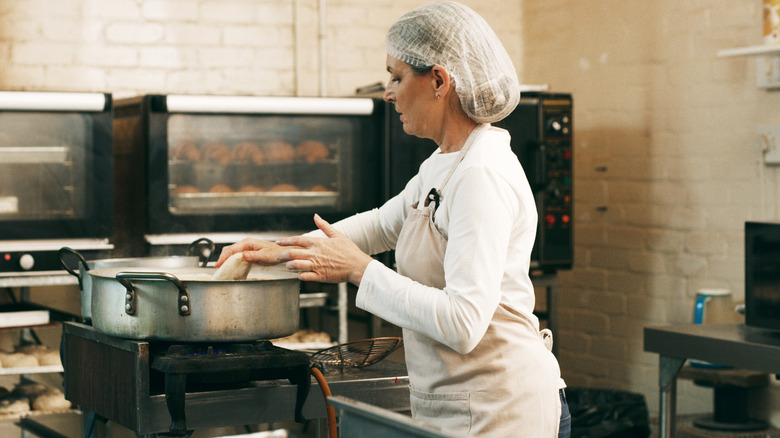
Sometimes, when baking at home, any shortcomings aren't necessarily the result of poor technique or using the wrong ingredients, but from not using the same high-end equipment you'd find in a bakery. While you can make great donuts at home, the truth is that it's often trickier without professional equipment. So, if your shaping's a little off or you don't get the most even golden finish, give yourself a break.
Kaitlyn Venable explains that commercial kitchen equipment generally requires less recovery time and retains a "more consistent environment" than people can manage at home. For instance, commercial fryers can recover more quickly from a temperature drop when you add donuts to the hot oil, which means you don't lower the temperature of the oil and end up with a soggy donut. Bakeries usually have proofers or other controlled environments. All this helps to get consistent results.
"Commercial kitchens generally have large work tables and more space than a home kitchen," Venable adds, noting that this makes production easier. When you've got more room for shaping, proofing, filling, decorating, and so on, it's simpler to get things right every time.
Bakers know how to make a well-balanced donut
thaweerat/Shutterstock
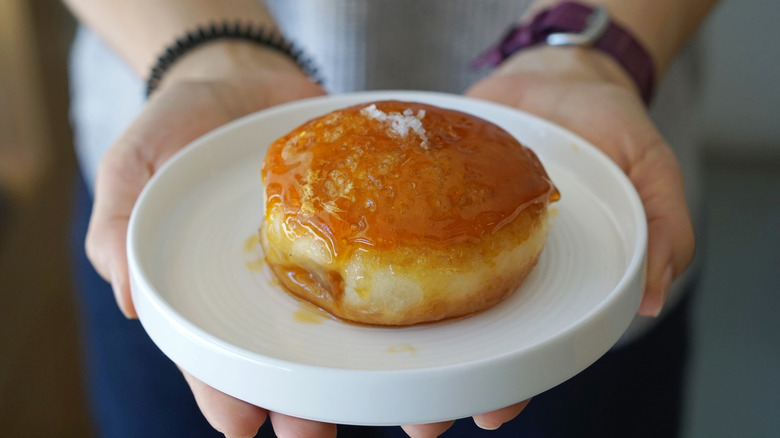
Have you ever eaten a donut that was just a bit mid? Maybe it wasn't necessarily bad, but it fell flat in a way that made it entirely unmemorable. Well, this is the case with many store-bought and homemade donuts, and it's down to balance. Bakers know how to make a well-balanced donut, but a lot of people don't.
"A great donut is balanced in sweetness, feels light rather than heavy, and makes you want to immediately take a second bite," Kaitlyn Venable remarks. A common complaint she has with many donuts is the glaze. "[It's] aggressively sweet, and it leaves a heavy, greasy film on the roof of your mouth," she says. This can be down to a lack of balance. You can also run into donuts that are too oily or fatty, which also desperately need balance.
"Acid, bitterness, and salt help balance the sugar and sweetness levels," says Venable. Jürgen Davis recommends adding a small amount of salt to the dough, while Mindy Crosato mentions pairing a maple glaze with a little smoked sea salt for balance. You can also help balance saccharine sweetness or heavy oiliness with something tart. Adding buttermilk or sour cream into the dough, for instance, or getting some sour notes from lemon or lime.
Professionals know the right oil to fry in
BJ Day Stock/Shutterstock
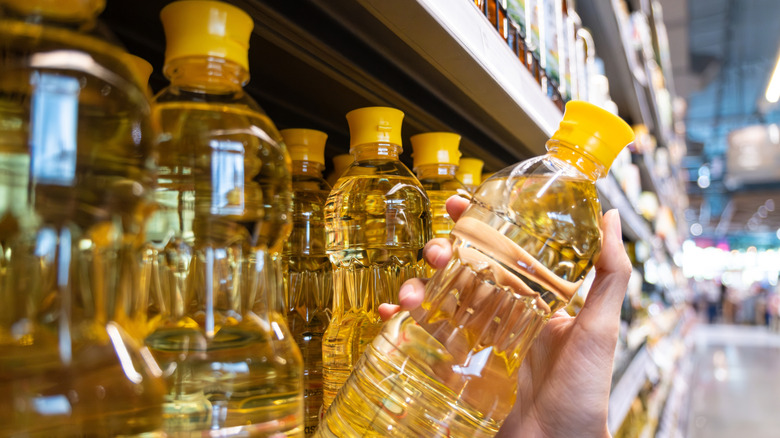
One of the common mistakes people make with deep frying is using the wrong oil. This is often an issue with homemade donuts in particular, because folks are likely to use whatever oil they have in the house, not realizing it could affect the results. Luckily, it's a simple fix.
When choosing an oil to fry donuts, you not only need to think about the flavor (neutral is best) but also how it responds to heat. Mindy Crosato recommends corn, grapeseed, or peanut oil for frying. "Do not use canola unless it's canola 'frying oil,' which has been food science modified to handle higher temperatures," she tells us. "Standard canola has a terrible fishy quality at fry temperatures."
Jürgen Davis also stresses the importance of choosing a neutral oil. "I wouldn't really fry in an olive oil, for example, because that's gonna have its own flavor profile," he tells us. He also notes that butter isn't suitable for frying because of its high water content. Like Crosato, he cites corn oil as a prime contender for donuts. Once you've used oil for frying donuts, you can strain out any particles and keep it for next time. This is one way to help reduce waste.
Donut makers are confident with frying
Bryan Sierra/Getty Images
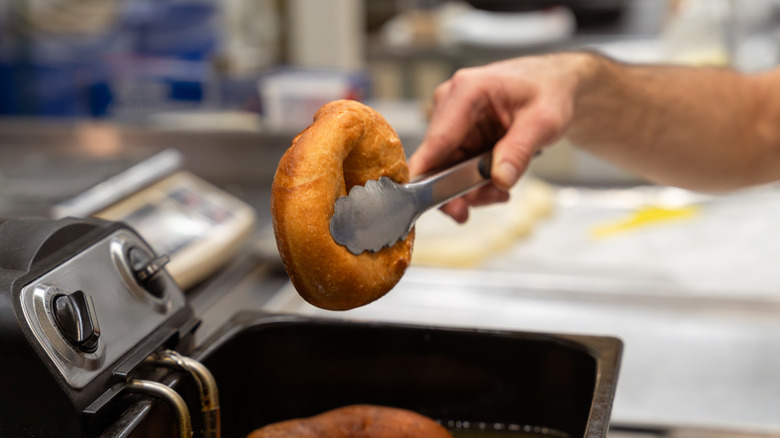
People who make donuts for a living are confident with frying. In comparison, a lot of home bakers are typically more inexperienced, which can lead to mistakes. There are air fryer donut recipes, and some people bake their donuts instead of frying, but neither method will give you that classic donut finish. We'd recommend getting comfortable with frying if you want to make great donuts, or else come to terms with the fact that your local donut shop will always do it better.
According to Mindy Crosato, when she teaches cooking classes, frying is the thing her students have the biggest issues with. She notes that keeping the oil temperature consistent is important. "In a professional setting, we inherently have a larger volume of oil, which naturally resists temperature fluctuations," she says. "When frying at home, I would use a candy thermometer pinned onto the side of a hefty pot."
Jürgen Davis agrees that temperature control is important. "If it's not hot enough, the oil is going to get absorbed by the item and you have something really super greasy — it will absorb the oil," he says. "If it's too hot, then it will burn your stuff and it will not cook to the center," he adds. Between 350 and 375 degrees Fahrenheit is usually the sweet spot. Another mistake Davis notices is not using enough oil. He recommends a depth of around 4 to 4.5 inches, with "an equal amount of rim of the pot above it to contain any splatter." With too little oil, your donuts won't cook evenly.
Donuts from a bakery are fresh and less packed with preservatives
Alena Kravchenko/Getty Images
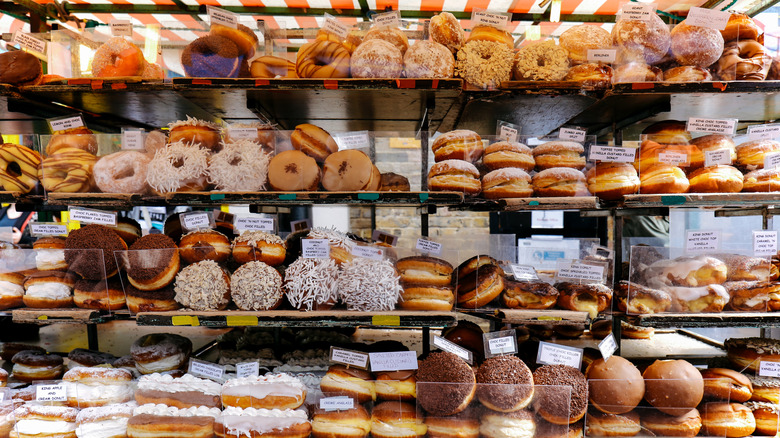
One of the reasons why bakery donuts are so delicious is that they're fresh. Grocery store offerings may have been sitting around for days or weeks and are often full of preservatives to make this possible. You can, of course, enjoy fresh donuts at home, but if you're not cooking for a crowd, you're unlikely to eat a whole batch in one day, and then you've got stale donuts on your hands.
Freshness matters a great deal, according to Kaitlyn Venable. "Just like any other bread product, they will stale over time," she says. "This is one reason why Shipley only [sells] donuts made that day." The same typically can't be said for store-bought donuts. "Mass-produced donuts are built for shelf-life," Venable tells us. "They rely heavily on chemical dough conditioners, artificial flavorings, and preservatives so they can be shipped and sit on grocery shelves for days."
Jürgen Davis notes that independent bakeries will often only work in small batches. They'll make as much as they think they'll sell, and then when they're out, they're out. It might be disappointing when you rock up to your favorite donut shop and see that your go-to sweet treat is done for the day, but we certainly prefer that option over ones that are mass-produced and disappointing on all fronts.
Professional bakers may experiment more with flavors
tiffy6380/Shutterstock
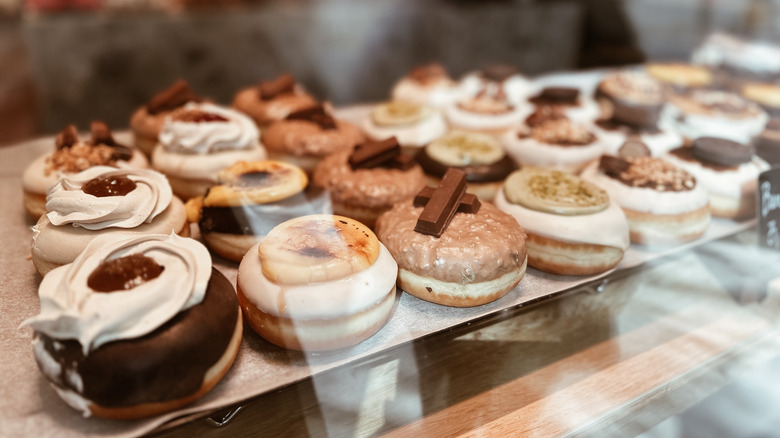
When you buy donuts from a supermarket, you'll notice the same old options coming up. Glazed, frosted with chocolate or vanilla, jelly-filled, covered in powdered sugar — you often won't find much else beyond that. Professional bakers, however, love to experiment with flavors. They might get inspiration from donuts around the world, from seasonal or local ingredients, or they might just want to try something wacky. Whatever the reason for their flavor combinations, you're more likely to find something interesting.
"When playing with donut flavors, it's by far the easiest to change up the glaze with different liquid substitutions like fruit purees, liquors, or extracts," says Mindy Crosato. "Dry low volume additions are the easiest to add directly to the donut dough recipe, like spices or tea powder," she adds. So, there are plenty of opportunities for bakers to add interesting flavors — and that's something that's perfectly replicable at home. We understand you might want to start with the basics, but once you've mastered the basic techniques, you can get to experimenting.
"To make it stand out in its flavor combination, play with the fillings and the glazes," Jürgen Davis advises. He's a proponent of homemade jelly fillings, which lets you experiment with fruits that wouldn't be easy to find at the grocery store. He also suggests experimenting with starch vegetables, like pumpkin or sweet potato, or adding cocoa to the dough to make chocolate donuts. If you opt for the latter, just be sure to adjust your recipe's moisture levels accordingly, as the cocoa powder will absorb some of the batter's liquid.

 English
 Arabic
 French
 Spanish
 Portuguese
 Deutsch
 Turkish
 Dutch
Dutch
 Italiano
 Russian
 Romaian
 Greek
Greek