


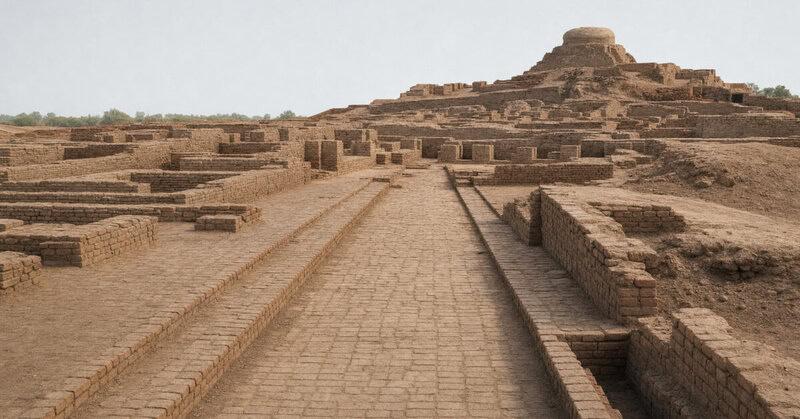
Walk the streets of Mohenjo-daro as they looked around 2500 BCE — straight lanes wide enough for ox-carts, covered brick drains running beneath the pavement, granaries stocked against the dry season — and you will notice, with a slow and deepening unease, what is missing: there is no palace, no throne room, no royal tomb, no monument to a single, towering ego.
A City With No Kings

Archaeologists have spent a century excavating Mohenjo-daro and its sister city Harappa, and they have yet to find the kind of evidence that defines other ancient civilisations — the pharaoh’s pyramid, the Mesopotamian king’s ziggurat reaching toward the sky. The Indus Valley Civilisation, it seems, ran itself on some other principle entirely. Whether that principle was a council of merchants, a priestly oligarchy, or something we have no modern category for, nobody knows. The silence is not empty; it is charged, like a room someone has just left.
The scale of this mystery is worth sitting with. At its peak, the civilisation that grew along the Indus River and its tributaries stretched across an area larger than ancient Egypt and Mesopotamia combined. Hundreds of settlements, two great cities, a standardised material culture that ran from the Himalayan foothills to the coast of what is now Gujarat — and yet the civilisation has told us almost nothing about itself in its own voice. The script its people carved onto small soapstone seals remains undeciphered. Their cosmology, their politics, their very names are lost. What survives is the extraordinary, mute evidence of how they lived.
That evidence is more than sufficient to astonish. Uniform brick sizes appear across settlements separated by hundreds of miles, implying coordinated regulation across a vast territory. Covered sewage drains ran beneath city streets. A large public bath complex at Mohenjo-daro — the Great Bath — was constructed of tightly fitted, waterproofed brick and may have served ritual as well as practical purposes. Grain stores point to a managed food supply. Standardised weights and measures found at multiple sites suggest a common system of trade and accounting. The whole enterprise radiates a civic seriousness that feels, across the millennia, almost startlingly contemporary — and makes the absence of any identifiable ruler all the more confounding.
Deep Roots: When the First Farmers Broke Ground

To understand how cities like Mohenjo-daro were even possible, you have to travel back roughly nine thousand years and five hundred miles northwest, to a place called Mehrgarh on the Kachi plain of what is now Balochistan. Around 7000 BCE, something decisive happened here. Communities began settling — not following herds across the grassland, but staying. They planted barley and wheat. They shaped river clay into vessels and fired them into some of the subcontinent’s earliest pottery. Children were born inside four mud-brick walls and grew up knowing one horizon.
Try to imagine what that choice felt like: the first farmer who looked at the seasonal flood-plain and saw, instead of a temporary campsite, a permanent home. Every nomadic instinct would have said move on. She stayed. That decision — multiplied across hundreds of individuals across generations — was the seed from which India’s first civilisations grew.
The geographical logic was powerful. The Indus River and its tributaries offered South Asia a gift comparable to what the Nile gave Egypt: seasonal floods that retreated to leave behind nutrient-rich silt and the quiet miracle of predictable harvests. By around 4500 BCE, settled life had spread outward from those early Balochistan communities across a broad arc of South Asia, from river valleys to coastal plains, weaving together hundreds of communities across a vast and varied landscape. The ground was being prepared — literally and culturally — for something unprecedented.
The Indus Valley Civilisation: A World Built on Order

The Indus Valley Civilisation stands alongside Mesopotamia and ancient Egypt as one of three places on Earth where humanity independently developed urban life on a large scale. That company matters. It means that what happened in the Indus basin was not borrowed or imported — it was an original human experiment, a genuinely independent answer to the question of how large numbers of people can live together.
And the answer the Indus people arrived at was, above all else, orderly. By 2500 BCE, Harappa and Mohenjo-daro had reached populations that some estimates place in the tens of thousands each — rivalling the great cities of Mesopotamia at the same period. Their streets followed a broadly grid-like orientation. Their bricks conformed to consistent proportional ratios across sites hundreds of miles apart. Their material culture — pottery styles, seal iconography, unit weights — showed a degree of standardisation across the entire civilisation that remains one of the most discussed puzzles in South Asian archaeology.
Yet the civilisation’s inner life is sealed away behind its undeciphered script. Hundreds of distinct signs appear on small carved seals, on copper tablets, on pottery — a script that scholars have studied for over a century without reaching a consensus on its language or its meaning. We can see the Indus people’s world with remarkable clarity; we simply cannot hear them. Their religion, their laws, whatever stories they told their children at night — all of it remains locked.
The end, when it came, was not dramatic. There was no burning, no sudden conquest, no layer of ash marking a moment of catastrophe. Between roughly 1900 and 1700 BCE, the great urban centres were gradually, almost quietly, abandoned. Leading theories focus on climate shift — a prolonged aridification across the region — and the apparent drying or course-changes of rivers that had sustained the agricultural surplus on which urban life depended. The people did not disappear; populations dispersed, moving eastward toward the Gangetic plain and southward. But the cities they left behind were never rebuilt to their former scale. An entire civilisation dissolved back into the landscape, leaving its drains intact and its name unknown.
The Fog of Time: Why Ancient Indian Chronology Is So Hard to Pin Down

Here is something professional historians acknowledge that popular accounts often skip over: there is no reliable continuous chronology of Indian history until roughly the 7th-6th centuries BCE. No unbroken royal annals. No near-unbroken sequence of dated inscriptions comparable to those of Egypt or Mesopotamia. The ancient Indian intellectual tradition measured time not in linear years but in vast cosmic cycles — ages within ages, each running for vast periods — a framework sublime in its ambition and genuinely difficult for the archaeologist trying to date a potsherd or a dynasty.
Compare this with Egypt, where stone stelae record the names and deeds of pharaohs in a sequence stretching back to around 3100 BCE, or with the Greco-Roman world, where administrative record-keeping gives historians dates precise enough to argue about individual months. Ancient India offers no such scaffold. What it offers instead are the combined results of archaeology, comparative linguistics, ancient DNA analysis, and the careful internal study of ancient texts — disciplines that sometimes illuminate each other beautifully and sometimes produce conclusions that sit in open tension.
The honest framing is not failure but frontier. Ancient India is still being actively discovered. The next excavation, the next analysis of ancient DNA recovered from a burial site, the next remote-sensing survey that reveals a buried structure beneath alluvial soil — any of these may revise chapters that seemed settled. This is emphatically not a story with a final page.
The Vedic Age: When Sacred Sound Shaped a Civilisation

After the Indus cities faded, the story of the subcontinent shifted eastward toward the Gangetic plain, and it shifted from brick and drain to something altogether more intangible: sound. The Vedic age, running roughly from 1500 to 600 BCE, produced one of humanity’s most remarkable intellectual achievements — a body of sacred verse, the Rigveda foremost among them, memorised and transmitted orally across generations with a precision that would impress a modern archivist. No papyrus, no stone inscription. Just the trained human voice passing an entire cosmology from teacher to student, century after century, with changes policed by the metre and phonology of the verses themselves.
The arrival and spread of Sanskrit-speaking pastoral communities across northern South Asia during this period reshaped the subcontinent’s cultural landscape profoundly. Sanskrit itself — a language of extraordinary grammatical sophistication, later systematised by the grammarian Pāṇini in one of the ancient world’s most rigorous intellectual achievements — became the vehicle for a philosophical culture of remarkable depth. The Upanishads, composed toward the end of this period, asked questions about consciousness, the nature of the self, and the relationship between the individual and the cosmos that still generate serious discussion in philosophy departments. These were not primitive speculations. They were rigorous, systematic, and in many cases genuinely original contributions to human thought.
Society during the Vedic age was organised around a fourfold social order — the varṇa system, comprising priests, warriors, traders, and labourers — that would shape Indian social structure for millennia. The period also saw the composition of the great narrative epics, the Mahabharata and the Ramayana, texts of enormous length and philosophical complexity that wove together mythology, ethics, statecraft, and cosmology into forms that remain living reference points across South and Southeast Asia today.
It was also during this age that the name Bharata — drawn from a legendary king of antiquity — emerged as a designation for the land itself. The name survived every subsequent dynasty, every conquest, every cultural transformation, until it was written into the Constitution of independent India in 1950 as an alternative official name for the country. Some words are old enough to carry civilisations inside them.
The Age of Heterodoxy: Buddha, Mahavira, and the Questioning of Orthodoxy

By the 6th and 5th centuries BCE, the Gangetic plain had become one of the most intellectually turbulent places on Earth. Prosperous urban centres, a diversifying economy, and a growing merchant class created conditions in which received orthodoxies — particularly the authority of Vedic ritual and the priestly class that administered it — came under sustained, serious challenge. The result was an explosion of new philosophical and religious movements that would permanently alter the course of Asian history.
The most consequential was the teaching of Siddhartha Gautama, known as the Buddha — the Awakened One. Born into a noble family in what is now southern Nepal, Gautama renounced his privileged life, pursued intensive meditative and ascetic practice, and arrived at a set of insights about the nature of suffering and the path to its cessation that he then spent decades teaching across the Gangetic plain. His core diagnosis — that suffering arises from craving and attachment, and that liberation is available to anyone willing to follow the Eightfold Path, regardless of birth or ritual status — was a radical democratisation of spiritual possibility. Buddhism spread from India across Central, East, and Southeast Asia, shaping the cultures of China, Japan, Korea, Tibet, Thailand, Sri Lanka, and Cambodia, among many others. It remains one of the world’s major religions.
At roughly the same time, Vardhamana Mahavira was systematising the Jain tradition, with its radical commitment to non-violence toward all living beings — a principle, ahimsa, that would echo forward through Indian thought and resurface, transformed, in the 20th century in the political philosophy of Mahatma Gandhi. The 6th and 5th centuries BCE in India were, in other words, an Axial Age moment: a period when entirely new frameworks for understanding human life emerged and proved durable enough to organise civilisations for the next two and a half millennia.
The Mauryan Empire: India’s First Continental State
By the 4th century BCE, the subcontinent’s political landscape had grown complex enough to produce its first pan-Indian empire. Around 322 BCE, a young man named Chandragupta Maurya — aided, according to tradition, by the strategist Kautilya — seized control of the Magadha kingdom in the Gangetic heartland and began, with extraordinary speed, to stitch together a state of genuinely continental scale. Within a generation, the Mauryan Empire controlled territories stretching from the Hindu Kush in the northwest to the Bay of Bengal in the east, encompassing most of the Indian subcontinent.
The administrative architecture was formidable. Kautilya’s Arthashastra — a treatise on statecraft and economic policy that is one of the most sophisticated political texts produced anywhere in the ancient world — describes a professional bureaucracy, a network of royal roads, standardised weights and measures, and an organised intelligence service. The Mauryan state was not a conquest held together by terror alone; it was a managed polity with institutions designed to outlast any individual ruler.
Its greatest figure was Chandragupta’s grandson, Ashoka, who came to power around 268 BCE. Around 261 BCE, Ashoka’s armies fought a devastating campaign against the kingdom of Kalinga on India’s eastern coast. The carnage — described in Ashoka’s own words carved into rock faces across the empire — broke something in the king. He converted to Buddhism, renounced conquest as a tool of statecraft, and spent the remainder of his reign carving edicts of compassion, justice, and religious tolerance onto pillars and rock surfaces from Afghanistan to southern India. He sent Buddhist missionaries outward across Asia and reportedly dispatched envoys to the courts of Hellenistic rulers in the Near East and Egypt. It was among history’s earliest experiments in the deliberate projection of ideas rather than armies.
The connection to the present is direct and visible. The lion-capital pillar that Ashoka erected at Sarnath — four lions seated back to back above a wheel-carved abacus — serves today as the national emblem of India. The Dharma Chakra, the wheel of law from that same pillar, spins at the centre of the Indian national flag. Ancient India is not merely past; in the most literal constitutional sense, it is present.
After the Mauryas: Classical India and Its Global Reach
The Mauryan Empire fragmented after Ashoka’s death, but the centuries that followed were far from an interlude. The Gupta period, running roughly from the 4th to the 6th centuries CE, is often described as a classical age — a period of synthesis in which earlier strands of Indian thought, art, mathematics, astronomy, and literature were brought to a maturity whose influence radiated well beyond the subcontinent.
The mathematical achievements of this era deserve particular emphasis, because they restructured how the entire world counts. Indian mathematicians formalised the concept of zero as a number in its own right — not merely an absence or a placeholder, but an entity with which arithmetic operations could be performed. They developed the decimal place-value system that is the foundation of virtually all modern mathematics and computation. These ideas travelled westward through the medieval Islamic world, reaching Europe as what we now call Arabic numerals — though their ultimate origin was the Indian subcontinent. The algorithm running on every digital device on Earth is a remote descendant of mathematical thinking developed in ancient and early medieval India.
In medicine, the texts of Charaka and Sushruta — which describe diagnostic categories, pharmacological treatments, and surgical procedures including rhinoplasty and cataract surgery — represent a tradition of systematic clinical observation that was among the most sophisticated in the ancient world. In astronomy, Indian scholars made precise calculations of planetary motion and the length of the solar year. In literature, the poet and playwright Kalidasa composed works of such refined elegance that he is routinely described as the Shakespeare of Sanskrit — a comparison that, whatever its limitations, conveys the scale of the achievement.
Trade networks carried Indian goods, ideas, and religious traditions across the Indian Ocean to Southeast Asia, East Africa, and the Arabian Peninsula — and returned with influences that fed back into Indian culture in turn. The subcontinent was not an isolated laboratory; it was a major node in a connected ancient world.
Why Ancient India Still Matters: The Long Echo
The name India itself is a gift from the ancient world. It flows from Sindhu, the Sanskrit name for the Indus River, carried westward through Persian as Hindu, borrowed by the Greeks as Indos, passed into Latin and then into virtually every European language. Every time the word is spoken — in any country, in any context — it carries inside it the memory of a Bronze Age river where some of humanity’s earliest urban planners laid out streets we still cannot fully explain.
But ancient India’s most durable export was never material. It was ideas. Zero. The decimal system. Philosophical frameworks concerning the nature of consciousness and the structure of reality. The principle of non-violence toward living beings. Medical and surgical techniques documented in texts that influenced Islamic and, through that transmission, European medicine. These are inheritances that restructured how humanity counts, heals, and thinks — often without the people who benefited from them knowing where the inheritance originated.
New excavations, advances in ancient DNA analysis, and remote-sensing technologies capable of detecting buried structures beneath dense vegetation or alluvial deposits are actively revising our picture right now. The Indus script has not been deciphered. Significant sites across the subcontinent almost certainly remain undiscovered. Every new find opens as many questions as it resolves.
The most honest and most exciting thing that can be said about ancient India is this: after two centuries of serious archaeological and historical inquiry, we are still in the early chapters of understanding what happened there. The streets of Mohenjo-daro run straight and silent, the drains still intact, the city still declining to explain itself fully. Whatever principle held it together — whatever idea of community, authority, or shared life made those bricks line up so precisely across so vast a territory — it is still, patiently, waiting to be heard.

 English
 Arabic
 French
 Spanish
 Portuguese
 Deutsch
 Turkish
 Italiano
 Russian
 Romaian
 Portuguese (Brazil)
 Greek
Greek