


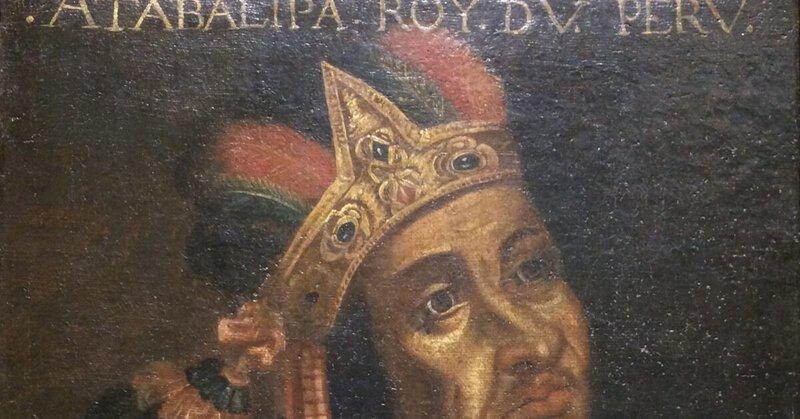
He raised his arm as high as it would reach and drew a line across the stone wall of his prison cell. Fill this room with gold up to that mark, he told his Spanish captors, and fill two more rooms with silver — and you will set me free. His captors agreed. The gold came. And then they killed him anyway.
Born Into a World That Believed Its Rulers Were the Sun

Atahualpa — also spelled Atahuallpa — was the son of the Inca emperor Huayna Capac and a secondary wife from the northern province of Quito. That detail of birth, the fact that his mother was not the principal queen, would eventually ignite a civil war and crack an empire open. But in the years of his youth, Atahualpa grew up inside one of the most extraordinary civilizations the Western Hemisphere had ever produced.
The Sapa Inca — the title meaning “Unique Lord” — was not merely a king. He was understood to be a direct descendant of Inti, the sun god, a living deity whose authority was not political but cosmic. Across an empire of roughly 12 million people stretching some 2,500 miles along the spine of the Andes, his word carried the weight of the universe itself. This was Tawantinsuyu, the Four Quarters of the World — a civilization that had built an extraordinary road network threading through some of the most inhospitable terrain on earth, developed vast storehouses capable of feeding armies and cities through years of drought or war, and woven a bureaucracy held together not by written documents but by knotted strings called quipus, which encoded numerical and possibly narrative information in ways scholars are still working to fully decode.
Atahualpa was the last Sapa Inca to rule as a free man. Understanding why requires understanding the fault line his birth created — and the catastrophe that fell upon his world from the outside before he ever had the chance to consolidate it.
Brother Against Brother: The Civil War That Cracked the Empire

Around 1527, Huayna Capac died — most likely from a smallpox epidemic racing invisibly ahead of Spanish explorers along South American trade routes, killing perhaps a third to half the population before Europeans arrived in force. He left behind a succession crisis as destabilizing as the disease itself. His designated heir, Huáscar, ruled from the traditional Inca capital of Cusco in the south. Atahualpa, who had won his father’s trust commanding armies in the north, controlled Quito and its battle-hardened forces. Neither man was willing to yield.
What followed was nearly five years of brutal civil war. Atahualpa’s generals proved ferocious and effective. They eventually routed Huáscar’s forces, captured Huáscar himself, and carried out purges so thorough they erased entire royal lineages — family members, supporters, and anyone who might carry a rival claim were systematically killed. It was consolidation through annihilation, and it left the empire exhausted and quietly hemorrhaging at precisely the moment a new threat was approaching from the coast.
By 1532, Atahualpa had emerged as the undisputed ruler of the Inca world. He was celebrating his victory near the city of Cajamarca when the strangers arrived.
Eighty Men with Steel and Guns: The Trap at Cajamarca

Francisco Pizarro commanded fewer than 200 men — around 168 by most careful estimates — deep inside a continent of millions. By any rational military calculus, his expedition should have been an irrelevance, a minor intrusion easily brushed aside. What he had instead of numbers were horses, steel armor, firearms, and a ruthlessness calibrated to exploit exactly the kind of moment that was about to unfold.
On November 16, 1532, Atahualpa agreed to meet Pizarro in the town square of Cajamarca. He came in full imperial splendor — carried on a litter, surrounded by thousands of attendants, many of them unarmed or ceremonially equipped at best. This was not a war party. It was a display of magnificence, the living sun granting an audience to curious visitors from the coast. The idea that these few dozen strangers posed a serious military threat would have been almost incomprehensible to anyone in that procession.
Pizarro had hidden his soldiers and artillery around the plaza. He sent a Dominican friar, Vicente de Valverde, forward to present Atahualpa with a Bible and demand that he submit to the Spanish crown and accept Christianity. Atahualpa — sovereign ruler of an empire that had no reason to recognize Spanish authority, encountering a bound paper object whose spiritual significance meant nothing to him — reportedly examined the Bible, could not hear the words attributed to it, and set it aside. Valverde called for the attack.
The assault was overwhelming and almost incomprehensibly fast. Cannons fired into the crowd. Cavalry charged through thousands of unarmed attendants. Spanish soldiers moved through the chaos with steel blades while the Inca forces, who had no horses, no firearms, and no psychological preparation for anything resembling this kind of violence, died in enormous numbers. In roughly half an hour, an emperor was in chains, thousands of his people were dead or wounded, and the central pillar of Inca civilization — the invincibility, the divinity, the cosmic permanence of the Sapa Inca — had been shattered in a single afternoon.
The Ransom: Gold Poured In, Freedom Never Came

Even in captivity, Atahualpa was not passive. He was a man who had spent years reading power and locating its pressure points, and he understood quickly what the Spanish wanted above all else. His offer was staggering in its scale: one room — approximately 22 feet long and 17 feet wide — filled with gold as high as a man could reach, and two similar rooms filled with silver, all delivered within two months.
The treasure came. From across the empire, streams of gold and silver converged on Cajamarca — golden statues, ceremonial vessels, the gilded walls of temples, sacred objects accumulated over generations, all melted down into anonymous ingots. It represented one of history’s great destructions of irreplaceable cultural material, an artistic and spiritual catastrophe measured in bars of metal. Historians estimate the ransom amounted to roughly 13,000 pounds of gold and 26,000 pounds of silver — the largest ransom in recorded history.
While the treasure accumulated, Atahualpa continued to govern from his cell as best he could. He issued orders, received reports, and made at least one fateful decision: he commanded the execution of his brother Huáscar, reportedly fearing the Spanish might recognize Huáscar as the more legitimate claimant and use him as a puppet to control the empire from within. It was a coherent political calculation and a profound moral catastrophe, and it would later be recycled as one of the formal charges against him.
As the gold piled up, something shifted among the Spanish leadership. Rather than satisfying them, the treasure’s sheer scale revealed the true dimensions of what lay before them. A free Atahualpa, able to command millions of subjects across thousands of miles, was not a defeated enemy — he was an existential threat to everything Pizarro was beginning to understand he could take.
A Trial Built to Reach One Verdict

In July 1533, with the ransom largely delivered, Pizarro convened a tribunal. The charges against Atahualpa included treason against the Spanish crown, idolatry, polygamy, and the murder of Huáscar. The proceedings moved quickly toward their predetermined conclusion.
The treason charge was, by any coherent legal standard, absurd. Atahualpa was the sovereign ruler of an independent civilization that had never acknowledged Spanish authority, signed no treaty with Spain, and owed no allegiance to the Spanish crown. He could not commit treason against a power he had never been subject to. Contemporary sources — including accounts from some of Pizarro’s own men — recorded visible unease with what was unfolding. One of Pizarro’s most prominent officers, Hernando de Soto, reportedly protested the proceedings and was deliberately sent away from camp while they concluded.
Intelligence had reached the Spanish that substantial Inca forces were converging on Cajamarca. Whatever the legal theater suggested, Pizarro’s real motive was strategic: executing Atahualpa eliminated the one man who could coordinate a unified military response and provide the empire’s resistance with a symbolic and practical center of gravity.
Atahualpa was offered a choice between being burned alive as a pagan or being strangled if he accepted Christian baptism. He accepted baptism, took the Christian name Juan Santos Atahualpa, and was executed by garrote on July 26, 1533. He was somewhere in his late twenties or early thirties. He had reigned, as a free man, for less than a year.
What Died With Him — and What Survived

With Atahualpa gone, the Spanish installed a succession of puppet Sapa Incas — men of Inca blood who wore the title while real authority drained steadily across the ocean to Spain. Within decades, the Inca administrative system — the roads, the storehouses, the relay runners, the quipu records — had been dismantled, disrupted, or absorbed into the colonial economy. A civilization that had engineered buildings still capable of surviving major earthquakes through sophisticated dry-stone construction, developed techniques for freeze-drying food at altitude, and sustained millions of people across one of the world’s most demanding landscapes was transformed within a generation into a colonial labor pool.
The loss of knowledge alone is staggering. Because the Inca kept no written records in the European sense, the destruction of the quipu-keepers and the administrative class meant that vast repositories of information — census data, histories, agricultural knowledge, astronomical records — vanished without recovery. Even Atahualpa’s tomb has never been conclusively located, leaving his physical end as unresolved as so much else about what was lost in those years.
Yet something survived. Within Andean oral tradition, Atahualpa became not a defeated king but an enduring symbol of a world violently stolen — a sovereignty that had been real and might yet be restored. His story seeded the myth of Inkarri, a prophecy that the Inca king, dismembered and scattered, would one day be made whole again and the world turned right-side up. The myth remains alive in Andean communities today, carried not through manuscripts but through memory and ceremony across five centuries.
The sharpest irony of Atahualpa’s story is also its final truth: the gold that was supposed to ransom an emperor instead confirmed to his captors the staggering wealth of everything he ruled. His greatest act of faith — his belief that a promise kept would be honored in return — became the instrument of his civilization’s undoing. He kept his word. He filled the room. And it made no difference at all.

 English
 Arabic
 French
 Spanish
 Portuguese
 Turkish
 Dutch
Dutch
 Italiano
 Russian
 Romaian
 Portuguese (Brazil)
 Greek
Greek