


Somewhere in a café, a curious traveler opens a laptop and types “mayan empire map” into a search engine, expecting something like the maps they remember from school — bold borders, a capital city ringed in red, arrows of conquest radiating outward like spokes on a wheel. What comes back is a patchwork of colored regions sprawling across five modern countries, and no matter how long they stare at it, the borders never quite make sense. That’s because they’re looking for something that never existed.
The Map That Doesn’t Exist — And Why You Keep Imagining It
No ancient Maya scribe ever drew a border around a “Mayan Empire.” No king ever claimed sovereignty from the Yucatán Peninsula to the highlands of Honduras. The map most people picture — a single political entity, color-coded and continuous — is, at best, a geographic range showing where Maya people lived, and at worst, a historical fiction dressed up in dramatic cartography. Every search for a tidy Mayan empire map runs into the same inconvenient truth: the thing itself never existed.
And yet what the Maya did build is arguably more fascinating than any empire. For roughly 3,000 years — across what is now southeastern Mexico, all of Guatemala and Belize, and stretching into parts of Honduras and El Salvador — dozens of rival city-states rose, warred, traded, and collapsed without a single ruler ever uniting them under one crown. The absence of an emperor isn’t a failure of the Maya story. It is the Maya story.
Why Historians Reject the Word “Empire”

The word “empire” carries specific political weight. An empire requires centralized authority: a capital that commands, distant territories that obey, and tribute flowing inward to a single ruler’s treasury. By that definition, the Maya world at no point in its long history qualifies. There was no Maya equivalent of Rome, no single city that dictated terms to all others, no bureaucracy stretching from the Gulf Coast to the Pacific lowlands.
This is why scholars who study Maya civilization consistently reach for different language — “civilization,” “world,” “region” — rather than “empire.” The distinction isn’t academic hair-splitting. The political structure of the Maya was decentralized by design, not by accident or underdevelopment. City-states governed themselves, forged their own alliances, waged their own wars, and worshipped their own patron gods. The political architecture they chose was in many ways more complex than simple imperial hierarchy.
The contrast sharpens when you set the Maya beside a civilization that genuinely was imperial. The Aztec Triple Alliance — centered on Tenochtitlan in the Valley of Mexico — extracted tribute from conquered peoples across central Mexico, maintained detailed tax records, and projected military power through a command structure that answered ultimately to one ruler. The difference between the Maya and the Aztecs isn’t a matter of scale or success; it’s a matter of fundamental political architecture. The Aztecs built an empire. The Maya built something else entirely.
City-States: The Real Architecture of Maya Power

At its peak during the Classic period, roughly 250 to 900 CE, the Maya world was a landscape of competing powers that would feel familiar to anyone who has studied ancient Greece or Renaissance Italy. Cities like Tikal, Calakmul, Palenque, Copán, and Caracol each maintained their own royal dynasties, standing armies, and ritual calendars. Alliances formed and dissolved. Wars erupted over trade routes, captives for sacrifice, and the prestige of a great king’s name.
The rivalry between Tikal in northern Guatemala and Calakmul in southern Mexico defined Classic Maya politics the way the Cold War defined the twentieth century — two superpowers circling each other for centuries, neither capable of delivering a knockout blow, each pulling smaller cities into their orbit as proxies. It was geopolitics without a map anyone today would recognize as imperial.
For a vivid illustration of how Maya power actually worked, consider what happened in 738 CE near the modern border of Honduras and Guatemala. The great city of Copán, ruled by a king known to scholars as 18 Rabbit — one of the most celebrated rulers in Maya history — was defeated in battle by the much smaller city-state of Quiriguá. Its king was captured and beheaded. A minor city had taken the head of a great one. There was no emperor to appeal to, no higher authority to restore order. Each city stood or fell on its own terms. That is not an empire. That is a world of sovereigns.
Understanding this is essential to any honest account of Maya civilization: the story of individual city-states is the real story, and it is more violent, more surprising, and more human than any flattened narrative of imperial rise and fall could ever be.
Reading the Real Map: Five Countries, Thousands of Years

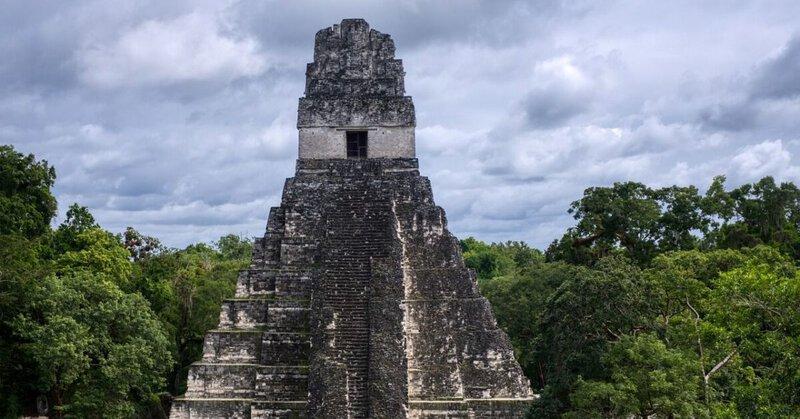
If you want to trace the true footprint of Maya civilization, start in the north, on the dry limestone shelf of Mexico’s Yucatán Peninsula, where Chichén Itzá once dominated the post-Classic landscape with its vast colonnaded halls and its famous stepped pyramid. Move south into the rain-forested lowlands of the Petén region in Guatemala, where Tikal’s temple-pyramids still pierce the jungle canopy. Veer east into Belize, where Caracol grew powerful enough to ally with Calakmul and humiliate Tikal in the sixth century. Drop further south into the river valleys of Honduras, where Copán’s sculptural tradition produced some of the finest stone carving in the pre-Columbian world. And continue west into El Salvador, where sites such as Tazumal mark the southwestern reach of Maya cultural influence.
Five modern countries. One ancient civilization. The borders cutting across it today were drawn by sixteenth-century Spanish colonizers who arrived more than a millennium after the height of the Classic Maya period — lines on a map imposed over a world that predated them by thousands of years.
What held this sprawling region together wasn’t political control but ecological interdependence. Jade came from Guatemala’s highlands. Obsidian — the volcanic glass essential for blades and ritual objects — moved south from sources in central Mexico. Cacao, prized as both currency and sacred offering, grew in the Pacific coastal lowlands. No single city controlled all of these resources, which meant that trade, not conquest, was the rational strategy. Cities needed each other too much to absorb each other entirely. The Maya world was knit together by commerce and culture in ways that a tribute empire would actually have disrupted.
The Maya and the Aztecs: Why the Comparison Matters

The contrast becomes most vivid at the moment of European contact. When Hernán Cortés arrived at Tenochtitlan in 1519, he walked into something unmistakably imperial: a capital city of perhaps 200,000 people, larger than any city in contemporary Europe, where a single ruler — Moctezuma II — presided over tax collectors, standing armies, and an administrative network reaching across central Mexico. Cortés understood immediately that toppling Moctezuma meant inheriting his empire. He was right. The Aztec state fell in 1521.
The Maya presented an entirely different problem. By 1519, the Yucatán Peninsula was a mosaic of competing post-Classic polities. The regional dominance of Mayapán — itself never a true empire, but at least a significant hegemon — had already collapsed in the 1440s after internal revolt. The Spanish did not find one Maya empire to conquer. They found dozens of separate, proud, and independently armed polities, each requiring its own campaign. The full military subjugation of the Maya took the Spanish nearly 170 years, ending only in 1697 with the fall of Nojpetén in the Petén lake district of Guatemala. An empire falls at once when its capital falls. A constellation of city-states must be extinguished, point by point.
This is precisely why any Mayan empire map misleads: it implies a political unity that would have permitted one decisive conquest. The true map of Maya political power cannot show borders the way a map of the Aztec empire legitimately can, because those borders, in the Maya case, never existed. What it can show is something far more complex — a web of relationships, rivalries, and regional powers that defies easy cartography.
How the “Empire” Myth Was Born — And What It Costs Us

The myth has a traceable origin. In 1839 and 1840, the American explorer John Lloyd Stephens and the British artist Frederick Catherwood traveled through the Yucatán and Central America and emerged with something that stunned the Western world: detailed documentation of monumental ruined cities — soaring pyramids, intricate stone carvings, hieroglyphic inscriptions that no one could yet read. The architecture was so vast, so clearly the product of enormous organized effort, that European and American audiences assumed it must be the remnant of a great empire, something comparable to Rome or Egypt.
That assumption was also convenient. A lost-empire narrative allowed the colonial imagination to sever the ruins from the living people. If the builders were a vanished imperial race, then the Maya descendants whom Stephens and Catherwood actually encountered — still farming, still speaking Maya languages, still performing ceremonies — could be viewed as somehow disconnected from that grandeur. It was easier to romanticize a phantom empire than to reckon with a living civilization that colonialism had brutalized but never erased.
The cost of the myth is real and ongoing. It collapses the extraordinary diversity of Maya history and culture into a single blunt label, erasing the astronomers of Copán, the scribes of Palenque, the military strategists of Caracol, and the merchants of Chichén Itzá into one anonymous “empire.” It erases the rivalries that drove innovation, the individual rulers whose personalities shaped their cities, and the ongoing, unbroken presence of Maya people in the modern world. It also, not incidentally, makes the history less interesting than it actually is.
Three Things That Actually Unified the Maya World
If political sovereignty never unified the Maya, three powerful forces did — and recognizing them transforms how you read any map of the region.
A shared writing system. The Maya developed the only fully elaborated writing system in pre-Columbian America, a complex script of logograms and syllabic signs capable of recording history, poetry, astronomical observation, and political propaganda with equal sophistication. Literate elites across the entire region used variants of this script, creating a network of textual culture that transcended any individual city’s boundaries.
A shared calendar and cosmology. Maya calendar calculations, including the 365-day solar calendar and the 260-day ritual calendar, were used consistently across the civilization. Their astronomical observations — tracking Venus cycles, solar eclipses, and lunar periods with remarkable precision — reflected a shared cosmological framework that gave different cities a common intellectual vocabulary even when they were at war with each other.
Long-distance trade. The movement of jade, obsidian, cacao, salt, feathers, and finished goods across hundreds of miles meant that merchants, goods, and ideas circulated continuously through the Maya world. Trade routes created relationships that diplomacy and warfare alone could not sustain. Economic interdependence was, in a real sense, the invisible infrastructure of Maya civilization.
What the Maya Actually Built — A Civilization Worth the Correct Name
Strip away the phantom empire and what remains is genuinely staggering. Maya monumental architecture — pyramids, palaces, ballcourts, astronomical observatories — was constructed without metal tools and without the wheel, by engineering ingenuity and organized labor on a scale that still impresses structural engineers today. Their agricultural systems, including raised-field farming in wetlands and sophisticated terracing in the highlands, fed millions of people in terrain that would challenge most modern planners.
And none of it ended. Maya civilization spans roughly 3,000 years of continuous history — far longer than the Roman Empire. Today, millions of people of Maya descent live across southern Mexico, Guatemala, Belize, Honduras, and El Salvador, still speaking dozens of distinct Maya languages, still practicing cultural traditions with deep pre-Columbian roots. The civilization did not collapse. It was colonized, suppressed, and partially destroyed — and it survived anyway.
The mental image worth carrying forward isn’t a bold-bordered empire on a map. It’s something more like a constellation — dozens of bright, distinct points of light, each with its own gravity, its own ruling dynasty, its own particular genius. These cities argued with each other, warred with each other, and sometimes beheaded each other’s kings. They also traded jade and obsidian and ideas across hundreds of miles, shared a writing system, tracked the same stars, and worshipped gods they all recognized. They were bound together by culture, language, and shared cosmology — but never, not once, by a single crown.
The next time a search for a Mayan empire map returns those familiar colored regions sprawling across five countries, consider what that map is really showing: not the domain of one ruler, but the footprint of one of humanity’s greatest and most enduring experiments in civilized life — decentralized, contentious, brilliant, and very much alive.

 English
 Arabic
 French
 Spanish
 Portuguese
 Deutsch
 Turkish
 Dutch
Dutch
 Italiano
 Romaian
 Portuguese (Brazil)
 Greek
Greek