


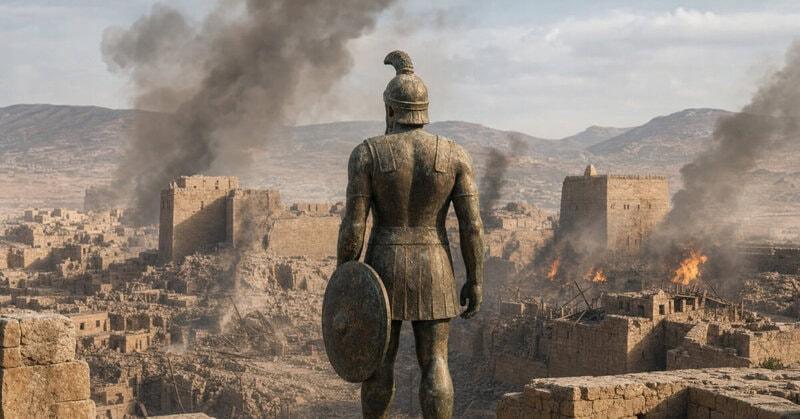
Imagine an entire interconnected world — trading empires, palace bureaucracies, diplomatic letter-writers, armies clad in bronze — and then imagine it gone, most of it within a single human lifetime. That is roughly what happened around 1200 BCE, and the Bronze Age collapse remains one of the most haunting unsolved puzzles in all of recorded history. But to understand why that collapse was so devastating, you first have to understand what the Bronze Age actually built — and how fragile the foundations beneath it really were.
What Was the Bronze Age, and When Did It Happen?

The Bronze Age is defined by the widespread use of bronze — an alloy of copper and tin — as the dominant material for tools, weapons, and armor. It followed the Neolithic (New Stone Age) and the Chalcolithic, or Copper Age, making it the third distinct phase of material-culture development across Europe, Asia, and the Middle East. Globally, it is broadly dated from approximately 3500 BCE to 1200 BCE, though those boundaries shift considerably depending on geography.
Parts of the Near East crossed into bronze-working as early as 3500 BCE, while Britain and much of northern Europe did not reach that same technological threshold until around 2000 BCE — a gap of fifteen centuries. Some regions of sub-Saharan Africa and the Americas never experienced a Bronze Age in the traditional sense at all. The Bronze Age is therefore a technological label rather than a synchronized global clock. Within that vast timeframe sit the invention of writing, the construction of the Egyptian pyramids, the era of the Trojan War, and dozens of other civilizational milestones — all of them technically “Bronze Age.” In Britain, the era ran as late as roughly 700 BCE, ending only when iron-smelting technology matured enough to displace bronze from everyday use.
Why Bronze Was a Revolutionary — and Fragile — Material

Pure copper is relatively soft and loses its edge quickly under hard use. Alloying it with tin produces a metal hard enough to hold a weapon’s cutting edge or tip a plow reliably. That difference mattered enormously: bronze tools and weapons replaced earlier stone versions, marking the first time humans systematically worked with metal alloys rather than naturally occurring materials.
Earlier stone and copper tools were shaped from substances you could pick up, recognize, and work directly. Bronze required something more abstract: the understanding that combining two metals could create a third thing that neither metal was on its own. That conceptual leap — intentional alloying — established the template for materials science that still underpins modern manufacturing. In a very real sense, every engineer who has ever combined elements to create a superior material is working in a tradition that began when an ancient smith first mixed copper and tin and watched the result harden into something new.
But bronze carried a structural vulnerability baked into its chemistry. Copper and tin almost never occur in the same place naturally. That geographic mismatch meant that every Bronze Age civilization was, from the very beginning, dependent on long-distance trade just to manufacture its defining material. Tin sources in the ancient Near East were especially scarce, and some supply lines stretched thousands of miles across mountain passes, deserts, and open sea. The system worked beautifully when it worked — but it was also brittle. A civilization that cannot source tin cannot make bronze, cannot equip its armies, and cannot maintain the palace economy that holds everything together.
How Bronze Age Civilizations Actually Functioned

At their height, Bronze Age palace economies were sophisticated administrative machines. Palace complexes in Mycenaean Greece, Hittite Anatolia, and the Levantine city-states employed scribes who tracked inventories in careful detail — rations of grain, lists of craftsmen, records of tribute owed and paid. The Linear B tablets recovered from sites like Pylos and Knossos are essentially accounting records, and they reveal economies organized around redistribution: the palace collected agricultural surplus and raw materials, then disbursed them to specialists, soldiers, and dependent workers.
These civilizations were also deeply interconnected. Diplomatic correspondence between the Egyptian pharaohs and other Near Eastern kings — preserved in the Amarna Letters — shows rulers exchanging gifts, arranging marriages, and negotiating trade agreements across vast distances. Bronze Age internationalism was real, sophisticated, and remarkably durable for several centuries. It was also, as events would prove, dangerously interdependent.
A Whole World Vanished in About 50 Years

Between roughly 1200 and 1150 BCE, the Mycenaean Greeks, the Hittite Empire, the kingdom of Ugarit, and Egyptian power in the Levant all fell or sharply contracted within the same narrow window. Palace economies that had hummed along for centuries simply stopped — their administrators, their scribes, their carefully maintained storerooms all disappearing from the archaeological record as though a curtain had been drawn. Some cities were abandoned and never rebuilt. Historians describe the pace as “very fast,” which in archaeological terms is almost alarming.
No single universally agreed-upon cause has ever been identified, which is part of what makes the late Bronze Age collapse so maddening — and so fascinating — to scholars even today.
Nobody Can Fully Agree on What Caused It

The list of suspects reads like a disaster film’s screenplay: invasions by the mysterious “Sea Peoples,” prolonged drought that starved agricultural systems, internal rebellions by overtaxed populations, devastating earthquakes, and the collapse of the long-distance trade networks that bronze itself depended upon. Each theory has genuine evidence behind it, and each has genuine holes.
Most modern scholars now favor a “systems collapse” explanation — a cascade of interlocking failures where each new stress made the next catastrophe easier to trigger, rather than one decisive blow felling everything at once. Paleoclimatological research published in recent decades has strengthened the drought hypothesis considerably, with pollen core samples and other proxies indicating a prolonged dry period across the Eastern Mediterranean beginning around 1200 BCE. But drought alone does not explain the collapse of the Hittites, whose heartland in central Anatolia was less dependent on the same Levantine agricultural systems. The fact that the Bronze Age collapse struck so many unconnected regions simultaneously is precisely what makes any single-cause explanation so hard to sustain.
Egypt Survived — Barely — While Everyone Around It Collapsed

Egypt is one of the only major civilizations of the late Bronze Age that did not completely collapse around 1200 BCE — but “survived” is doing a lot of work in that sentence. The Egypt that emerged from the crisis was severely weakened and never recovered its former imperial reach in the Levant. Pharaoh Ramesses III recorded desperate battles against the Sea Peoples during this period, and his temple inscriptions at Medinet Habu provide some of the only written testimony of what the collapse actually looked like from inside a civilization trying to hold on.
After about 1150 BCE, Egypt contracted inward. It lost reliable access to its Nubian gold sources, its treasury strained under military costs, and it entered a long era of internal division and competing dynasties. Egypt was a diminished survivor of the collapse, not a victor — a civilization that had weathered the storm but would never again cast the same shadow across the ancient world.
Ugarit Sent a Letter Describing Its Own Destruction — and Never Received a Reply

Few archaeological finds capture catastrophe as viscerally as what excavators uncovered at Ugarit, on the Syrian coast. The city was destroyed around 1185 BCE, and in its ruins lay unfinished clay tablets — including a desperate diplomatic letter describing enemy ships attacking the coast and begging for military aid. The letter was still in the kiln when the city fell, preserved for over three thousand years precisely because the catastrophe interrupted its firing and delivery.
No reply ever came. Ugarit was never rebuilt or reoccupied as a major city. It makes the site one of the cleanest archaeological snapshots of the late Bronze Age collapse available — a city frozen mid-sentence, a civilization caught in the act of dying and preserved in that exact moment by the disaster itself. The tablets read less like ancient history and more like a distress call that arrived too late.
What the Bronze Age Left Behind

The Bronze Age gave humanity intentional alloying, literate palace bureaucracies, long-distance trade networks, and diplomatic systems sophisticated enough to sustain correspondence across thousands of miles. Writing — invented in Mesopotamia during this era — began as an accounting tool and became the medium through which law codes, religious texts, and literature were first recorded. Many of the institutional patterns that later civilizations inherited, from taxation to treaty-making, were worked out during the Bronze Age’s long run.
Then, in one of history’s most dramatic contractions, much of the interconnected Eastern Mediterranean world fell apart within a generation or two. The collapse was not the end of human civilization — populations survived, knowledge persisted in fragments, and the Iron Age that followed eventually produced new empires of its own. But the specific, dense, palace-centered world that bronze had made possible was gone. Archaeologists and historians are still arguing over the wreckage, and the questions the Bronze Age’s history and collapse raise — about how interconnected systems fail, about what makes civilizations resilient or fragile — feel considerably less ancient than they once did.

 English
 Arabic
 French
 Spanish
 Portuguese
 Deutsch
 Dutch
Dutch
 Italiano
 Russian
 Romaian
 Portuguese (Brazil)
 Greek
Greek