


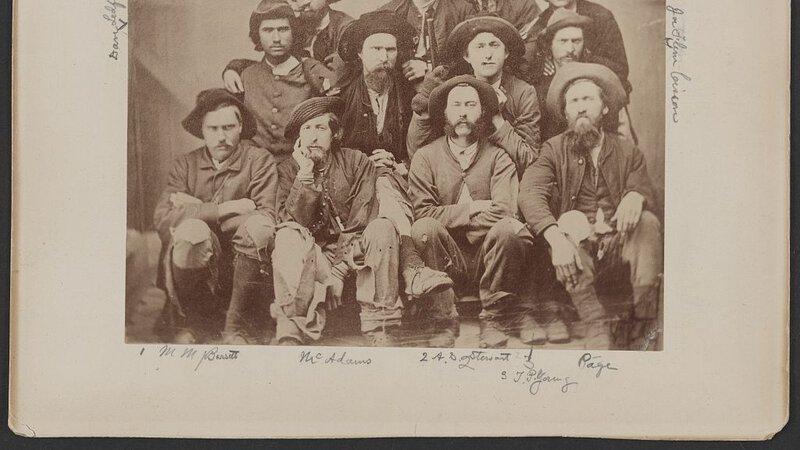
In the autumn of 1864, the trenches outside Petersburg, Virginia, had become something close to hell on earth — men sleeping in mud, living on rotting rations, watching their regiments dissolve wound by wound. Somewhere in that catastrophe, a young Confederate soldier from the mountains of western North Carolina made a choice that his family would spend generations hiding: he walked away.
The Man Behind the Myth — and the Film That Found Him
That soldier’s name was W.P. Inman, and for most of the twentieth century he was exactly the kind of person history forgets — a deserter, a man the postwar South had no use for in its carefully constructed narrative of noble Confederate sacrifice. Then Charles Frazier wrote a novel, and everything changed.
Frazier’s 1997 debut Cold Mountain won the National Book Award and sold millions of copies before Anthony Minghella adapted it into the 2003 epic film, with Jude Law playing the wounded, world-weary Inman and Nicole Kidman as Ada, the woman pulling him home across hundreds of miles of collapsing Confederate territory. For audiences worldwide, the film was a sweeping wartime love story set against ravishing Appalachian landscape. But beneath the romance lay something stranger and darker than the marketing admitted: a documented historical figure whose real fate illuminates one of the Civil War’s most deliberately buried chapters.
Frazier has always been candid about his source. Inman was not invented wholesale — he was rooted in a real great-great-uncle, a man named William Pinkney Inman, who lived in Haywood County, North Carolina, enlisted in the Confederate army, was wounded, deserted, and died before the war ended. The novelist spent years working through pension records, county histories, and the kind of guarded family oral tradition that tends to accumulate around shameful secrets. What he found was a man the historical record had almost entirely swallowed.
Who Was the Real W.P. Inman?

The historical William Pinkney Inman came from the southern Appalachian highlands — a region that looked nothing like the Confederate heartland of plantation Georgia or coastal South Carolina. Haywood County sat deep in the Blue Ridge, a landscape of steep ridges and isolated coves where most families owned no enslaved people and had voted, in many cases, against secession. The war arrived in these mountains not as a cause men believed in but as a conscription notice — an order to go fight and die for a political project that served the planter class far more than it served them.
The fragmentary historical record confirms the broad outlines Frazier used: Inman enlisted, was wounded, deserted, and attempted to make his way back home. He was killed — a fact the novel preserves in its devastating final pages. But the exact circumstances of his death remain murky, disputed within what survives of family memory, and undocumented in any official record that has surfaced. He left no letters, no diary, no written testimony of any kind. For a writer, this is both frustrating and clarifying: the real Inman was a perfect vessel for fiction precisely because history had left him almost entirely empty.
What the historical record does suggest is a man shaped less by the brooding philosophical clarity Jude Law brings to the screen and more by poverty, exhaustion, homesickness, and a mountain culture with profound ambivalence toward the Confederate cause from the very first muster. Real deserters — and there were staggering numbers of them — were rarely driven by clean moral awakening. They were driven by hunger, by letters from starving wives, by watching friends die for ground that would be abandoned the following week, and by the simple calculus of survival.
Confederate Desertion — The Civil War’s Darkest Open Secret

The scale of Confederate desertion is one of those historical facts that tends to startle people raised on Lost Cause mythology. By some estimates, more than 100,000 Confederate soldiers deserted over the course of the war, with the rate accelerating sharply after 1863 as casualties mounted, supply chains collapsed, and early optimism curdled into something bleaker. By the final months, entire units were dissolving as men simply went home.
The Confederate government’s response was brutal and increasingly desperate. Deserters could be shot upon capture. More ominously, the Confederate War Department authorized local Home Guard militias — irregular units of men too old or otherwise exempt to serve in the regular army — to hunt deserters through their own communities. In practice, this meant neighbor hunting neighbor through the same mountain hollows where they had grown up together. The Home Guard in western North Carolina became feared for a level of violence that went well beyond any recognizable military necessity.
The most notorious single incident was the Shelton Laurel Massacre of January 1863, when Confederate troops executed thirteen unarmed men and boys in neighboring Madison County — some barely into their teens — on suspicion of Unionist sympathies and association with deserters. It was not an aberration. It was the logical endpoint of a policy that treated mountain communities as enemy territory within Confederate borders.
Deserters’ families faced a calculated campaign of deprivation as well. Confederate authorities deliberately withheld food relief from the wives and children of men who had fled, a policy designed to pressure deserters to return to their units. The effect was often the opposite: men who heard that their families were starving deserted faster, rushing home to feed children the Confederacy had decided to let go hungry as a matter of military strategy. The cycle of desperation this created — documented in Confederate army records and postwar testimony — is the true historical darkness that Cold Mountain carries beneath its love story.
The Home Guard — Real Terror Behind the Film’s Villains

One of the places where Cold Mountain‘s historical grounding holds most uncomfortably firm is in its portrayal of the Home Guard. In the film, the militia is led by the sadistic Teague — a character whose violence initially reads as dramatic license, the kind of ruthlessness stories use to generate stakes. But Teague and his men are not exaggerations. The documented behavior of Home Guard units in western North Carolina includes torture, summary execution, and the deliberate targeting of women and children to coerce deserters out of hiding.
Historians of Appalachian Civil War history describe what amounted to a civil war within the Civil War across counties like Haywood, Madison, and Yancey — a low-intensity but genuinely savage internal conflict that the triumphalist Confederate memory cultivated after the war had every reason to suppress. Men who had been neighbors for generations were killing each other in the woods over a political question many of them had never wanted to answer in the first place.
This is the world the real W.P. Inman was trying to navigate on his journey home. Not a romantic landscape of noble hardship, but a fractured community where encountering the wrong person on the wrong road could end a man’s life before morning.
What the Film Gets Right — and Where It Softens the Truth

The 2003 film holds up well on the broad historical strokes. The geography of Inman’s journey, the functioning of the Home Guard, the experience of women managing farms and households in the near-total absence of men, and the physical and economic devastation of late-war Confederate society are all rendered with genuine research behind them. Minghella and Frazier were not manufacturing atmosphere — the atmosphere was that bad.
Where the film softens reality is in Inman himself. The screen hero is given a coherent moral arc and an almost mythological gravity — a man who has seen through the war’s lies and is walking toward love and truth. The historical record supports none of that interiority, because the historical record is nearly silent. The real Inman may have been exactly that man. He may equally have been something far more ordinary: simply afraid, simply desperate to survive, driven by forces he could not have articulated in the elevated terms Frazier’s prose provides. The novel is generous enough to hold both possibilities. The film, by necessity, collapses them into one.
The ending — Inman shot down in a final confrontation, dying within reach of home — does honor the darker historical truth. Most Confederate deserters who were caught did not survive, and the real W.P. Inman did not live to see Appomattox. That much the story gets exactly right.
Scholars of the period have noted that Cold Mountain, for all its romanticism, did more to bring public awareness to Southern Unionism and the complex reality of Confederate desertion than decades of academic publishing had managed. It is a rare case of popular fiction doing genuine historical work — returning a suppressed chapter of American history to people who had been taught a very different story about what the war meant in the southern mountains.
Why Inman’s Story Still Matters

The real W.P. Inman sits at the uncomfortable intersection of several histories America has never fully reckoned with: the myth of Confederate unity, the erasure of Appalachian Unionism, and the humanity of men branded as cowards for refusing to die in a cause that served wealthy slaveholders while offering men like him almost nothing in return.
After the war, deserters’ families frequently destroyed or concealed evidence of desertion. The social stigma in communities rebuilding their identities around Confederate veteran honor was crushing and real. Men like Inman were doubly erased — killed young, then written out of family memory, their names carefully omitted from the stories grandchildren were told about what the family had done during the war.
Frazier’s act of literary recovery gave the real Inman something the historical record had denied him: a witness, an audience, and a love story that makes a short, violent life feel significant rather than merely sad and forgotten. But the truest thing Cold Mountain says about the Civil War has nothing to do with romance. It is in the geography — the insistence that the mountains of western North Carolina were never Confederate country in the way Richmond or Charleston were, that the war arrived there as an imposition rather than a calling, and that the men who died on those ridges, on every side of the desertion question, were not symbols. They were individuals caught in forces far larger and more brutal than any ending — Hollywood or otherwise — can fully contain.

 English
 Arabic
 French
 Spanish
 Portuguese
 Deutsch
 Turkish
 Dutch
Dutch
 Italiano
 Russian
 Portuguese (Brazil)
 Greek
Greek