


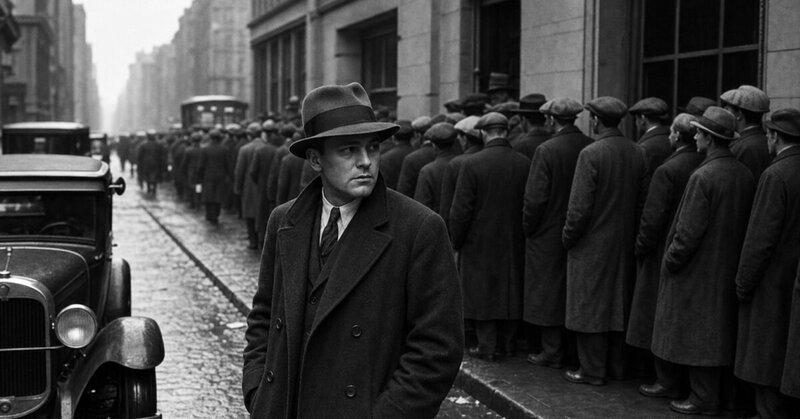
Manhattan, 1933: bread lines snake past the brass doors of jazz clubs, the morning papers scream about a body found floating off the West Side piers, and somewhere uptown a man in a silk suit is deciding which judge to bribe this week. Nobody invented this city. It was already there, stranger and darker than any fiction, waiting for a storyteller willing to look straight at it.
A Depression-Era Stage Already Set for Darkness

That is precisely the stage that Spider-Noir on MGM+ and Prime Video steps onto. Developed by Oren Uziel and starring Nicolas Cage, the series drops Ben Reilly — an aging, down-on-his-luck private investigator who was once the city’s only superhero — into what The Hollywood Reporter calls “an alternate universe version of Depression-era New York City.” The blend of web-slinging action and hard-boiled storytelling the show reaches for is genuinely inventive. But the historical raw material it borrows from — the mob bosses, the institutional rot, the desperate people filling bread lines beneath skyscrapers — is not invented at all. Every major element of Spider-Noir’s grim atmosphere has a documented, often shocking real-world counterpart waiting in the archives. The alternate universe didn’t have to travel very far from the actual one.
The Great Depression Breaks New York First

To understand why 1930s New York feels like a natural home for noir, you have to understand what the Depression actually did to the city at street level. By the early 1930s, roughly one in three New Yorkers who wanted work couldn’t find it. The city’s unemployment rate outpaced the national average, and the municipal government was so cash-starved that teachers in some districts were paid in tax-anticipation warrants rather than actual wages. The machinery of civic life was not merely strained — it was visibly, publicly failing.
The physical texture of the city reflected that failure. Central Park’s Great Lawn hosted a sprawling Hooverville — a shantytown of improvised shelters named with bitter irony after the president who presided over the collapse — and similar encampments lined the banks of the East River. These were not marginal details on the edges of normal life. They were the dominant visual fact of the city: the same rain-soaked, shadow-heavy cityscape that Spider-Noir renders in its production design.
The Depression also did something more insidious than create poverty: it created a credibility vacuum. When the government demonstrably could not feed people, it had no moral authority left to claim it could protect them either. That vacuum had to be filled by something — and in New York, it was filled from below, by men with no interest in justice whatsoever. This is the precise civic rot that makes a lone former superhero grinding out PI work the only figure a neighborhood might trust. The institutional failure is not background flavor in Spider-Noir’s historical setting. It is the load-bearing wall the whole story rests against.
The Real Mob Bosses Who Owned the City

The gangster antagonists a show like Spider-Noir requires are not archetypes pulled from thin air. They are lightly fictionalized versions of men who ate at midtown restaurants, attended prize fights at Madison Square Garden, and appeared in the newspapers by name — because the mob in 1930s New York was not a shadow organization. It was the city’s second government, and it operated in broad daylight.
The architecture of that criminal government had been under construction for years. Arnold Rothstein — already legendary for his alleged role in fixing the 1919 World Series — built the financial and organizational frameworks that would define American organized crime before his murder in 1928. His protégés inherited both his methods and his city. Meyer Lansky, Bugsy Siegel, and others carried Rothstein’s lessons forward into the 1930s, operating as genuine power brokers of Depression-era Manhattan rather than the theatrical villains that popular imagination tends to produce.
Then, in 1931, Lucky Luciano reorganized the American Mafia into what would become known as the Five Families, following the bloody conclusion of the Castellammarese War — a period of internal mob conflict that ended in a wave of assassinations and left Luciano as the dominant figure in New York organized crime. What Luciano built was less like a gang and more like a corporation: structured, rational, and deeply embedded in legitimate industries. The docks, the garment trade, restaurants, and the judiciary were all nodes in the same network. This is the world any 1930s New York crime story inherits whether it acknowledges it or not.
For a street-level view of what mob power actually felt like in Depression-era New York, Dutch Schultz is the essential figure. Schultz ran the Harlem numbers racket — an illegal lottery that functioned as a genuine financial lifeline for the neighborhood’s poorest residents — generating enormous revenue and requiring the bribery of officials at essentially every level of municipal government. He was not operating in the shadows. He was operating through the system, which is what made him so difficult to dislodge and so useful as a model for any noir antagonist who needs to feel genuinely dangerous rather than merely theatrical.
The Hard-Boiled Detective as Historical Figure

Ben Reilly’s role as a private investigator is not simply a genre convention. It is a historically grounded choice. Private investigation in 1930s New York was a genuinely grimy trade — licensing requirements were loose, pay was irregular, and the work ranged from divorce surveillance to union-busting on behalf of corporations that preferred to keep their methods out of a courtroom. The PI occupied a legal gray zone that mirrored almost exactly the moral gray zone that noir fiction would assign him.
That gray zone existed for a structural reason: the NYPD was too deeply compromised to be trusted for sensitive work, and too overextended to handle the volume of need a city in crisis generated. Private operators — whether working for individuals, law firms, or corporations — filled the space that official channels left empty. This is precisely Ben Reilly’s narrative position: the former hero reduced to PI work because the city’s official institutions have failed or been corrupted, and because the people who need help have nowhere else to go.
The literary voice the show adopts has an equally documented historical root. Dashiell Hammett wrote The Maltese Falcon in 1930, drawing directly from his years as a Pinkerton Agency operative — men who were hired precisely because clients didn’t trust or couldn’t access official law enforcement. Raymond Chandler, whose Philip Marlowe novels defined the hard-boiled idiom through the 1930s and 1940s, drew on the same understanding that the detective’s value lay in his willingness to move through a corrupt world without being consumed by it. The world-weary precision and morally exhausted narration that Spider-Noir channels were not invented by writers sitting in comfortable offices imagining a grittier world. They were transcribed from one.
Harlem, Hell’s Kitchen, and the Geography of Noir

One reason the Spider-Noir historical setting resonates so specifically is that 1930s New York was not a single city with a single power structure. It was a mosaic of ethnic and geographic enclaves, each operating under different rules, each with its own informal authority. Hell’s Kitchen ran on Irish gang politics. The Lower East Side carried the legacy of Jewish organized crime figures who had emerged from its tenements. Brooklyn’s waterfront, controlled by the International Longshoremen’s Association under leadership with direct ties to organized crime, was a place where asking the wrong questions got people hurt.
Harlem occupies a particularly complex position in this geography. The Harlem Renaissance was producing some of the most vital cultural output in American history at exactly the same moment the Depression was hitting Black residents hardest. The Cotton Club — arguably the most famous entertainment venue in New York — served exclusively white audiences while the surrounding community faced eviction and poverty that would eventually erupt in the Harlem Riot of 1935. The same neighborhood that gave the world Duke Ellington and Langston Hughes was simultaneously being systematically exploited by white-run numbers operations that Dutch Schultz had muscled his way into controlling.
This contradiction — glamour and desperation occupying the same geography, sometimes the same block — is the exact emotional frequency that noir operates on. A city where a jazz solo floats out of a speakeasy door onto a street where men are sleeping in doorways is already a city that thinks in shadow and light. The documented history of 1930s New York is, in this sense, pre-formatted for the genre.
Tammany Hall and the Corruption That Made It All Possible

No mob empire in 1930s New York could have sustained itself without political protection, and the provider of that protection had a name: Tammany Hall. The Democratic Party machine that had run New York City politics since the nineteenth century was, by the 1930s, so deeply enmeshed with organized crime that the distinction between political infrastructure and criminal infrastructure was largely notional. Judicial appointments, police promotions, licensing decisions — all of it flowed through the same channels, greased by the same money.
Mayor Jimmy Walker, who resigned in 1932 under corruption investigations led by Judge Samuel Seabury, embodied the era’s political style with almost theatrical completeness. Charming, nightclub-haunting, and apparently unbothered by the graft that flowed through his administration, Walker was not an aberration. He was the logical product of a system in which corruption was the operating mechanism rather than a deviation from it.
Fiorello La Guardia’s election in 1933 promised genuine reform, and La Guardia was a genuinely different kind of mayor who pursued organized crime with real determination. But the infrastructure of corruption was too deeply embedded to dismantle quickly. The judges were still in place. The police captains were still in place. The connections between city hall, the courts, and organized crime had been built over decades and could not be undone in a single election cycle. This is what makes Spider-Noir’s specific setting so dramatically rich: the old criminal order was visibly threatened but not yet broken, and in that narrow space of genuine uncertainty, a lone operator with a code and a complicated past becomes not a fantasy figure but a plausible one.
Nicolas Cage and the Weight of the Role
Casting matters enormously in a premise this dependent on texture. Nicolas Cage, who previously voiced the Spider-Man Noir character in the animated film Spider-Man: Into the Spider-Verse, brings to the live-action series a screen presence built on exactly the kind of controlled strangeness the role demands. Ben Reilly is a man who has outlived his era, grinding forward on principle when principle barely pays the rent — a character type that requires an actor capable of projecting exhaustion without surrendering charisma. The critical reception documented at The Hollywood Reporter and audience response tracked at Rotten Tomatoes reflect the degree to which that casting choice either anchors or strains the show’s ambitions, depending on the episode.
Why the 1930s Still Hit Different
The decade endures as noir’s definitive setting because the economic catastrophe of the Depression stripped away every comfortable fiction about meritocracy and fair play. What it left behind was a raw, unmediated view of how power actually works — who accumulates it, who suffers because of it, and what a person of conscience is supposed to do when the systems designed to distribute it fairly have been revealed as fraudulent. These are not abstract questions. In 1930s New York they had specific addresses and specific names attached to them.
Spider-Noir‘s central conceit — an aging man who was once his city’s only hero, now working PI cases in the margins of a city that has moved on — maps precisely onto the decade’s emotional logic. The Depression turned former successes into has-beens overnight, at scale. The city was full of men who had been something once and were trying, with varying degrees of dignity, to figure out what they were now. Ben Reilly is a superhero version of a figure who actually walked those streets.
The neo-noir superhero blend the series attempts only works because the historical scaffolding is genuinely load-bearing. Take away the real 1930s New York — the documented gangsters, the measurable poverty, the photographed bread lines, the recorded corruption — and the fiction has nothing to push against. The darkness becomes decorative. But leave the history in place, and every element of the show finds its footing in something that actually happened, to actual people, in an actual city that already looked like a comic book before anyone thought to draw one. That 1933 Manhattan had everything a storyteller needs: monsters in silk suits, a broken city eating its heroes for breakfast, and enough genuine darkness that an alternate universe version barely had to alter the contrast. The real version was already dark enough.

 English
 Arabic
 French
 Spanish
 Deutsch
 Turkish
 Dutch
Dutch
 Italiano
 Russian
 Romaian
 Portuguese (Brazil)
 Greek
Greek