


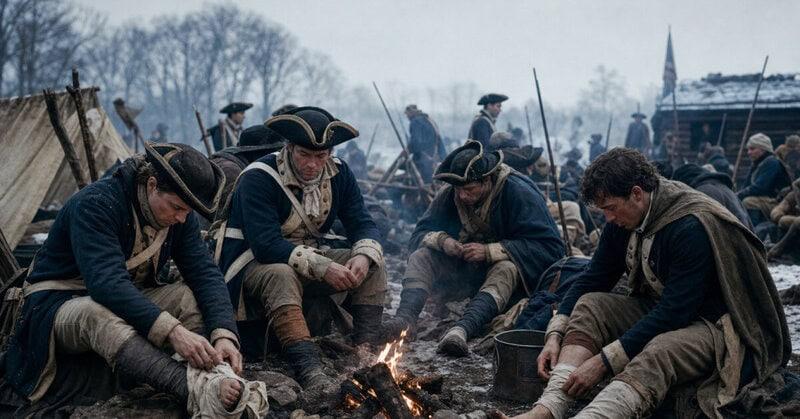
Picture a frozen Pennsylvania night in the winter of 1777: Continental soldiers wrapping rags around bleeding feet, huddled against wind that cut straight through Valley Forge like a bayonet. It is the image most people carry of the American Revolution — desperate, heroic, half-improvised. What that image leaves out is the 19-year-old French aristocrat who had just defied his king, abandoned his pregnant wife, and smuggled himself onto a ship across the Atlantic to join a war in a country he had never visited. That young man was the Marquis de Lafayette, and his story is only the beginning of how strange, contingent, and genuinely astonishing this war really was.
The War That Keeps Surprising Us

The American Revolution is one of the most mythologized events in recorded history, which means it is also one of the most misunderstood. The sanitized version — wise Founding Fathers, virtuous militiamen, inevitable triumph — irons out all the wrinkles that make the real story so much more gripping. Beneath the marble statues and the schoolbook summaries, there are teenage generals, iconic figures sharing the same birthday, a hurricane that reshaped the strategic balance of the war, and a spy network so sophisticated the CIA would later study it with admiration. These are not embellishments. They are verified, documented, and more dramatic than anything a novelist would dare invent. Consider this your invitation to meet the Revolution as it actually happened.
The Founding Fathers Were Younger Than You Think

The Marquis de Lafayette arrived in America at the age of 19. To put that in contemporary terms: he was young enough to need parental permission to rent a car. He was a wealthy French aristocrat, recently married, with every material comfort available to him — and he wanted none of it as badly as he wanted to fight for the American cause. The French crown had explicitly forbidden him from going. His in-laws were furious. He purchased passage anyway and sailed west. When he landed, he wrote to his wife that the country he had just arrived in was “beautiful,” “simple,” and “worthy of the liberty it is fighting to defend” — before he had seen a single battle.
George Washington, who was not easily impressed, made Lafayette a Major General almost immediately. The young Frenchman proved the promotion justified. He was wounded at the Battle of Brandywine, wintered at Valley Forge alongside Washington’s starving army, and — in the war’s final act — played a decisive role in keeping British General Cornwallis pinned in Virginia before Washington could arrive to deliver the killing blow at Yorktown. After the war, Lafayette returned to France carrying American revolutionary ideas like seeds in his coat pockets. He became a principal architect of the Declaration of the Rights of Man in 1789, the document that helped ignite the French Revolution — making him, uniquely, a founding figure of two republics on two continents. This “Who Am I?” quiz from George Washington’s Mount Vernon captures exactly how many revolutionary figures remain half-known to modern readers.
Lafayette was not alone in his youth. James Monroe was 18 years old when he crossed the Delaware River with Washington on Christmas night 1776 and was wounded at the Battle of Trenton. Alexander Hamilton was around 21 when he became Washington’s chief aide-de-camp, essentially running the general’s correspondence with the energy of someone who had absolutely nothing to lose. The Revolution was, in a very real sense, a young person’s war — fought by people who had not yet learned that the things they were attempting were supposed to be impossible.
The Continental Army: Both Enormous and a Revolving Door

The popular image of the Continental Army is a ragged band of farmers with muskets, vastly outnumbered and outgunned, somehow holding on through sheer grit. The reality is considerably more complicated, and considerably more interesting. Approximately 230,000 soldiers cycled through the Continental Army across the course of the war — a staggering number when set against the colonial population of roughly 2.5 million people. By that math, something close to one in ten colonists served at some point during the conflict. This was not a fringe insurgency. It was a mass mobilization.
The catch was that Washington could rarely keep those soldiers in the same place at the same time. Enlistments ran as short as three months, and men who had planted crops in the spring felt entitled to go home and harvest them in the fall, war or no war. Washington was perpetually hemorrhaging trained soldiers and scrambling to replace them with raw recruits who needed to be taught everything from scratch — sometimes while an enemy army was a day’s march away. The army that won at Yorktown in 1781 looked almost nothing like the one that crossed the Delaware in 1776. It had turned over multiple times.
This is also where the myth of the scrappy, self-sufficient militia deserves a direct challenge. Militias did exist and did serve a function — guerrilla harassment, local defense, intelligence gathering. But the Continental Army was deliberately built on European professional military models, and the man most responsible for imposing that structure was a Prussian officer named Friedrich von Steuben, who arrived at Valley Forge in 1778 speaking almost no English and proceeded to transform Washington’s exhausted survivors into a disciplined fighting force through a combination of theatrical cursing — in French and German, translated in real time — and genuine tactical brilliance. Desertion remained chronic throughout the war, making morale management as strategically important as any battle plan. Britannica’s American Revolution quiz covers exactly the kind of structural history that tends to get glossed over in popular accounts.
Three Icons, One Birthday — and the Real Paul Revere

Here is a fact that sounds like the setup to a joke: Betsy Ross, Paul Revere, and General Anthony “Mad Anthony” Wayne were all born on January 1. Different years, the same calendar date — three of the most immediately recognizable names in American revolutionary history sharing a New Year’s Day birthday. The coincidence alone is remarkable. The company is extraordinary.
Each of them, looked at closely, overturns a comfortable assumption. Betsy Ross is remembered as a seamstress who stitched a flag, but she was first and foremost a skilled businesswoman who ran her own upholstery shop in Philadelphia — a serious commercial operation, not a cottage hobby. Whether she sewed the first flag remains genuinely debated by historians, but her professional competence is not in question. Paul Revere is remembered for his midnight ride, but he was equally significant as a master silversmith, an engraver, and one of the Revolution’s most effective propagandists — his engraving of the Boston Massacre shaped public opinion across the colonies more powerfully than many pamphlets. As for General Wayne, his nickname was not affectionate irony. He was genuinely, sometimes alarmingly, brave — the kind of commander who led charges his subordinates considered suicidal and somehow survived them, earning Washington’s admiration and the nervous respect of everyone who served under him.
Which brings us to a correction every American deserves to hear: Paul Revere almost certainly did not shout “The British are coming.” The mission was covert — shouting would have defeated the entire purpose. More significantly, most colonists in 1775 still considered themselves British subjects, so the phrase would have been conceptually incoherent. Revere was also captured by a British patrol before he reached Concord. It was Samuel Prescott who completed the ride and delivered the warning. Revere’s role was real and important; the legend is a later invention, cemented largely by Longfellow’s 1861 poem. This collection of American Revolution trivia questions is a good place to find more of these satisfying myth-and-fact pairings.
The British Were Winning — Until a Hurricane Changed Everything

By 1780, the situation for the American cause was genuinely dire. The British had captured Charleston, South Carolina — the largest city in the South — in May of that year, in what remains one of the worst American military defeats of the entire war. The Southern Continental Army had been effectively destroyed. Inflation had gutted the Continental currency to near worthlessness. Most informed observers in Europe considered an American victory a remote possibility at best. France had entered the war as an ally, but the tangible benefits of that alliance remained frustratingly limited.
Then nature intervened. A catastrophic hurricane swept through the Caribbean in October 1780 — one of the deadliest Atlantic storms of the eighteenth century, known today as the Great Hurricane of 1780 — and tore through the British Caribbean fleet with devastating efficiency. Ships were sunk or badly damaged. Naval resources that Britain had counted on for operations in North American waters were suddenly unavailable. The strategic calculus of the war shifted, not because of a battle or a political decision, but because of weather.
The consequences became visible at Yorktown in 1781, where the war effectively ended. Cornwallis had positioned his army on the Virginia peninsula, reasoning that the British navy would keep him supplied and, if necessary, evacuate him. Instead, the French fleet under Admiral de Grasse arrived from the Caribbean and won the Battle of the Chesapeake — a naval engagement most Americans have never heard of — sealing Yorktown harbor and stranding Cornwallis between water he could not cross and a combined Franco-American army he could not defeat. It was Lafayette who had spent the preceding months shadowing Cornwallis through Virginia, keeping pressure on him and preventing his escape southward, so that when Washington arrived, the trap was already set. The teenage runaway had helped win the Revolution’s decisive campaign.
Spies, Traitors, and the Politics of What You Ate

Washington’s Culper Spy Ring, operating out of British-occupied New York, used techniques that would not look out of place in a modern thriller: invisible ink, numerical codes for names and locations, dead drops, and a network of couriers with plausible cover stories for their movements. Among the operatives was one known only as Agent 355 — a woman whose true identity has never been definitively established — believed to have moved in Loyalist social circles in New York and passed intelligence that proved valuable to the American cause. The CIA has formally recognized the Culper Ring as one of the most effective intelligence operations in American history. It remained almost entirely secret for well over a century after the war ended.
Benedict Arnold is the Revolution’s archetypal villain — but understanding him only as a villain misses the genuine tragedy of his arc. Before his defection in 1780, Arnold was arguably the most talented battlefield commander the Continental Army possessed. He was a hero of the Battle of Saratoga, a turning-point victory that convinced France to enter the war as a formal ally. He had also been passed over for promotion by Congress, had his expenses reimbursed late or not at all, and felt — with some justification — that the country he was bleeding for was treating him with contempt. His treason was a moral catastrophe. It was also a human story about bitterness, financial desperation, and institutional failure — the kind of story the Revolution is full of, once you know where to look.
And then there is the food. It sounds trivial, but food in revolutionary America was political in ways that went far beyond the famous tea boycott. Colonists who rejected British tea were making a public ideological statement with every cup they declined. Local produce, local cheeses, local beer — the choice to consume American-made goods was understood as a form of patriotism, and the choice to consume British imports was understood as a form of collaboration. The dinner table was a battlefield. The Revolution was, among many other things, an argument conducted through commerce, craft, and the contents of one’s pantry.
Why These Facts Matter Beyond Trivia Night
The mythologized American Revolution — clean, inevitable, conducted by men who were somehow already the marble figures on their monuments — does its actual participants a profound disservice. The real Revolution was contingent, chaotic, and almost lost more than once. It was won by a 19-year-old who defied a king to cross an ocean, by craftswomen who ran their own businesses in occupied cities, by a Prussian officer swearing creatively in two languages at soldiers who desperately needed someone to teach them how to march, and by a spy whose name we still do not know.
These are not footnotes to the history of the American Revolution — they are the history. The people who made the Revolution succeeded not because success was guaranteed, but because they kept finding unexpected angles when the expected ones had closed. They were younger, stranger, more flawed, and more resourceful than the textbook version allows. That is exactly the kind of history worth knowing — and worth retelling.
If the genuine article has left you hungry for more, Britannica’s American Revolution quiz and the Mount Vernon “Who Am I?” quiz are both excellent places to keep pulling threads. The more you look, the stranger and truer the story gets.

 English
 Arabic
 French
 Spanish
 Portuguese
 Deutsch
 Turkish
 Italiano
 Russian
 Romaian
 Portuguese (Brazil)
 Greek
Greek