


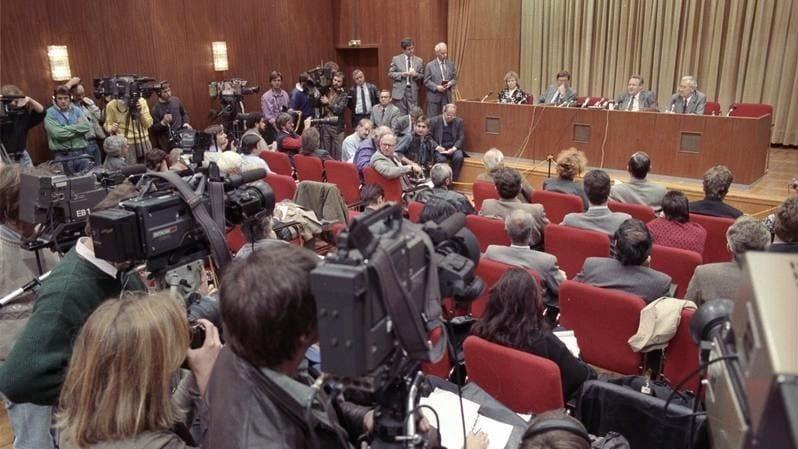
At 6:53 p.m. on November 9, 1989, a visibly tired East German Communist Party spokesman named Günter Schabowski sat beneath television lights in East Berlin, shuffled through a stack of papers he had barely glanced at, and accidentally ended the Cold War.
The Moment Nobody Planned: A Shrug That Changed the World

The press conference was supposed to be routine — a chance for the regime to signal cautious reform and manage an increasingly restless population. Schabowski read out a new regulation announcing that East German citizens could apply for permission to travel or emigrate. Cameras rolled. Reporters scribbled. Then an Italian journalist called out a question that would crack the world open: When does this take effect?
Schabowski rustled his notes. A long pause filled the room. He had spent the day away from the Politburo meeting where critical implementation details had been hammered out; the regulation was intended to take effect the following day, with orderly processing at checkpoints and proper paperwork in place. But nobody had told Schabowski that. So he improvised, reading nothing useful from the page in front of him, and offered four words that would echo across a generation: “Immediately, without delay.”
One of history’s most celebrated turning points — the fall of the Berlin Wall — was triggered not by a storming of the barricades, not by a military coup, not even by a diplomatic agreement. It was triggered by a scheduling memo that one exhausted official had never read. The Wall had stood for almost 30 years, a slab of concrete and ideology that separated families mid-goodbye and divided a city down the middle of streets, rivers, and living rooms. It came down because of a bureaucratic blunder broadcast live on West German television.
Why the Wall Existed in the First Place: Almost 30 Years of Concrete Logic

To understand why that blunder had such seismic force, you have to understand what the Wall actually was — and what it cost to keep standing.
By 1961, approximately 3.5 million East Germans had fled westward since the end of World War II, draining the German Democratic Republic of doctors, engineers, teachers, and anyone with options. The regime’s answer was blunt and brutal: in the early hours of August 13, 1961, soldiers and workers began sealing the border with barbed wire that would harden, over years, into reinforced concrete. Families were cut off mid-visit. Streets were bisected. In some apartment buildings along the border, residents found their front doors bricked up by morning.
What rose from that wire was more than a border. The Berlin Wall was the physical skeleton of the Iron Curtain — proof, visible to the entire world, that the Eastern Bloc could only retain its population through imprisonment. Life in its shadow developed its own grim architecture: a “death strip” of raked sand designed to show footprints, floodlights that turned night into interrogation, watchtowers manned around the clock, and more than 140 people confirmed killed in attempts to cross. Berliners on both sides learned to live with an obscene normality — to look past the concrete, to not think too hard about what it meant that a government had to cage its own citizens to survive.
As long as the Wall stood, so did the logic of two Germanys, two Europes, and two irreconcilable visions of how human beings ought to live. It was both symptom and symbol, both cause and consequence of the broader Cold War standoff that had frozen the continent in place for decades.
The Autumn That Was Already on Fire: 1989’s Wave of Revolutions

November 9 didn’t arrive from nowhere. By the time Schabowski shuffled his papers, 1989 had already been a year of cascading shocks that left the Soviet-led communist bloc visibly staggering.
In Poland, the Solidarity movement had won a stunning electoral victory that summer, forming the first non-communist-led government in the Eastern Bloc since the late 1940s. In May, Hungary had quietly dismantled sections of its fortified border with Austria — a seemingly minor act that created an enormous hole in the Iron Curtain. East Germans began pouring west through it in their thousands, choosing Hungary and Austria as an escape route their own government hadn’t thought to seal. The hemorrhage of citizens accelerated through the autumn, an exodus so visible it became its own form of protest.
Inside East Germany, those who stayed took to the streets. The Monday demonstrations in Leipzig became a phenomenon of extraordinary courage — hundreds of thousands of ordinary citizens marching through the city chanting Wir sind das Volk, “We are the people,” reclaiming a phrase the Party had used as propaganda and turning it into a demand. The regime had faced down protesters before, but not at this scale, and not with the memory of Tiananmen Square — where Chinese authorities had massacred demonstrators just months earlier — fresh in the international eye.
East German leader Erich Honecker, who had overseen the Wall’s construction and presided over decades of repression, resigned on October 18, replaced by Egon Krenz. Krenz inherited a regime simultaneously losing its population and its nerve. Crucially, the signal from Moscow under Mikhail Gorbachev was clear: Soviet tanks would not roll in to save fraternal socialist governments this time. The safety net that had preserved Communist rule through Hungary in 1956 and Czechoslovakia in 1968 was gone. As historians have noted, the Wall fell amid a wave of revolutions already transforming the Eastern Bloc from within. Schabowski’s blunder was the spark — but the kindling had been laid all year.
The Memo Nobody Read: How the Blunder Happened

The Politburo’s plan had been modest, even cynical. Under unbearable pressure from the protests and the emigration crisis, the leadership drafted a new regulation: East Germans would be permitted to apply for exit visas, allowing for legal emigration or travel. It was designed as a pressure valve — a controlled, orderly measure that would ease the immediate crisis without surrendering political control. Implementation was set for the following day, November 10, with border checkpoints briefed to process applications in an orderly fashion.
Schabowski had not been in the room when those details were finalized. When the paper was handed to him to announce at the press conference, no one pulled him aside to explain the timeline or the conditions. He walked into the cameras carrying a regulation he understood only partially, in a meeting he had not expected to become historic.
When the Italian journalist’s question hung in the air — when does this take effect? — and Schabowski found no answer in his notes, he did what officials under pressure often do: he guessed. “Immediately, without delay, without preconditions.” The words left his mouth and entered the broadcast stream of West German television, which East Germans could receive across most of the country. Within an hour, the clip had been replayed repeatedly. Within two hours, crowds were already gathering at checkpoints across the city, having heard their own government apparently announce, on live television, that the border was open — right now.
The Night the Crowds Rewrote the Script

Border guards at checkpoints across East Berlin were receiving no coherent orders. Their superiors were watching television, as bewildered as everyone else. At the Bornholmer Strasse checkpoint — the first to open — guards faced a swelling crowd of East Berliners who had heard the announcement and simply shown up, expectant and determined. The crush grew through the evening. There was no guidance from above. Around 11:30 p.m., the guards made the decision that no order had authorized: they raised the barrier.
What followed was one of the most remarkable scenes of the twentieth century. East Berliners streamed through checkpoints in disbelief, some still in their slippers, some weeping without fully understanding why. West Berliners ran to meet them. Strangers embraced strangers. People climbed onto the hoods of Trabants — the small, underpowered East German car that had become a symbol of the regime’s managed mediocrity. Champagne materialized from nowhere in the November cold, passed between people who had been, until that hour, citizens of two different worlds.
And then the hammers came out. During the night of November 9, 1989, crowds of Germans began dismantling the Berlin Wall — first with bare hands, then with whatever tools they could find. The soldiers trained to shoot anyone crossing that border now stood facing thousands of their fellow citizens, armed with a broadcast from their own government. They stood aside. In doing so, they made history.
What Actually Fell That Night: Beyond the Concrete

The physical Wall took weeks and months to come down fully — cranes and bulldozers would finish what hammers began. But what collapsed on the night of November 9 was something larger and less tangible. The opening of the checkpoints marked the definitive end of the SED dictatorship’s grip: not just a border opening but the visible implosion of a 40-year political order built on surveillance, enforced conformity, and the daily management of fear.
The ripples spread fast. Within weeks, Czechoslovakia’s Velvet Revolution succeeded peacefully, removing the Communist government with barely a shot fired. Romania’s Nicolae Ceaușescu fell — far less peacefully — before December was out, executed on Christmas Day. The Soviet empire’s European architecture, which had seemed as permanent as the concrete it was built on, dissolved with a speed that astonished even those who had worked hardest to bring it down. German reunification, which had seemed a distant abstraction even to many Germans, followed on October 3, 1990 — less than a year after the Wall opened.
So why did the Berlin Wall fall? The honest answer is layered. It fell because of a bureaucratic accident, yes — but that accident only had power because East Germans had already decided, in their hundreds of thousands on Leipzig’s streets, that they were done. It fell because the regime was too brittle and too hollowed out to contain them. It fell because Gorbachev had signaled that Moscow would not send tanks. The forces that converged on that single night had been building for decades. Schabowski’s blunder didn’t create the revolution. It simply gave it a time.
Why This Story Still Demands Attention
There is a temptation, in retrospect, to tidy history — to find the grand cause, the inevitable force, the heroic moment that explains everything. November 9, 1989, resists that tidying. It was simultaneously a spontaneous popular uprising, a regime’s slow-motion implosion, and a single official’s failure to read a briefing note. It was a revolution that nobody planned and everyone made possible.
The accident framing doesn’t diminish what preceded it. The courage of the Leipzig marchers — who took to the streets not knowing whether soldiers would fire, who had the memory of Tiananmen to remind them that the answer might be yes — belongs fully to this story. The almost 30 years of families separated by concrete, birthdays missed, funerals attended alone, children who grew up not knowing cousins on the other side: those losses are woven into why the pressure was so explosive by autumn 1989. And the more than 140 people killed trying to cross the Wall made their sacrifice part of the charge that finally blew the thing apart.
But there is strange poetry in how it ended. One of the Cold War’s most fortified and ideologically freighted symbols was brought down not by missiles, not by treaties signed in marble halls, but by a press conference, a misread memo, and a crowd that decided to believe what it heard. Grand turning points rarely look the way we imagine them from a distance. Up close, they tend to look like a tired man shuffling papers under fluorescent lights, pausing too long before he speaks.
The image that endures, though, is this: ordinary Berliners standing on top of the Wall in the November dark — the structure that had defined a generation’s entire geography of life — swinging hammers and laughing. History’s hinge moments are often held shut by nothing more than habit and paperwork. And sometimes they are opened by someone who simply forgot to ask what time it was.

 English
 Arabic
 French
 Portuguese
 Deutsch
 Turkish
 Dutch
Dutch
 Italiano
 Russian
 Romaian
 Portuguese (Brazil)
 Greek
Greek