


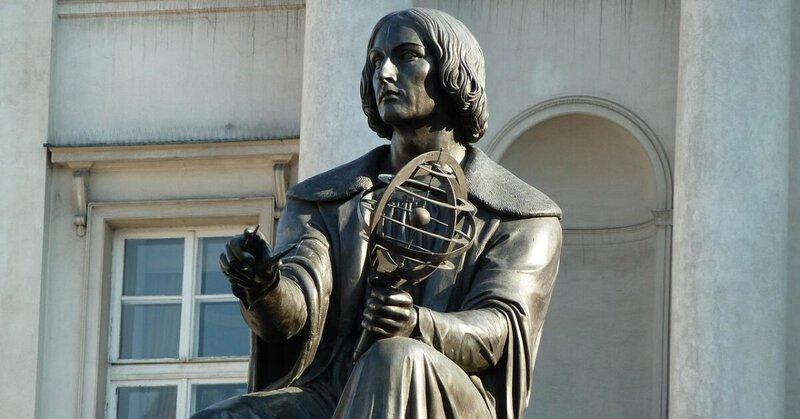
On a spring day in 1543, in a drafty cathedral town on the cold edge of Polish Prussia, an old man lay dying. Someone placed a book in his hands — freshly printed, smelling of new ink — and it is said he managed to touch the cover before slipping away. The book was De Revolutionibus Orbium Coelestium. It would move the Earth from the center of the cosmos and crack open the modern scientific age. Its author, Nicolaus Copernicus, had been sitting on its central argument for roughly thirty years.
The Man Behind the Manuscript

Copernicus was born on 19 February 1473 in Toruń, a prosperous trading city in Royal Prussia — a territory then under the Polish Crown. His family were wealthy merchants of Silesian origins, and when the elder Copernicus died young, a powerful uncle named Lucas Watzenrode, a bishop, stepped in to secure the boy’s future. That patronage bought Nicolaus something most Renaissance thinkers could only dream of: time. Time to study in Kraków, then in Bologna and Padua, absorbing mathematics, medicine, law, and the ancient astronomical texts that would eventually become the scaffolding he tore down.
To call him a polymath is almost to undersell the variety. Copernicus was a mathematician, an astronomer, a church jurist with a doctorate in law, and a practicing physician — treating the sick, managing a diocese’s finances, writing on monetary reform, and, in whatever hours remained, mapping the architecture of the heavens. He was not a monk hunched over a telescope in monastic isolation. He was a busy administrator of the Chapter of Warmia, a bureaucrat who also happened to be quietly dismantling two thousand years of received cosmological wisdom.
Crucially, Copernicus never took holy orders as a priest. His role in the Church was canonical and administrative rather than priestly — a distinction that matters enormously when assessing what he stood to lose and what ecclesiastical authority could realistically do to him. He was a church official, yes, but not a theologian sworn to defend Ptolemaic orthodoxy with his vocation.
What Copernicus Actually Claimed — and Why It Was So Unsettling

The idea that Copernicus proposed the Sun as the effectively stationary center of the cosmos, with Earth moving around it as one planet among several, sounds straightforward enough today. In the early sixteenth century, it was something close to a category error — like arguing that the ground beneath your feet is, in fact, moving. Ptolemy’s Earth-centered model was not merely a theological comfort. It was the operating system of European civilization: embedded in how physicians understood the influence of celestial bodies on health, how navigators read the sky, how the Church calculated Easter. To overturn it was to rewrite a technical manual that an entire society was running on.
Around 1514, Copernicus quietly circulated a short handwritten document among trusted colleagues. This text, known as the Commentariolus, sketched the basic heliocentric framework in outline. The fact that he shared it at all proves he was not simply hiding his idea. He was doing something more revealing: floating a kite without attaching his name to the string. The full, mathematically rigorous case — the one that would demand public accountability — remained locked in his study.
Part of his hesitation was scientific rather than social. Copernicus’s heliocentric model still used circular orbits and layers of epicycles — small circles riding on larger ones — to account for the observed motions of the planets. It was not, as a result, dramatically more accurate in its predictions than the Ptolemaic system it replaced. Copernicus knew this. He was a perfectionist confronting a model that was philosophically revolutionary but mechanically imperfect, and that tension kept him revising, recalculating, and delaying for decade after decade.
The Real Reasons He Waited — and They Are Grimmer Than You Think

The popular story is simple: Copernicus feared the Catholic Church and kept his work hidden to avoid persecution. It is also, at best, a dramatic oversimplification. In the preface he eventually wrote for De Revolutionibus, Copernicus identified his deepest fear in plain terms — and it was not inquisitors. It was colleagues. He wrote of dreading being driven from the stage by the ridicule of fellow mathematicians and astronomers, men whose technical judgment he respected and whose contempt he could imagine in precise, stinging detail. The tribunal he feared most was the one composed of his intellectual peers.
This is a psychologically grimmer scenario than simple religious oppression, because it has no villain to blame and no dramatic confrontation to survive. It is the paralysis of a man who understood exactly how good his argument was, and exactly how many legitimate objections it still invited. Scientific communities can be as conservative and as socially brutal as any institution, and Copernicus had watched enough academic disputes to know how they ended for the person who overreached.
Then there was the question of professional exposure. As a senior church administrator in Warmia, Copernicus had a livelihood, a community, and a network of patrons who had supported him for decades. Publishing a cosmos-shattering theory under his own name — with his title and position on the cover — meant staking all of that on a book that might be mocked, condemned, or simply ignored. The danger was not abstract theological censure from Rome. It was the immediate, local, social kind: the bishop who might withdraw favor, the colleagues who might stop taking him seriously, the cathedral chapter that might question his judgment.
What finally broke the deadlock was not Copernicus’s own resolve. It was a visitor.
Rheticus, the Unlikely Catalyst

In 1539, a young Lutheran mathematician named Georg Joachim Rheticus traveled to Frombork specifically to meet Copernicus. He had no invitation. He showed up, essentially, as an admirer who refused to leave. What followed was one of the stranger partnerships in the history of science: a young Protestant firebrand and an elderly Catholic canon, working in a corner of Prussia that most of Europe couldn’t locate on a map, pushing a manuscript toward the world.
Rheticus understood something that Copernicus could not quite bring himself to act on: the book needed to exist. In 1540, Rheticus published a summary of the heliocentric system under his own name — the Narratio Prima, or “First Account” — framing it as a report of Copernicus’s ideas. It was a Renaissance trial balloon, a way of testing the intellectual temperature without forcing Copernicus to stand fully in the open. The reaction was cautious but not catastrophic. The manuscript, Rheticus argued, was ready. The world would not end.
Copernicus relented. De Revolutionibus was printed in Nuremberg in 1543. In a gesture that revealed how clearly he understood the politics of what he was doing, Copernicus dedicated the book to Pope Paul III — framing the heliocentric theory not as a challenge to the Church but as a service to it, specifically to its ongoing effort to reform the Julian calendar, which had drifted badly out of alignment with the astronomical year. It was a careful, almost lawyerly maneuver by a man who had spent his life inside institutional structures and knew precisely how they worked.
The copy that arrived in Frombork on or around 24 May 1543 came too late for Copernicus to appreciate it fully. He had suffered a stroke months earlier and was, by most contemporary accounts, barely conscious when the book was placed in his hands. He died that same day.
The Church Controversy — Setting the Record Straight

Here is the timeline that most retellings quietly omit: the formal Catholic condemnation of heliocentrism did not arrive until 1616 — more than seventy years after De Revolutionibus was published, and seventy-three years after its author was dead. The Church that supposedly drove Copernicus to hide his work for three decades did not actually place the book on its Index of Forbidden Books until long after everyone involved in writing it had turned to dust.
In 1533, Pope Clement VII was briefed on Copernican ideas by a Vatican scholar and reportedly responded with interest rather than alarm. The first loud voices of religious condemnation came not from Rome but from Protestant reformers — Martin Luther reportedly dismissed Copernicus as a fool who contradicted Scripture, and Philip Melanchthon also criticized the theory on scriptural grounds. The irony that Rheticus, Copernicus’s great champion, was himself a Lutheran adds another layer of texture to a story that resists clean ideological lines.
The eventual Church censure was real and serious, but it was largely a reaction to how later thinkers — Galileo chief among them — deployed and publicized the Copernican model in ways that made confrontation unavoidable. Copernicus himself died in a quiet diocese, honored at his death, never tried, never condemned. The persecution narrative became attached to his story largely by retroactive association with Galileo’s more dramatic and documented fate.
Legacy: What Copernicus Actually Started

It would be a mistake to treat De Revolutionibus as a finished revolution. Copernicus occupies a pivotal but deeply ambiguous position in the history of astronomy: a man who identified an essential structural truth about the solar system while retaining many of the old model’s most cumbersome features. His planets still moved in perfect circles. His system still required epicycles to match observed planetary positions. In terms of raw predictive accuracy, it offered little immediate improvement over Ptolemy.
What it offered instead was a conceptual permission slip. By demonstrating — mathematically, in print, with full workings shown — that a Sun-centered system could account for planetary motion, Copernicus gave subsequent thinkers a legitimate framework to test, argue with, and improve. Johannes Kepler replaced the circles with ellipses, eliminating the need for epicycles. Galileo pointed a telescope at the sky and found evidence — the moons of Jupiter, the phases of Venus — that fit the Copernican picture and not the Ptolemaic one. Isaac Newton supplied the gravitational mechanics that explained why any of it worked. Each of those steps required Copernicus’s prior step to be possible.
The shift Copernicus initiated — displacing humanity from the geometric center of the universe — reverberates far beyond astronomy. It seeded a recurring pattern of scientific thought in which the observer is not the center of what is being observed, a principle that would later reshape biology, geology, and cosmology in turn.
Why the Thirty-Year Wait Matters More Than the Discovery
The delay is, in a way, more instructive than the theory itself. It is a window into how scientific revolutions actually unfold — not in sudden, heroic moments of publication, but in long, socially complicated negotiations between what a person knows and what a world is prepared to hear. Copernicus identified the essential geometry of the solar system and then spent thirty years trying to make it unanswerable before he would let it out of the room.
He did not entirely succeed on his own terms. It took Kepler’s ellipses, Galileo’s telescope, and Newton’s mathematics to finish the architecture Copernicus had roughed in. What he left behind was less a complete system than a demonstration — printed, bound, and impossible to un-publish — that the Earth could be moved.
The psychological portrait that emerges across those three decades is of a man who understood exactly what he had found and exactly what it would cost. Not imprisonment. Not martyrdom. Something quieter and in some ways harder: the surrender of the careful, respected, professionally secure life he had built in a cold cathedral town on the margins of Europe, in exchange for being the person who told everyone that the ground beneath their feet was hurtling through space.
He waited until he was dying to let that particular truth loose. And in doing so, he gave the rest of us nearly five centuries of consequences to work through — still ongoing, still incomplete, and still tracing back to an old man in Frombork, holding a book he could no longer read.

 English
 Arabic
 French
 Spanish
 Portuguese
 Turkish
 Dutch
Dutch
 Italiano
 Russian
 Romaian
 Portuguese (Brazil)
 Greek
Greek