


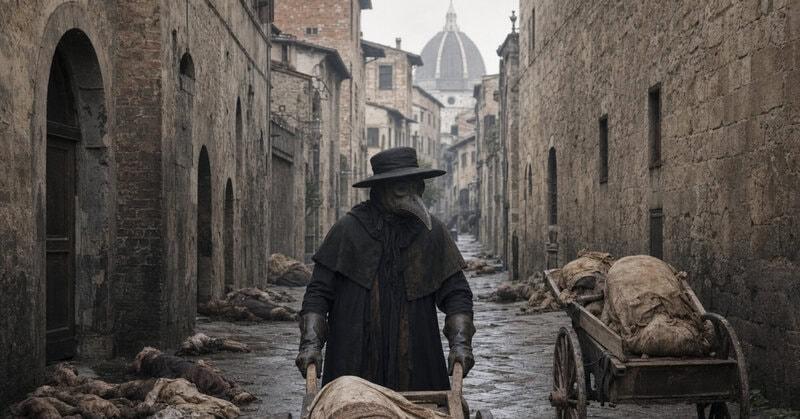
In the summer of 1348, the city of Florence smelled of fire and rot. Doors hung open on houses whose entire families had died within days of each other. The Arno kept moving, indifferent, through streets so quiet that travelers reported hearing their own footsteps echo off stone walls that had, just months earlier, rung with the noise of one of Europe’s most prosperous cities. In eight months, Florence lost somewhere between a third and half of its population to the Black Death. What came after — what we now call the Renaissance — was not the story of a civilization in bloom. It was the story of survivors who had stared into an abyss and could not look away.
The Myth We Inherited

Most of us carry a particular picture of the Renaissance in our heads: Florence bathed in golden afternoon light, wealthy merchant-princes with an almost suspicious love of art, geniuses emerging from workshops — Botticelli, Brunelleschi, and eventually Michelangelo and Leonardo — collectively lifting Europe out of the so-called Dark Ages into something radiant and new. It is one of history’s most seductive stories. It is also, historians are increasingly arguing, a story the Renaissance largely invented about itself.
The broad contours of this popular image were packaged and exported by 19th-century historians, most influentially the Swiss scholar Jacob Burckhardt, whose 1860 work The Civilization of the Renaissance in Italy enshrined Florence as the cradle of modernity. Burckhardt and those who followed him needed a usable myth about Western civilization’s origins. They found one in the Italian city-states of the 14th through 17th centuries, tidied up the contradictions, and installed the result in textbooks and museum wall labels across the world. The dates hardened. The narrative calcified. The story of how that rebirth happened — as a product of abundance, patronage, and inspired genius — became nearly unquestionable.
Nearly. Historian Ada Palmer has written a significant challenge to this consensus. Her book Inventing the Renaissance: The Myth of a Golden Age, argues that the golden-age framing is itself a Renaissance-era invention — a form of propaganda, or perhaps a coping mechanism, that the period’s own thinkers created to make sense of chaos they could barely survive. The Renaissance, in Palmer’s characterization, was not a triumphant flowering. It was a desperate, backward-looking era, shaped by recurring plague, political violence, and an overwhelming sense that civilization had already peaked and been lost.
Which raises an uncomfortable question: if the Renaissance wasn’t a golden age, then what was it really — and what does that mean for how we read it now?
Before the Rebirth, the Dying: The Black Death as Catalyst

The Black Death arrived in Sicily in October 1347, carried by merchant ships from the Black Sea. By 1353 it had swept across Italy and most of Europe, killing an estimated 30 to 60 percent of the continent’s population — somewhere between 25 and 50 million people, in an era when medicine had no concept of germ-based contagion and the church had no adequate theological answer for mass, indiscriminate death. Entire villages disappeared. Family lines ended in weeks. The economic infrastructure of medieval Europe, built on feudal hierarchies and inherited labor arrangements, cracked under the pressure of sudden, massive labor shortages.
The survivors found themselves in an altered world. Land and money concentrated in fewer hands as inheritance lines thinned. Workers, suddenly scarce, had leverage they had never possessed before. And educated Italians — monks, scholars, merchants literate enough to write about what they were experiencing — were left with a question the medieval church was struggling to answer convincingly: why had God allowed this? Why had ancient Rome, which seemed so much more capable, more beautiful, more fully human, collapsed centuries earlier? And why did the present feel so diminished by comparison?
Those questions drove a generation of scholars to do something that would have enormous consequences: they began hunting. Literally and figuratively, they searched for ancient manuscripts in monastery libraries and forgotten archives. They sought pre-Christian wisdom, classical philosophy, the writings of Roman statesmen and Greek thinkers who had grappled with mortality and civilization without the framework of Christianity. What emerged from that search was humanism — the intellectual movement at the heart of everything we call the Renaissance.
The Black Death and the Renaissance are not sequential events, one following politely after the other. The plague was the ignition. The cultural explosion that followed was the combustion.
Grief, Gold, and Greek Manuscripts: What Actually Caused the Renaissance

Humanism was not an accident of genius. It was, in significant ways, a coping mechanism — an intellectual response to catastrophic loss. Petrarch, writing in the decades just before the worst of the plague struck, was already romanticizing ancient Rome as a lost paradise, mourning a greatness he believed his own age had failed to recover. The devastation of the mid-14th century only intensified that longing across an entire educated class. To study Rome was to insist that beauty and order had once existed and might exist again.
Wealth redistribution played its part. Plague-thinned inheritance lines concentrated money in fewer hands, and Florentine banking families — most famously the Medici — found themselves with remarkable concentrations of capital at precisely the moment when scholars and artists were desperate for patronage. The Medici did not create the Renaissance out of pure generosity. They invested in art and scholarship because a plague-convulsed economy had positioned them to do so, and because cultural patronage was how power announced itself in this particular world. Cosimo de’ Medici’s support of the Platonic Academy in Florence was as much a political calculation as an act of intellectual devotion.
Then, in 1453, came the fall of Constantinople to Ottoman forces under Sultan Mehmed II. Greek scholars fled westward, carrying manuscripts that offered direct access to Plato, to classical science, and to texts that had circulated in Byzantium but were largely unknown in Western Europe. They arrived in a culture already primed, by a century of loss and longing, to receive exactly what they brought.
Palmer’s argument in Inventing the Renaissance is essential here: Renaissance thinkers were not celebrating a new world. They were mourning an old one. Their obsession with antiquity was performative nostalgia — a reach backward toward an ancient greatness they believed had been lost, and which they were not entirely confident they could recover. The golden age they described was always in the past. Their own present felt diminished, precarious, and haunted.
What the Textbooks Leave Out About Renaissance Italy

The Italy of the Renaissance was not a peaceful garden of enlightened creativity. It was a patchwork of rival city-states at near-constant war — Milan against Venice, Florence against Naples and the papacy and whoever else presented a threat — and the artists and scholars we celebrate worked directly inside this political violence, frequently in the service of the warlords and political operators funding them. Machiavelli didn’t write about power in the abstract. He wrote about it because he lived inside its machinery, serving the Florentine Republic as a diplomat before being imprisoned and tortured after the Medici returned to power in 1512.
Plague, furthermore, did not politely step aside after 1353. It returned in waves: 1363, 1374, 1383, 1400, and repeatedly into the 15th century and beyond. This means the entire classical period of the Renaissance — Brunelleschi designing his dome, Botticelli painting his mythological allegories, Machiavelli drafting The Prince — unfolded inside a society living with recurring epidemic death as a persistent background condition. These were not people secure in their civilization’s progress. They were people who had learned not to count on anyone being alive next season.
Understanding this changes how we read the art. The serene Madonnas, the idealized marble bodies, the luminous landscapes of Florentine painting — these were not expressions of confidence in the world. They were expressions of longing for a world the painters and their patrons knew they did not actually inhabit. The beauty was aspirational, even desperate. It was what human beings reach for when the real world around them feels irreparably broken. Botticelli’s Primavera, painted around 1482, depicts a mythological garden of impossible abundance — created for a family that had survived plague, political assassination, and the near-destruction of its own dynasty.
When Did the Renaissance Begin? Why the Question Still Matters

The conventional textbook answer — roughly the 14th to 17th centuries, beginning in Florence — is less a historical fact than a retrospective label, one the people living through those centuries would barely have recognized as describing their own experience. They did not think of themselves as inhabitants of a Renaissance. The very word was applied to the period much later; Vasari used rinascita (rebirth) in the 16th century to describe artistic recovery, but the broader concept of a distinct historical era called the Renaissance was largely a 19th-century construction. The people living through it thought of themselves as struggling to recover something precious that had been lost, living simultaneously in the shadow of ancient greatness and recent catastrophe.
If we locate the true origins of the Renaissance not in Medici patronage or Florentine banking but in the psychological and social rupture of the Black Death, the entire moral of the story changes. Cultural flowering does not require prosperity. It does not require stability or confidence or the benevolent attention of wealthy collectors. It can erupt, with remarkable force, from trauma — from grief that has nowhere else to go, from questions that demand answers, from a civilization reaching backward for wisdom because the present has become unbearable.
That reframing carries real contemporary resonance. Historians studying how societies respond to mass death, pandemic disruption, and civilizational stress have found the post-plague Renaissance an instructive case study precisely because it defies the easy assumption that catastrophe destroys culture. Sometimes catastrophe is the condition under which culture becomes most necessary, most ferocious, and most alive.
The harder, truer question is not when the Renaissance began. It is why we needed to mythologize it into a golden age — what that need reveals about how civilizations process their worst memories, and what we lose when we sand down the grief and violence to make the story more comfortable.
What the Story Actually Means

Return to Florence, a decade after the worst of the plague. The streets are slowly filling again. Workshops are reopening. A young sculptor is at work on marble — not because life is golden, not because the city has returned to what it was, but because making beautiful things is one of the ways human beings insist on surviving what should not be survived. That act of making is both defiant and mournful. It knows what it has lost.
Palmer’s Inventing the Renaissance: The Myth of a Golden Age reads, unusually for a work of serious scholarship, like a detective story — and its central mystery is why a civilization in crisis chose to tell itself it was experiencing a rebirth rather than a reckoning. The answer, when it comes, says as much about us as it does about them. Every era mythologizes the past it needs. The 19th century needed a secular origin story for Western progress. The Renaissance needed proof that beauty was still possible. Both built that proof out of selective memory and deliberate image-making.
The Renaissance did not begin in Florence’s golden halls, in the studies of wealthy bankers or the workshops of celebrated geniuses. It began in the graveyards — in the particular kind of hunger that takes hold of people who have lost almost everything and find themselves, somehow, still alive. Understanding that is not merely an academic correction. It changes everything about what the story means, and what it has to teach a world that has its own reasons, right now, for looking back at ruins and asking what can still be built.

 English
 Arabic
 French
 Spanish
 Deutsch
 Turkish
 Dutch
Dutch
 Italiano
 Russian
 Romaian
 Portuguese (Brazil)
 Greek
Greek