


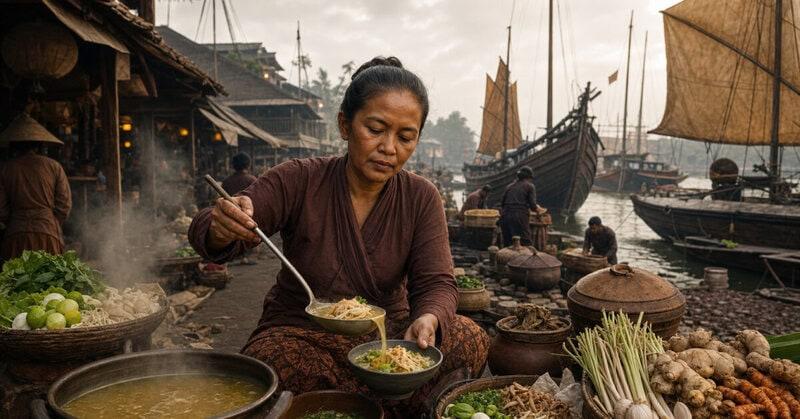
Before the city wakes, she is already there — a hawker crouched over a gas flame in the grey pre-dawn, ladling a trembling arc of gold into a clay bowl. The steam that rises carries turmeric, lemongrass, and galangal, and if you know your history, you know that those three aromatics once made the islands behind her the most coveted real estate on the surface of the earth.
The Bowl That Remembers Everything

Soto ayam is Indonesia’s most beloved soup. Almost everyone who eats it thinks of it as comfort food — something grandmothers make, something hawker stalls ladle out at sunrise, something that costs almost nothing and tastes like everything. What very few people consider, as they fish a tangle of rice vermicelli from that luminous yellow broth, is that they are eating a liquid archive. Every ingredient in the bowl has a paper trail stretching back two thousand years, written in trade ledgers, Sanskrit inscriptions, colonial shipping manifests, and the navigation charts of Chinese admirals. Soto ayam is not just a chicken soup. It is a civilisation in a bowl.
The spices that color and perfume it — turmeric, lemongrass, galangal, makrut lime leaves — were once worth more than gold by weight. The people who controlled their supply shaped the ancient world’s economy. Tracing the history of this single dish means sailing the same routes as Indian Ocean merchants, Hindu-Buddhist kings, Tang dynasty traders, and Dutch East India Company commanders. It means understanding that Indonesian cuisine was never a local, isolated tradition. It was built at the crossroads of the ancient world’s most profitable highway.
Before the Europeans: The Spice Islands and Their Ancient Trade Web

Begin at the beginning, which is further back than most people imagine. By at least the first century of the common era, Indonesian spices were circulating through active trade networks that reached Rome, India, Persia, and China. Archaeological and textual evidence confirms that turmeric and galangal — two of the defining aromatics in soto ayam broth — were prized medicinal and culinary commodities long before any European ship rounded the Cape of Good Hope. Roman writers mentioned Southeast Asian spices. Indian Ayurvedic texts catalogued them. Chinese imperial records tracked them.
The Maluku archipelago, a chain of small volcanic islands in eastern Indonesia, was the original and for centuries exclusive source of cloves and nutmeg — spices so valuable that medieval European merchants invented elaborate fictions about their origins to protect their supply chains. Further west, Java and Sumatra functioned as the great clearing houses of this trade: port cities where merchants from a dozen cultures offloaded goods, exchanged techniques, and left behind culinary footprints that have never entirely faded.
What is easy to miss in the conventional telling of spice-trade food history is how thoroughly this commerce shaped local cooking, not just export commodities. Turmeric, lemongrass, and galangal were traded across the Indian Ocean on outrigger vessels, but they were also grown in home gardens, pounded into pastes, and built into the structural DNA of Indonesian kitchens. The Southeast Asian food-origins story is fundamentally a maritime story. Indonesian cuisine was never sealed off from the world. From the very beginning, it absorbed, adapted, and transformed everything that arrived on its shores.
India’s Shadow in the Bowl: How Hindu-Buddhist Kingdoms Shaped the Broth

Between roughly the first and the thirteenth centuries of the common era, a process historians call the Indianisation of Southeast Asia reshaped the archipelago at a deep cultural level. Hindu and Buddhist kingdoms — Srivijaya, which commanded the Strait of Malacca and dominated Indian Ocean trade for centuries, and later the great Majapahit empire of Java — absorbed Sanskrit language, Hindu-Buddhist religion, artistic traditions, and, critically for our purposes, Indian culinary technique.
The structural fingerprint of Indian cooking on Indonesian cuisine is clearest in the use of pounded spice pastes — what Indonesians call bumbu — as the aromatic foundation of almost every dish. This technique, building a dish from a wet paste of ground spices rather than simply seasoning at the end, is a hallmark of Indian cooking, and its arrival in the archipelago almost certainly followed the same trade and cultural routes as Sanskrit literature and temple architecture. The soto template — a clear, fragrant broth built on a foundation of pounded turmeric, galangal, lemongrass, and coriander — bears exactly this structural imprint.
Coriander is a useful case study. It is not native to the Indonesian archipelago, yet it is integral to the broth in many regional versions of the dish. Coriander arrived via Indian Ocean trade and was absorbed so thoroughly into the local culinary vocabulary that it ceased to feel foreign within a few generations. This is how the history of Indonesian cuisine actually works: not as a series of impositions, but as a centuries-long process of genuine assimilation, in which outside ingredients were taken in and made entirely local. Most popular food histories underweight this Indian chapter, but it is arguably the most important formative influence on the dish we are tracing.
China’s Contribution: Noodles, Technique, and the Name Itself

The Indian Ocean trade routes ran east as well as west, and from the Tang dynasty onward, Chinese merchants were a constant and shaping presence in Java’s port cities. They came to trade ceramics, silk, and manufactured goods for spices and forest products. Many stayed. Chinese communities took root in Javanese coastal cities, intermarried with local populations, and left culinary contributions that are now so thoroughly woven into Indonesian cooking that most people never think of them as foreign at all.
Consider the noodle. Soto ayam is traditionally served with thin rice vermicelli — a preparation almost certainly introduced through Chinese contact, since noodle-making technology developed in China and spread across Southeast Asia along the same maritime routes that carried traders and settlers. The thin, slippery noodles that sit at the bottom of a bowl of soto ayam, soaking up that golden turmeric broth, are a quiet Chinese inheritance.
Even the name of the dish may carry a Chinese imprint. Some food historians have proposed that soto derives from a Chinese term roughly transliterated as caudo, describing a style of mixed or miscellaneous soup — the kind of catch-all, use-everything broth that port-city cooking tends to produce when resources are pooled and cultures overlap. The etymology is debated, as food etymologies usually are, but the debate itself is instructive. It points to soto ayam’s origins in exactly the kind of multicultural urban cooking environment where names, ingredients, and techniques from half a dozen traditions get stirred together into something that eventually becomes its own distinct thing. This is the normal alchemy of port-city cooking, and it produced one of the world’s great soups.
If you want to understand what that layered complexity tastes like in practice, this detailed breakdown of soto ayam’s components and technique at Glebe Kitchen traces each element of the broth with unusual care.
The Colonial Cauldron: Dutch Spice Wars and What They Meant for the Kitchen

In the seventeenth century, the Dutch East India Company — the VOC — arrived in the Indonesian archipelago and proceeded, with extraordinary violence and commercial ruthlessness, to seize control of the global spice trade. They established monopolies over cloves and nutmeg, destroyed crops on islands that refused to comply, and built Batavia — modern Jakarta — as the headquarters of a commercial empire founded on the forced extraction of the very ingredients that had made these islands famous for two thousand years.
The irony is almost too neat to be believed: while European powers fought wars over Indonesian spices, Indonesians themselves were using those same spices with a culinary sophistication that no European kitchen came close to matching. Turmeric, lemongrass, galangal, makrut lime leaves — the building blocks of soto ayam broth — continued to be grown, pounded, and simmered in Indonesian households and market stalls throughout the colonial period, largely beneath the notice of the administrators who were simultaneously shipping the archipelago’s spice harvest to Amsterdam warehouses.
In this sense, the bowl of yellow, turmeric-gold soup carried a quiet defiance. Cooking with these ingredients — the very ingredients that European empires had bled to control — was an act of cultural continuity. The colonial period also introduced new proteins, produce, and culinary influences that gradually enriched the extended soto family of soups, but the core herbal broth remained stubbornly, recognisably local. It survived the VOC. It survived everything.
A Soup with Provinces: How Soto Ayam Became a National Dish with a Hundred Faces

Today, calling soto ayam a single dish is a little like calling jazz a single song. The form is consistent — a clear herbal broth rendered golden by fresh turmeric, served over noodles with shredded chicken, finished with lime and sambal — but the variations are where the real history lives. Each regional version preserves the particular trade contacts, ethnic communities, and agricultural conditions of its home territory.
- Soto Ayam Madura, from the island of Madura off the northeast coast of Java, is perhaps the most classically spiced version — fragrant with turmeric, coriander, lemongrass, and makrut lime leaves, its broth clear and intensely herbal.
- Soto Betawi, from Jakarta (the old colonial Batavia), is richer and more indulgent, enriched with coconut milk or sometimes fresh milk, reflecting the layered ethnic mix of Indonesia’s capital city.
- Soto Lamongan, from East Java, is distinguished by a topping of koya — a powder made from ground prawn crackers and fried garlic that dissolves into the broth, thickening and enriching it in the most satisfying way.
The dish has also traveled. Soto ayam is popular not only across Indonesia but in Singapore and Malaysia, carried there by Javanese and Madurese migrants who followed, in their way, the same maritime routes their spices once traveled. In hawker centres in Singapore, you can find bowls of soto ayam that are unmistakably Indonesian in their bones while inflected with Chinese-Malay-Peranakan culinary traditions. The soup kept moving, kept absorbing, kept becoming new versions of itself — just as it always had.
For those ready to cook it at home, this accessible home cook’s guide to soto ayam at Wok and Skillet walks through the process with clarity and practical detail. The New York Times recipe for Indonesian chicken soup with noodles, turmeric, and ginger is a well-tested version that captures the dish’s essential character. And for a closer look at the technique behind the broth, Serious Eats offers a thorough recipe with detailed explanations of each step.
How to Make Soto Ayam: What You Need to Know Before You Start
Understanding a dish’s history is one thing. Getting the bowl right in your own kitchen is another. A few principles separate a genuinely good soto ayam from a pale imitation.
Fresh turmeric is not optional. Dried turmeric powder will color the broth, but it will not give you the bright, slightly peppery, faintly earthy quality that fresh turmeric root provides. If you can find fresh turmeric at an Asian grocery store — and in most cities you can — use it. The difference is immediately visible in the color of the broth and clearly audible in its flavor.
The bumbu is the soul of the soup. The spice paste — typically blended or pounded from fresh turmeric, galangal, lemongrass, shallots, garlic, and coriander — must be fried in oil until it is fragrant and has lost its raw edge before the broth is added. Frying the paste rather than simply simmering it raw into the liquid is what develops the deep, rounded complexity that distinguishes a real soto ayam from a turmeric-flavored chicken broth.
The chicken should be poached, not boiled. Starting the chicken in cold water and bringing it up gently produces a cleaner, clearer broth than a rapid boil, which clouds the liquid and toughens the meat. Once cooked, shred the chicken by hand rather than chopping it — the torn texture holds the broth better.
Garnishes are not decorative. They are structural. The boiled egg, fried shallots, sliced tomato, celery leaves, lime wedge, and sambal that finish the bowl are not afterthoughts. Each one adds a distinct texture, temperature, or flavor contrast that makes the assembled dish more than the sum of its parts. Do not skip them.
Serve it hot and immediately. Soto ayam is a dish assembled at the last moment: noodles in the bowl first, then shredded chicken, then the boiling broth ladled over the top, then garnishes. Letting it sit makes the noodles bloated and the garnishes limp. The hawker at dawn serves it in thirty seconds and moves to the next customer. Follow her lead.
Why This Bowl Still Matters
Food scholars and chefs around the world have in recent years begun to recognise soto ayam as one of the planet’s genuinely great soups. It achieves a complexity that many Western soups chase through long reduction, cream, or butter — and it does so instead through herbs and spice, through the careful layering of aromatics that carry two thousand years of accumulated culinary knowledge. It is light and profound at once. It is the kind of soup that makes people who have never been to Indonesia feel, for a moment, that they have arrived somewhere ancient and specific.
Every ingredient in the bowl has earned its place through history. The turmeric that turns the broth gold was traded across the Indian Ocean before Rome had an emperor. The lemongrass and galangal that lift and perfume it were pounded into spice pastes in Majapahit palace kitchens. The rice noodles that tangle at the bottom carry the memory of Chinese port merchants. The lime leaves that finish it were growing in gardens that survived the VOC. None of this history makes the soup taste better, exactly — but it does make the eating of it feel different, once you know.
Return to the hawker at dawn, then — the woman crouched over her flame, ladling gold into clay. She is not just making breakfast. She is the living endpoint of one of history’s longest and most consequential culinary supply chains, a chain that runs back through Dutch colonial ledgers and Chinese trading junks and Indian Ocean outriggers to a time when the islands around her were the axis on which the ancient world’s economy turned.
Some soups feed you for a meal. Soto ayam feeds you a civilisation.

 English
 Arabic
 French
 Spanish
 Portuguese
 Deutsch
 Turkish
 Dutch
Dutch
 Russian
 Romaian
 Portuguese (Brazil)
 Greek
Greek