


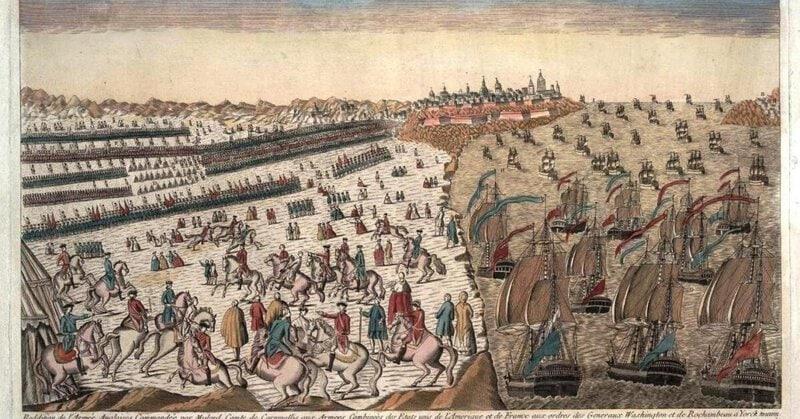
On the morning of September 5, 1781, two of the most powerful naval forces on earth drifted toward each other off the Virginia coast in light winds and late-summer haze — and almost nobody on the American side knew it was happening, because the man who would get all the credit was still marching through New Jersey.
The Battle Nobody Watched That Won the Revolution

George Washington was somewhere on the road south when the guns opened up off the Virginia capes. He had gambled everything on a forced march from New York, pulling Franco-American forces toward a trap he hoped to spring around a British army dug into the tobacco port of Yorktown, Virginia. The trap only worked if the sea lanes were sealed. And sealing those lanes fell entirely to a French admiral named François-Joseph Paul de Grasse — a man whose name most Americans would struggle to pronounce today, let alone recognize as one of the principal architects of their independence.
Here is the uncomfortable arithmetic of the Siege of Yorktown: the famous 22-day ordeal of trenches, bombardment, and eventual British collapse that ran from September 28 to October 19, 1781, was only possible because de Grasse had already fought — and strategically won — a naval battle three weeks before the first allied soldier set foot outside Williamsburg. The surrender on October 19 was the culmination. The decision happened at sea, in a clash most American schoolchildren have never been taught to name.
How Yorktown Became a Death Trap

Lord Charles Cornwallis had good reasons to feel secure in Yorktown that summer. He commanded a veteran British army, battle-hardened from years of campaigning across the Carolinas, and he occupied a defensible position on the York River with access to open water. In the world of 1781, that access meant something simple and reassuring: the Royal Navy controlled American coastal waters, and if things went badly, the navy would come for him. He could be resupplied. He could be evacuated. The sea was a door that opened from the outside.
Washington and his French counterpart, the Comte de Rochambeau, were betting they could lock that door before the British fleet arrived to open it. Through the sweltering summer of 1781, they force-marched roughly 7,000 Franco-American troops from the New York area toward Virginia — a logistical gamble that stripped New York of much of its defending force and committed everything to a single theater. The march only made sense if the Chesapeake Bay was sealed before the allied army arrived. If British ships held the bay, Cornwallis could simply walk out, and the allied army would have marched hundreds of miles for nothing.
British Admiral Thomas Graves understood the danger. He sailed south from New York with 19 ships of the line, intent on reaching Cornwallis before the allied noose tightened. He was too late. De Grasse had already sailed north from the Caribbean with 28 ships of the line and thousands of French soldiers, arriving in the Chesapeake first and in overwhelming strength.
The Man History Forgot: Who Was de Grasse?

François-Joseph Paul de Grasse was, by the standards of his era, a physically imposing figure — standing around six feet two inches, aristocratic in bearing, and aggressive in temperament. He was also operating under a strict timetable that made his mission a calculated risk from the outset. Paris had loaned him to the American theater only temporarily; the Caribbean remained his primary responsibility, and his window in Virginia waters was narrow.
His decision to bring his entire fleet north from Saint-Domingue, rather than detach a portion of it, was a unilateral gamble that surprised even his allies. Washington, when he received word that de Grasse was coming in force, was reportedly overcome with something close to disbelief and relief in equal measure. Washington’s own accounts of the Yorktown campaign make clear how central the French naval commitment was to his entire strategic calculation. De Grasse was the piece the campaign had been missing.
So why has de Grasse been largely erased from the popular memory of the American Revolution? The answer is partly chronological bad luck. In April 1782, just months after Yorktown, de Grasse met the British fleet again at the Battle of the Saintes in the Caribbean, suffered a decisive defeat, and was taken prisoner. He returned to France under a cloud. History is written by winners, and a man who ended his active career as a captive found it easy for later generations to minimize — or simply forget — what he had achieved before that final chapter.
But the French role at Yorktown was not symbolic, not decorative, not the moral support of an ideologically sympathetic ally. De Grasse was the cork in the bottle. Without him, there is no siege, no surrender, and quite possibly no United States in the form that emerged from the peace negotiations of 1783.
The Battle of the Chesapeake Capes: The Hours That Changed Everything

On September 5, 1781, de Grasse’s fleet was anchored inside the Chesapeake Bay when lookouts reported British sails on the horizon. Graves had arrived with his relief fleet, and de Grasse faced an immediate problem: his ships were at anchor, crews were scattered ashore on various duties, and the wind conditions were difficult. His response was characteristic. Rather than wait for a more favorable moment, he ordered his captains to cut their anchor cables — sending the anchors themselves to the mud of the bay floor — and get underway immediately.
What followed was roughly two hours of close-range cannon fire between two lines of warships, a brawling and imperfect engagement fought in the tactical confusion that always attends large fleet actions under sail. Neither side destroyed the other. Ships on both sides were damaged, men on both sides were killed, and when the smoke cleared, the two fleets drifted apart and watched each other warily for several more days.
By the conventional measures of naval victory — ships sunk, prizes taken, enemy routed — the engagement at the Battle of the Chesapeake was something close to a tactical draw. Graves had not been destroyed. De Grasse had not been driven off.
Yet it was a catastrophic British strategic defeat. Graves, his ships damaged, withdrew northward toward New York to refit. He never returned. While he was gone, a French squadron arrived from Newport carrying the heavy siege artillery that would eventually reduce Yorktown’s defenses to rubble. De Grasse now controlled the entire Chesapeake Bay. The door Cornwallis had depended on was bolted shut from the outside, and the man holding the bolt was French.
Twenty-Two Days in the Trenches

On September 28, 1781, the allied army marched out of Williamsburg and began investing the British works at Yorktown, formally opening the final, decisive chapter of the American Revolution. The siege that followed was less dramatic than popular imagination tends to suggest. It was grinding, exhausting work, measured in yards of trench line advanced per week rather than cavalry charges and heroic moments.
Parallel approach trenches were dug progressively closer to the British fortifications, each new line opened under fire from the defenders, each advance tightening the noose. Once the siege guns were positioned, they began a methodical destruction of the British earthworks. Cornwallis found himself in an impossible position: his men were running short of supplies, his fortifications were crumbling under sustained bombardment, and every dispatch he sent hoping for news of a relief fleet returned with silence.
The siege sharpened decisively on the night of October 14, when allied forces launched coordinated assaults on two key British positions — Redoubt 9 and Redoubt 10 — that anchored the outer defensive line. American light infantry, including troops under Alexander Hamilton, stormed Redoubt 10. French forces took Redoubt 9. Both assaults succeeded within roughly half an hour, and with those positions in allied hands, the bombardment intensified beyond anything the British garrison could absorb.
By October 17, British cannon fire from inside Yorktown had fallen nearly silent — a grim signal of what was coming. Cornwallis opened negotiations. Two days later, the formal British surrender was completed at Yorktown, with roughly 8,000 British and Hessian soldiers marching out to lay down their arms.
The Surrender and What It Actually Meant

The theater of October 19, 1781 was as rich with wounded pride as any scene the revolution produced. Cornwallis, who had every reason to be present for the formal ceremony, pleaded illness and sent Brigadier General Charles O’Hara to carry his sword to the victors. O’Hara, perhaps hoping to soften the humiliation by offering surrender to a European peer rather than a colonial rebel, first approached Rochambeau. The French commander, with impeccable diplomatic instinct, directed O’Hara firmly toward Washington. Washington, unwilling to accept the sword of a deputy from a subordinate officer, directed O’Hara in turn to his own second-in-command, General Benjamin Lincoln. The sword passed through three sets of hands before the ceremony concluded — a small comedy of dignity played out against an enormous historical backdrop.
The scale of Britain’s loss was staggering. Roughly 8,000 soldiers surrendering in a single action represented one of the largest captures of the entire war, and the shock in London was immediate and profound. Yorktown proved to be the decisive engagement of the American Revolution not because it destroyed every British army in North America — British forces remained in New York and Charleston — but because it destroyed British political will. The machinery of peace negotiations began turning almost immediately, and though the Treaty of Paris was not signed until September 1783, the outcome was determined within weeks of Cornwallis’s surrender.
Why Yorktown Matters Beyond the Mythology
The Siege of Yorktown is often taught as a triumphant finale — Washington’s masterstroke, the Continental army’s finest hour, the moment American perseverance finally broke British resolve. All of that contains truth. But the full picture is considerably more complicated, and considerably more interesting, than the standard account allows.
The campaign succeeded because of an unusual convergence of factors that none of its architects fully controlled: de Grasse’s unilateral decision to bring his entire Caribbean fleet north, Graves’s failure to force a decisive naval engagement before the trap was set, the logistical feat of moving thousands of troops hundreds of miles overland in late summer, and Cornwallis’s fatally misplaced confidence that the Royal Navy would rescue him in time. Remove any one of those factors and the history unravels quickly.
Washington, who was not given to easy generosity in his assessments of other commanders, wrote to de Grasse acknowledging that the victory was in great measure to be attributed to him. It was one of the most forthcoming acknowledgments the Virginian ever committed to paper, and it suggests that the man most celebrated for winning Yorktown understood perfectly well who had made Yorktown possible.
The reasons de Grasse faded from American memory are not mysterious. National mythology requires national heroes, and a French aristocrat who later suffered defeat and capture in the Caribbean did not fit comfortably into the story a young republic wanted to tell about itself. The alliance with France became politically complicated after the French Revolution, and by the time American historians were constructing the canonical narrative of independence, it was easier — and more convenient — to foreground Washington’s generalship and the courage of the Continental soldier than to fully reckon with the foreign admiral who had actually sealed the victory at sea.
On the morning of October 19, 1781, as the British army filed out of Yorktown to stack their muskets and the band reportedly played The World Turned Upside Down, de Grasse’s fleet sat at anchor in the Chesapeake Bay, visible from the shore, heavy with guns, riding easily in the autumn water. It was the actual reason any of it was possible — already beginning its long drift toward the edges of the story America chose to tell about itself.

 English
 Arabic
 Spanish
 Portuguese
 Deutsch
 Turkish
 Dutch
Dutch
 Italiano
 Russian
 Romaian
 Portuguese (Brazil)
 Greek
Greek