


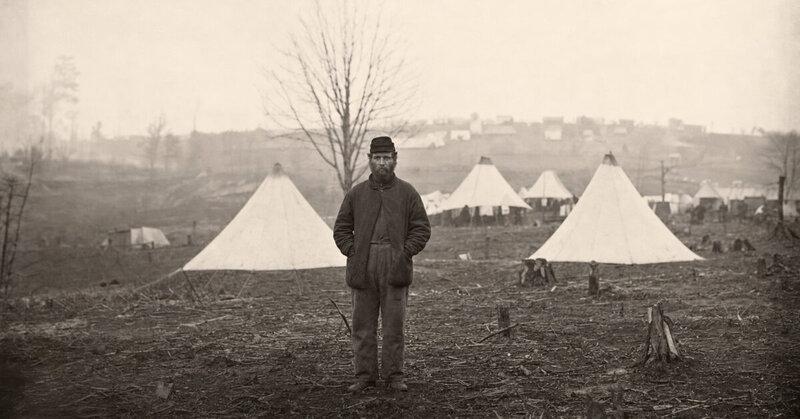
When Americans picture Civil War death, they picture the battlefield — the sunken road at Antietam, the stone wall at Fredericksburg, the churned earth of Cold Harbor. But the war’s most relentless killer never fired a shot. It crept through the water, pooled in the latrines, and moved from bunk to bunk in the dark of winter quarters, and for every soldier it let the bullets take, it quietly claimed two more of its own.
Disease Killed Roughly Two Soldiers for Every One Felled by Combat

Historians estimate somewhere between 620,000 and 750,000 total deaths across both Union and Confederate sides — a toll that still staggers the imagination — and roughly two-thirds of those deaths came not from weapons but from illness. For every man who fell to a bullet or a blade, disease erased two more, making the camp latrine a deadlier address than any contested ridge or river crossing. Understanding how Civil War soldiers actually died reshapes the entire picture of what the war was.
This 2-to-1 disease-to-combat death ratio represented grim progress of a kind. In earlier American conflicts, that ratio had hovered closer to 5-to-1. Armies of the 1860s were marginally better at keeping men alive — yet still catastrophically unprepared for the epidemiological consequences of massing hundreds of thousands of young men in close quarters. Civil War medical history is, in many ways, the history of a society learning that lesson at enormous human cost.
Dysentery and Diarrhea — Not Typhoid, Not Smallpox — Were the Single Biggest Killers

It was not the dramatic, named plagues that broke the armies. It was something humiliatingly ordinary: intestinal disease, primarily dysentery and chronic diarrhea, which caused more deaths than any other single illness across both sides. Union Army medical records alone logged over 1.7 million cases of diarrhea and dysentery — in a force that never exceeded roughly one million men at any given time. That number means nearly every soldier in blue suffered the condition more than once, and for tens of thousands, a second or third bout proved fatal.
The mechanism was almost insultingly preventable. Contaminated water drawn from streams fouled by latrines placed upstream drove the epidemic. Basic camp-siting discipline — digging latrines downhill and downwind from water sources, moving encampments before waste accumulated — could have dramatically reduced the toll. That it so often did not speaks to how little the armies, at the war’s outset, understood about the relationship between sanitation and survival. The disease statistics on intestinal illness alone tell a story of institutional failure as much as medical ignorance.
The Germ Theory of Disease Did Not Yet Exist When the War Began

It is easy, looking backward, to condemn Civil War surgeons for operating with unwashed hands and instruments used on one patient after another. But the condemnation misses something essential: Louis Pasteur’s foundational germ-theory work appeared only in the early 1860s, and Joseph Lister’s antiseptic surgical methods did not arrive until 1867 — after the last shot had been fired. The men cutting and suturing in field hospitals were not monsters or fools. They simply did not know what microbes were, and medicine had not yet told them.
The reigning explanation for disease was miasma theory — the idea that illness arose from bad air emanating from swamps, rotting organic matter, and decaying flesh. This produced some accidentally useful behavior: armies were sometimes steered away from low, wet ground precisely because it “smelled of disease.” But miasma pointed at the wrong mechanism entirely, offering no guidance on water filtration, hand-washing, or instrument sterilization. Civil War medicine is therefore also the story of a profession operating at the outer edge of what it was yet capable of knowing.
A Soldier Was More Likely to Die in Camp Than on a Picket Line

The statistics are unambiguous on a point that would have surprised many recruits marching off to war: the most dangerous place a Civil War soldier occupied was his own encampment during periods of inactivity, not an active engagement. Disease rates spiked sharply when armies went into winter quarters or held a position for weeks at a stretch, as latrines filled, water sources grew contaminated, and crowded, poorly ventilated quarters spread respiratory illness from bunk to bunk through the long cold months.
The cruel irony is that many regiments lost more men to sickness in their first three months of service — before they had ever heard a hostile shot — than they would lose in their bloodiest single day of battle. Young men from scattered farms and small towns arrived in camp having never been exposed to the concentrated disease environment of a mass army, and the camps consumed them before commanders even had a chance to count their rifles.
The Union Army’s Sanitary Commission Was the War’s Most Effective Medical Innovation

In 1861, a coalition of physicians, reformers, and civic leaders founded the United States Sanitary Commission — a civilian organization with no formal military authority and, initially, little respect from Army brass. What it had was persistence. Inspired in part by Florence Nightingale’s sanitary reforms during the Crimean War of 1853-56, the Commission lobbied, pressured, and occasionally shamed commanders into relocating latrines, enforcing cooking standards, ventilating hospital tents, and inspecting camp conditions with a rigor the military had never applied to itself.
Historians credit the Commission with measurably bending the Union disease mortality curve downward in the war’s later years — a rare, documented instance of public health advocacy producing visible results during an active catastrophe. It was one of the earliest examples of organized civilian public health intervention in American history, and its legacy fed directly into the sanitary reform movements of the Gilded Age. The quiet administrative battle behind the front lines shaped who would even be available to fight — a dimension of the war that operational histories rarely capture.
Typhoid Fever Ravaged Both Armies and Was Frequently Misdiagnosed

Typhoid spread through exactly the same route as dysentery — fecal contamination of water and food — and it killed tens of thousands of soldiers on both sides, becoming so common in the camps that it acquired its own grim nickname: camp fever. Entire regiments could be reduced to a fraction of their listed strength by fever before they had fired a single volley, a scene repeated in hundreds of Union and Confederate encampments alike.
What makes typhoid’s true toll so difficult to pin down is that physicians of the era lacked reliable diagnostic tools to distinguish it from malaria, dysentery, or other febrile illnesses. Patients were frequently recorded under vague labels such as “bilious fever” or “continued fever,” meaning official disease statistics almost certainly undercount typhoid’s actual body count. The disease was hiding inside its own paperwork, its victims quietly miscategorized even as they died.
Pneumonia and Respiratory Illness Preyed Heavily on Soldiers From Rural Areas

Men who had grown up in isolated rural communities arrived at the army’s mass encampments with immune systems that had never been tested by the respiratory diseases circulating freely in towns and cities. When soldiers from across multiple states were crowded into the same tents and barracks, the results were predictable in hindsight and devastating in practice. Pneumonia ranked among the top three infectious killers of the war, striking with particular ferocity during the winter months when men slept damp, cold, and packed together in poorly ventilated quarters.
This pattern would repeat itself with terrible consistency in later conflicts. Epidemiologists studying the First World War found nearly identical dynamics, where isolated rural populations drafted into mass military camps suffered catastrophic first-exposure mortality from respiratory disease. The Civil War was, in this sense, an early and unheeded warning about what happens when immunologically inexperienced populations are suddenly thrown together — a lesson that took another half-century to be properly understood.
Confederate Soldiers Died From Disease at Even Higher Rates Than Their Union Counterparts

The Union’s advantages in this invisible war were real, if modest. The Sanitary Commission’s inspections, a more robust supply chain, and greater access to quinine — the era’s primary treatment for malaria — gave Northern soldiers a meaningful edge. Southern troops fighting in the malarial lowland theaters of Georgia, Mississippi, and the Carolina coast had comparatively little effective pharmaceutical recourse, because the Union naval blockade had systematically cut off the pharmaceutical imports on which the Confederacy depended.
Some estimates suggest Confederate disease death rates exceeded Union rates by a meaningful margin, compounding the South’s already severe manpower disadvantage. Every soldier the Confederate Army lost to typhoid or malaria was a soldier it could not replace from a population base already stretched thin. The strategic attrition the Ultimate General: Civil War game models on the campaign map had a hidden accelerant that no battlefield victory could fully stanch: the disease drain that quietly hollowed out Southern regiments between engagements.
The War Accidentally Produced America’s First Systematic National Public Health Data

Out of catastrophe came an unexpected gift to American medicine. The Union Army’s Surgeon General commissioned a massive, multivolume postwar medical history — The Medical and Surgical History of the War of the Rebellion — published in installments between 1870 and 1888. It compiled case records, mortality statistics, surgical outcomes, and epidemiological patterns at a scale and methodological rigor that had never before been attempted in the United States. It was, in the grimly practical sense, the country’s first serious attempt at national public health data.
The document’s influence rippled outward for decades, directly informing the push for sanitary reform in cities, military installations, and public institutions throughout the Gilded Age. Civil War public health history, properly understood, does not end at Appomattox — it continues in the sewers laid beneath American cities in the 1870s and 1880s and in the slow, grinding work of turning a nation’s relationship with its own waste into something more honest and more survivable.
Soldiers Themselves Understood Something Was Wrong — and Wrote About It With Dark Clarity

The men living inside these camps did not have germ theory, but they had noses and they had eyes, and their letters home leave no doubt that they understood the camp was killing them even when they could not say precisely how. Diaries and correspondence from Union and Confederate soldiers alike return again and again not to fear of battle but to dread of the sinks — the latrine areas — and of the “Virginia quickstep,” the soldiers’ mordant slang for the diarrhea that swept through encampments with the reliability of weather. One Union private wrote that he would sooner face a Rebel musket than spend another week near the sinks, where the smell alone told you who would be sick next.
This ground-level awareness — ordinary men grasping that their environment was the enemy, that something invisible and terrible moved through the water and the air, even without the vocabulary to name it — is one of the Civil War’s most poignant and least-told dimensions. Players who have spent time with Ultimate General: Civil War or followed the community’s reflections on the experience know how powerfully the game renders the tactical and strategic pressures of command. But behind every unit on that map stood men writing home about a fear that no general could order them to stop feeling — and a killer that no order of battle recorded.
The Civil War’s death toll was always two wars in one: the war of powder and iron that history memorized, and the quieter, larger war of water and waste that history long preferred to forget. Counting both is the only way to truly reckon with what those years cost.

 English
 Arabic
 French
 Spanish
 Portuguese
 Deutsch
 Turkish
 Dutch
Dutch
 Italiano
 Russian
 Portuguese (Brazil)
 Greek
Greek