


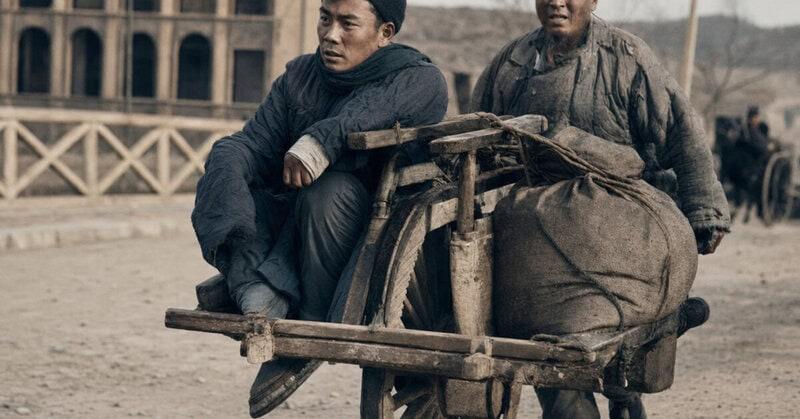
Somewhere along a mountain pass in Han dynasty China, around the first century CE, a single wooden wheel creaked under a load that would have buckled the knees of four grown men. One person guided it forward — and in that quiet, unremarkable moment, the world changed in a way it would not fully appreciate for another thousand years.
A Single Wheel That Moved an Empire

The wheelbarrow seems almost too simple to be called an invention. A frame, a wheel, two handles — what could be revolutionary about that? The answer, it turns out, is everything: where you put the wheel, who bears the weight, and what you choose to carry. China understood this long before anyone else on earth, and the gap between that understanding and Europe’s eventual adoption of it runs to roughly a millennium.
Europe would not see its first wheelbarrow until approximately the 12th or 13th century CE. China had already been using them for over a thousand years. That single fact reframes the entire history of human labour, logistics, and ingenuity — and it arrives with two distinct storylines woven together. One is civilian: a practical road vehicle that carried passengers and goods across the vast distances of the Chinese empire. The other is military: a logistics weapon that helped decide the outcomes of wars. Both stories begin with a name half-swallowed by legend — Ko Yu.
Ko Yu and the Birth of a Legend

Chinese folk tradition celebrates Ko Yu as the wheelbarrow’s originator, a figure whose story sits at the border between myth and history. He is credited with a stroke of practical genius — the realisation that a single wheel, properly positioned, could transform how human beings moved weight across the earth. Like many celebrated inventors in ancient history, Ko Yu probably represents not one man but a community of anonymous craftsmen whose collective problem-solving crystallised, over time, into a single heroic narrative.
The historical record is more grounded. The earliest credible evidence for the wheelbarrow in China points to around 100-118 CE, during the Han dynasty, when single-wheeled wooden carts begin appearing in records and, crucially, in tomb art — stone carvings that the Han used to document the material world of the living. The original design was elegantly, almost deceptively simple: a wooden frame, a single wheel, constructed entirely from timber. No iron fittings, no sophisticated engineering. And yet it represented a conceptual leap in how humans thought about moving weight.
What problem did it solve? Han China was a civilisation of enormous scale — vast road networks, agricultural supply chains feeding millions, military campaigns stretching across thousands of miles of difficult terrain. The efficient movement of loads was not a convenience; it was a civilisational priority. The wheelbarrow answered that priority with a device any carpenter could build and any labourer could operate, yet whose underlying logic was quietly radical.
The Genius of the Central Wheel

Here is the detail that separates the Chinese wheelbarrow from the version that eventually reached Europe, and it is a detail worth sitting with: the Chinese design placed the wheel at the centre of the load. This meant the wheel bore virtually all the weight. The operator’s job was not to lift but to steer and balance — a fundamentally different relationship between human effort and mechanical advantage.
The European front-wheel barrow, by contrast, positioned the wheel at the front of the frame. The load sat behind it. The person at the handles still carried a significant portion of the burden through their arms and back. It worked, but it was a compromise. The Chinese design was not a compromise — it was an insight. A person using a central-wheel barrow could move loads that would otherwise have required several people carrying by hand, transforming the economics of labour across farming, construction, and trade in a single stroke.
The stability that the central wheel created had one further consequence: the Chinese wheelbarrow was stable enough to carry passengers. Long-distance roads in China saw barrows loaded not with grain or timber but with people — travellers, the elderly, the infirm — transported across distances that would otherwise have demanded sedan chairs or costly horses. It was, in its way, a personal transport vehicle for ordinary people: something approaching public transit before the concept had a name.
This fits a broader pattern in ancient China’s technological culture. A civilisation already producing silk, paper, and cast iron was not leaving the everyday challenge of moving things to chance. It was applying systematic ingenuity to load-bearing just as it did to everything else — and finding that the solutions, once found, were often elegantly, permanently useful.
Zhuge Liang and the Wheelbarrow as a Weapon of War

By the early 3rd century CE, the wheelbarrow had found its most famous champion and its most consequential military application. Zhuge Liang was the preeminent strategist of the Three Kingdoms period, a man whose reputation for brilliance has endured in Chinese culture for nearly two millennia. Among his many attributed innovations, he is credited with refining the wheelbarrow into a dedicated military supply vehicle known as the mu niu liu ma — the “wooden ox and gliding horse.” Scholars continue to debate the precise mechanisms of these devices, and some caution that later accounts may have embellished the originals, but the broad association between Zhuge Liang and an improved military supply barrow is well established in the historical record.
The tactical problem was real and urgent. Armies of the period needed to move food, weapons, and equipment across rugged terrain where horses struggled and wheeled carts were useless. Supply lines were not merely logistical concerns — they were strategic ones. Campaigns had been lost not on the battlefield but on the road, when armies ran out of provisions before reaching the enemy. Zhuge Liang’s improved design addressed this directly, giving his forces a reliable, human-powered supply chain capable of navigating terrain no horse-drawn wagon could manage.
What makes this chapter of wheelbarrow history particularly striking is the element of secrecy. Some accounts suggest Zhuge Liang deliberately obscured the mechanism of his wooden ox to prevent enemies from copying it. Whether or not those details are fully accurate, the broader point stands: the wheelbarrow was being treated as controlled military technology — a strategic asset as significant as a new weapon. Ancient China’s military edge was not only about swords and formations. It was about the unglamorous science of keeping armies fed across impossible distances, and the wheelbarrow was central to that edge.
Wind, Animals, and an Empire in Motion — How China Pushed the Design Further

The Chinese wheelbarrow did not remain frozen in its original form. Over the centuries following its invention, it evolved in ways that still seem striking today. Historical records describe barrows being pulled by animals — beasts of burden harnessed to a device originally conceived for human hands alone — extending its range and load capacity still further.
And then there is the detail that caused early European travellers to be dismissed as fantasists when they reported it home: the sail-equipped wheelbarrow. On the flat plains of China, where wind was reliable and roads were long, wheelbarrows were fitted with sails — small masts and cloth panels that harnessed the wind to reduce the effort of the operator. Goods moved across the landscape partly propelled by weather, centuries before the idea of sail-assisted land transport would occur to anyone in the Western world.
This iterative innovation reflects something important about how the wheelbarrow was treated in China. It was not a finished object — it was a living technology, continuously adapted to different landscapes, different loads, and different energy sources. Unlike in Europe, where the wheelbarrow remained primarily a short-range construction and garden tool, in China it functioned as genuine long-distance transport infrastructure, moving people and commerce across an empire.
Europe Discovers the Wheel — a Thousand Years Later

When the wheelbarrow finally appeared in medieval Europe — most plausibly carried westward along the Silk Road trade networks that had already delivered paper, printing, and other Chinese innovations — it arrived, as ideas often do in translation, slightly diminished. The front-wheel design that Europe adopted was genuinely useful. It accelerated cathedral construction, castle building, and agricultural work. The economics of physical labour shifted meaningfully, and workers who had carried loads by hand or in baskets suddenly found themselves capable of far more. Even an imperfect wheelbarrow was transformative.
But the front-wheel design was not the Chinese design. The idea had arrived without its full engineering context — without the central-wheel insight that made the original so powerful. It is a telling pattern: a technology crosses continents and arrives as an echo of itself, carrying enough of the original genius to be useful but not enough to be complete. It is worth noting that whether Europe’s front-wheel design was independently conceived or derived from Chinese precedent remains a matter of historical debate — the transfer of knowledge along premodern trade routes was rarely clean or direct.
Which raises a broader question: how many other breakthroughs from ancient China reached the West centuries late, or arrived stripped of their most important details, simply because the knowledge transfer was incomplete? The wheelbarrow is not an isolated case. It sits alongside gunpowder, the printing press, and cast iron as part of a pattern — and recognising that pattern changes how we read the history of human progress.
What the Wheelbarrow Actually Tells Us About Ancient China
It is easy, in retelling this history, to focus only on the gap between Chinese and European timelines and miss the more interesting question: why did China develop the wheelbarrow when it did, and why did it develop so far beyond what any other civilisation managed?
Part of the answer lies in scale. The Han dynasty governed a population estimated in the tens of millions across a territory spanning thousands of miles. Feeding that population, supplying its armies, and connecting its markets was a logistical challenge of the first order. The wheelbarrow was not an accidental discovery — it was the product of a civilisation that treated practical engineering as seriously as it treated philosophy or statecraft. Agricultural surplus depended on moving grain efficiently. Military campaigns depended on moving supplies across mountains. Commerce depended on moving goods between cities separated by days of travel. The wheelbarrow addressed all three needs simultaneously.
Part of the answer also lies in materials and craft tradition. China’s early mastery of woodworking, its sophisticated carpentry traditions, and — by the Han period — its access to iron tools all made it possible to produce the consistent, reliable components a functioning wheelbarrow required. The device looks simple, but building one that does not collapse under load, that rolls true, and that can be repaired in the field requires a baseline of craft knowledge that not every ancient society possessed.
Why the Wheelbarrow’s Story Still Matters
Look around any construction site or market garden in the world today. The wheelbarrow is there — steel or plastic now rather than timber, but operating on the same principle that Han dynasty craftsmen worked out nearly two thousand years ago. Few technologies have lived so long. Fewer still have remained so fundamentally unchanged. The wheelbarrow endures because the insight it embodies is genuinely permanent: repositioning a single wheel multiplies human capability many times over.
That insight says something important about the civilisation that produced it. Ancient China was not only a culture of grand dynasties and monumental achievements — the Great Wall, the terracotta armies, the imperial palaces. It was a culture that invested deeply and seriously in the practical technologies that made ordinary life possible and large-scale organisation achievable. The wheelbarrow was not a curiosity or a footnote. It was infrastructure — as essential to the functioning of the empire as its roads or its granaries.
The human-scale lesson is perhaps the most durable of all. The wheelbarrow’s genius was not complexity. It was perception — the ability to look at a familiar problem (moving weight from one place to another) and see it differently (what if the wheel bore the load instead of the person?). Transformative innovation is often not about adding more. It is about seeing what has always been there and rearranging it with fresh eyes.
Go back, then, to that mountain pass in Han dynasty China. One person, one wheel, a load that should have required four. The soldier watching from the roadside might not have thought much of it — just another contraption, part of the vast machinery that kept the empire moving. He would have had no way of knowing that the creaking wooden frame beside him was already a thousand years ahead of the rest of the world, or that its descendants would still be rolling across every continent when his own dynasty was a distant memory. Some of the most important things ever made looked, at first glance, exactly like that: ordinary, obvious, almost too simple to notice. Almost.

 Arabic
 French
 Spanish
 Portuguese
 Deutsch
 Turkish
 Dutch
Dutch
 Italiano
 Russian
 Romaian
 Portuguese (Brazil)
 Greek
Greek