


Off the southern edge of the Aegean, a long, mountainous island sits at the exact hinge between Europe, Africa, and Asia — and for thousands of years, that position made it the stage for some of the most astonishing chapters in Crete’s history and culture. These ten facts reveal why this single island changed the course of Western civilization — and why it still rewards close attention today.
1. The Cradle of Europe’s Oldest Known Civilization

Around 2000 BCE, while most of Europe was still organized around scattered farming villages and seasonal camps, the island of Crete was already home to the Minoans — a palace-building, seafaring, literate civilization that predates classical Greece by more than a thousand years. Archaeologists widely recognize the Minoan civilization as Europe’s first advanced civilization, with its roots stretching back to roughly 3000 BCE and its influence felt across the eastern Mediterranean until around 1100 BCE.
What makes this achievement even more striking is the geography behind it: this was not a vast, fertile river valley like the Nile basin or the Euphrates floodplain, but a single rugged island. The Minoans built something extraordinary in a place that offered no obvious imperial advantage — no inexhaustible alluvial soil, no continental hinterland to draw on. That is precisely why ancient Crete remains one of the most consequential and surprising pieces of land in all of Western history.
The broader significance is easy to understate. Minoan Crete did not merely precede classical Greece; it appears to have supplied many of the raw ingredients from which Greek civilization was later assembled — religious imagery, artistic conventions, and trade networks that the Mycenaean Greeks inherited and transformed. Europe’s cultural story, in a real sense, begins here.
2. Knossos: A Labyrinthine Palace Complex That Seeded One of History’s Greatest Myths

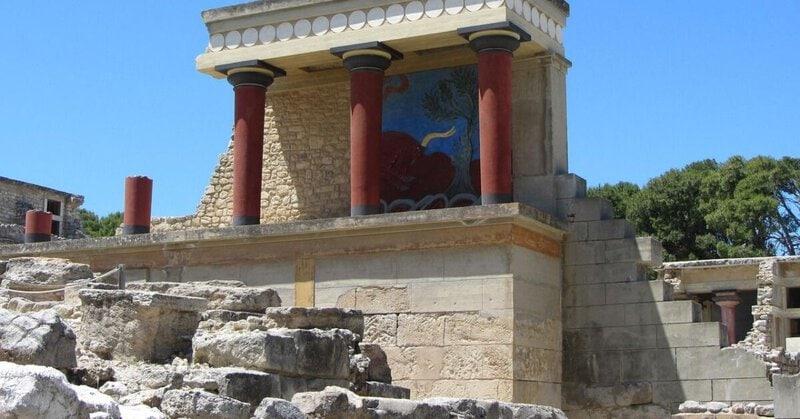
The Palace of Knossos, sitting just south of modern Heraklion on a low hill above the Kairatos River, was first constructed around 1900 BCE and eventually sprawled across roughly 20,000 square metres — a multi-storey warren of storerooms, throne rooms, light wells, and painted corridors large enough to house and administer thousands of people. Its dizzyingly interconnected layout almost certainly seeded the Greek myth of the Labyrinth, the impossible maze built by Daedalus to contain the half-human, half-bull Minotaur. Walking its ruins today, it is not difficult to understand how the legend was born.
The palace’s modern story is nearly as dramatic as its ancient one. British archaeologist Sir Arthur Evans began excavating Knossos in 1900 CE and spent decades reconstructing its frescoed halls using reinforced concrete — a decision that made the site vivid and accessible to millions of visitors but ignited a controversy among archaeologists that has never fully cooled. His restorations sit at an uncomfortable crossroads between preservation and invention: some of the painted scenes visitors see today reflect Evans’s informed guesswork as much as hard archaeological evidence. The history Evans uncovered at Knossos, however contested his methods, transformed our understanding of European prehistory and remains foundational to everything we know about Minoan culture.
3. A Crossroads Geography That Made Minoan Trade Almost Inevitable

Crete sits approximately 300 km southwest of Anatolia and roughly 100 km south of the Greek Peloponnese, placing it at the precise pivot point between three continents. That is not a fortunate accident — it is a geographic destiny. Minoan traders were within reasonable sailing distance of Egypt, the Levant, Cyprus, and the broader Aegean world simultaneously, and the archaeological record confirms they exploited every one of those routes: Minoan-style artifacts and pottery have been recovered in Egypt, Cyprus, and along the Anatolian coast.
Geography handed the Minoans a ready-made trade network before they had to conquer a single neighbor. Where other ancient powers expanded by force, the Minoans appear to have expanded by sail and commerce, exchanging Cretan olive oil, pottery, and timber for Egyptian gold and Levantine copper. It was a model of prosperity that their island position made almost inevitable, and it funded the palace culture that continues to astonish visitors today. The critical implication is that Minoan power was soft power — built on exchange rather than domination, centuries before that distinction became fashionable.
4. A Dramatic Shape: 260 km Long but Sometimes Only 12 km Wide
Crete stretches approximately 260 km from its westernmost cape to its eastern tip, yet at its narrowest point — near the isthmus of Ierapetra in the east — the island pinches down to a mere 12 km across. At its broadest it reaches around 60 km, and three great mountain massifs run along its spine: the White Mountains (Lefka Ori) in the west, the towering mass of Mount Ida (Psiloritis) in the center, and the Dikti range in the east. The interior is not gently rolling farmland; it is fierce, deeply gorged highland that remained historically almost impenetrable.
That rugged interior pushed ancient settlement toward the northern coastal plains, where the soil is deeper, harbors are natural, and communication by sea is straightforward. It is no coincidence that the great Minoan palaces — Knossos, Malia, and Zakros — were all concentrated in these accessible northern and eastern lowlands. The mountains did not just shape the scenery; they shaped the entire pattern of Minoan settlement, power, and survival. Even in the twentieth century, Crete’s mountain heartland provided the terrain that allowed Cretan resistance fighters to hold out against German occupation during World War II — an echo of how that landscape has always sheltered those who knew how to use it.
5. Minoan Script: Europe’s First Writing System, and Still Partly Undeciphered

The Minoans did not merely build and trade — they wrote. They developed two distinct scripts: an older pictographic system known as Cretan Hieroglyphic, and a later, more fluid system called Linear A, used from roughly 1800 to 1450 BCE on clay tablets, stone vessels, and cult objects. Linear A is believed to record the Minoan language itself — a language that appears unrelated to any known language family, which means that even scholars who can identify every sign face the deeper problem of understanding what those signs mean.
Linear A has never been fully deciphered, making it one of the most tantalizing unsolved puzzles in ancient history. By contrast, Linear B — a related script adapted by the Mycenaean Greeks who later occupied Crete — was successfully decoded in 1952 by British architect Michael Ventris, confirming it recorded an early form of Greek. That decipherment only deepened the mystery of Linear A by showing how close and yet how distant its predecessor remains. Minoan literature, religious texts, and royal proclamations — if they existed in written form — are entirely beyond our reach. We can see the marks pressed into the clay; we cannot hear the voice that made them.
6. A Civilization That Apparently Preferred Frescoes to Fortifications

One of the most striking anomalies of Minoan culture is what is conspicuously absent from the archaeological record: defensive walls. Unlike almost every other Bronze Age palace culture — the Mycenaeans with their massive cyclopean fortifications, the Hittites with their heavily walled citadels — the great Minoan palaces show little evidence of military architecture designed to keep enemies out. In a world where power was routinely expressed through stone ramparts and armed garrisons, the Minoans appear to have built open, largely undefended complexes.
What they built instead were frescoes: vivid, technically accomplished paintings of leaping dolphins, young athletes vaulting over the backs of bulls, women in flounced skirts engaged in ritual ceremony, and garden scenes of extraordinary delicacy. This pattern suggests a culture that directed its surplus wealth toward spectacle, ceremony, and beauty rather than conquest or defense. The most pragmatic explanation is that the sea itself served as the Minoans’ fortress — an island moat that made costly stone walls redundant as long as their fleet remained dominant. But the artistic legacy they left behind speaks to something more than mere strategic calculation: it speaks to a civilization with a distinctive and confident aesthetic identity.
7. The Fifth Largest Island in the Mediterranean — a Scale with Real Historical Consequences
With a total area of 8,450 km², Crete ranks as the fifth largest island in the Mediterranean Sea and the largest island belonging to modern Greece. That scale gave the Minoans something genuinely rare in the ancient Aegean: enough arable land, timber, and natural resources to sustain a complex, stratified society — with palace administrators, specialized craftsmen, priests, and farmers — without needing to constantly expand into foreign territory to feed itself. Size bought them a stability that smaller Aegean islands could never have achieved.
But that same size made Crete an irresistible prize for every power that came after the Minoans. The Mycenaeans moved in as Minoan society collapsed, followed in succession by Romans, Byzantines, Arab conquerors who held the island for over a century, Venetians for 465 years, and finally Ottomans. Each left their own architectural, linguistic, and cultural fingerprints on the island. Crete’s post-Minoan history is, in many ways, a compressed version of the entire Mediterranean story: conquest, assimilation, resistance, and reinvention, repeated across three thousand years on a single elongated landmass.
8. Venetian Rule Left Crete a Second Layer of Monumental Architecture
From 1204 to 1669 CE, the Republic of Venice controlled Crete in one of the longest colonial occupations in Mediterranean history — 465 years during which the island was substantially remade in the Adriatic republic’s image. Venetian engineers built harbor fortifications, loggias, fountains, arsenals, and city walls of such quality that entire old-town quarters of Heraklion and Chania still feel, to a startling degree, like transplanted corners of Venice itself. The Koules fortress — a massive stone bastion guarding the entrance to Heraklion’s harbor, completed in its current form around 1540 — is perhaps the most dramatic single monument of this era, but Venetian architectural detail is visible on almost every street corner in the island’s historic urban centers.
The Venetian period also produced one of the most unexpected figures in Western art history. Domenikos Theotokopoulos was born on Crete in 1541, trained as an icon painter in the Byzantine tradition before traveling to Venice and then to Toledo, Spain — where he became known to the world simply as El Greco. His elongated figures, electric color, and visionary intensity made him one of the most consequential painters of the late Renaissance and Mannerist traditions. His Cretan origins are a reminder that the island has consistently been a place where cultural streams collide and something genuinely new is born from the collision.
9. A Nearby Volcanic Catastrophe That May Have Doomed the Palace Culture
Around 1600-1500 BCE — the dating remains a subject of scholarly debate — the volcanic island of Thera (modern Santorini), sitting roughly 110 km north of Crete, erupted in one of the largest volcanic events in recorded human history. The eruption collapsed an entire island caldera, sent ash and pumice across the eastern Mediterranean, and almost certainly generated devastating tsunamis that struck Crete’s northern coastline. The trading ships, coastal warehouses, and harbor infrastructure that powered the Minoan economy would have been among the most vulnerable targets.
Scholars continue to debate the precise sequence of cause and effect. Was the Thera eruption the killing blow to Minoan civilization, or merely one destabilizing shock among several — including possible internal conflict and mainland Greek pressure? The timeline is undeniably suggestive: within roughly a century of the eruption, every major Minoan palace on Crete had been destroyed or abandoned, and Mycenaean Greek culture had moved in to fill the void. Whether by tsunami, ash-induced agricultural failure, trade collapse, or outright conquest, the civilization that had flourished for nearly two millennia was gone. The question of what finally extinguished Minoan civilization remains one of ancient history’s most debated and haunting unresolved problems.
10. Mount Ida: The Mythological Birthplace of Zeus, Rising Over a Minoan Sacred Landscape
At 2,456 metres, Mount Ida — known today as Psiloritis — is the highest peak on Crete, a massive limestone presence that dominates the center of the island and is visible from considerable distances at sea. In Greek mythology it was venerated as the birthplace of Zeus himself: according to tradition, his mother Rhea concealed the infant god in a cave on its slopes to protect him from his infanticidal father Cronus. That myth does not emerge from nowhere. The Idaean Cave on Mount Ida was a genuine pilgrimage destination from Minoan times through the Roman period, and archaeologists have recovered thousands of bronze votive offerings deposited there by worshippers across many centuries — physical evidence that the mountain held sacred significance long before the Greeks assigned it a name from their own mythology.
This sacred mountain points toward something important about how Greek mythology actually formed. The Olympian gods of classical Greece were not invented from scratch by Greek-speaking newcomers arriving to a blank cultural landscape; they were, at least in part, layered over much older Minoan and pre-Greek religious traditions. The Greeks absorbed what they encountered on Crete — the holy mountain caves, the bull iconography, the powerful goddess figures, the peak sanctuaries — and rewrote those elements in their own language and their own mythological grammar. Mount Ida did not merely overlook the Minoan world; it helped generate the mythological inheritance that all of Western culture has lived inside ever since.
From the palace-builders who gave Europe its first literate civilization to the Venetian stone-cutters who lined its harbors with Renaissance fortifications, Crete has been shaped by layer upon layer of human ambition, creativity, and catastrophe. No other island of comparable size compresses so much consequential history into a single landscape — and no other place makes the long arc from prehistoric palace culture to medieval harbor town quite so physically visible. Four thousand years of history are still present here, written in stone, painted on plaster, and pressed into ancient clay.

 English
 Arabic
 French
 Spanish
 Deutsch
 Turkish
 Dutch
Dutch
 Italiano
 Russian
 Romaian
 Portuguese (Brazil)
 Greek
Greek