


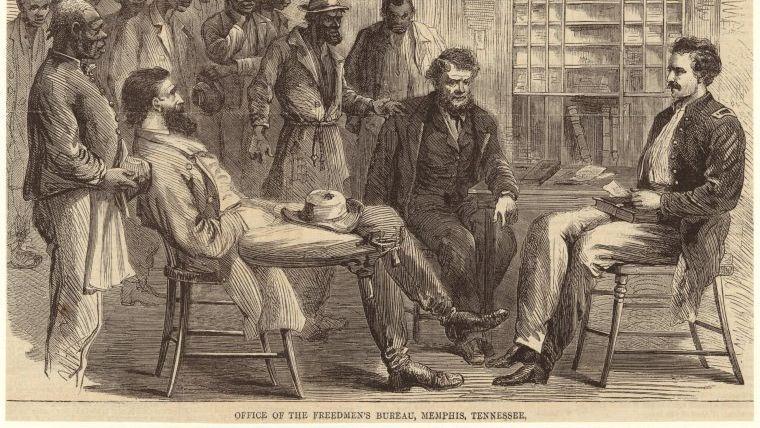
In the spring of 1865, the roads of the American South filled with a kind of traffic the continent had never seen: four million people walking away from the only lives they had ever been allowed to have, carrying almost nothing, heading somewhere — anywhere — that was not the plantation. They had no surnames recorded on any deed, no wages saved, no doctor who had ever treated them as patients rather than property, no school that had ever opened its doors to them. And in Washington, with the guns of the Civil War still firing, Congress faced a question no democracy had ever been forced to answer at this scale: what do you owe people whose entire civilization was stolen from them, and how do you even begin to give it back?
Born Before the War Even Ended: Congress Creates Something Unprecedented

The answer Congress reached — imperfect, contested, underfunded, and ultimately sabotaged — was the Bureau of Refugees, Freedmen, and Abandoned Lands. On March 3, 1865, two days before Abraham Lincoln would stand on the Capitol steps and speak of binding the nation’s wounds, Congress passed an act establishing the Bureau for the Relief of Freedmen and Refugees. The war had not yet ended. Richmond would not fall for another month. Yet Congress was already trying to legislate the morning after.
Nobody quite knew where to put something so unprecedented, so they placed it inside the War Department — a relief agency wearing a soldier’s uniform. Its formal mandate was sweeping almost to the point of absurdity: supervision and management of all matters relating to refugees and freedmen, plus oversight of abandoned and seized Confederate lands. In practice, this meant the Bureau was simultaneously a food pantry, a hospital network, a school system, a labor court, and an embryonic civil-rights enforcement body. It was expected to compress centuries of stolen opportunity into a single institution. It was given roughly 900 agents to cover eleven states.
The man appointed to lead this undertaking was Oliver Otis Howard, a one-armed Union general whose sincerity and idealism were genuine. He was deeply committed to the advancement of the freedpeople and believed in the transformative power of education and free labor with something close to religious conviction. What he consistently underestimated was the ferocity of those who would rather burn the schoolhouse down than see it open.
From its first days, the Bureau was structurally vulnerable. Congress had authorized it but initially provided no dedicated appropriation, forcing Howard’s agents to scavenge surplus military supplies — hardtack, army blankets, condemned hospital tents. An agency charged with rebuilding a shattered civilization was being asked to do it with the leftovers of a war. This was not an oversight. It was a preview of what was coming.
What the Bureau Actually Did — and Did Remarkably Well

Despite everything working against it, the Freedmen’s Bureau accomplished things that deserve to be called extraordinary. It issued millions of rations — to Black Southerners devastated by enslavement, yes, but also to thousands of poor white Southerners left homeless and starving by the war. The Bureau’s founding legislation explicitly covered refugees alongside freedmen, making it a relief agency for the broken South broadly, not a racially exclusive program, whatever its enemies would later claim.
The medical work alone was staggering. Bureau hospitals and physicians treated an estimated one million patients during the agency’s operation, confronting smallpox, cholera, and the cascading illnesses of people who had spent their entire lives denied access to professional medical care. In many communities, Bureau physicians were the first doctors formerly enslaved people had ever encountered whose intention was to heal rather than to evaluate them as property.
Then there were the schools. By the late 1860s, the Bureau supervised or supported roughly 4,000 schools across the South, staffed largely by Northern missionaries and teachers who had traveled into genuinely dangerous territory because they believed education was the irreducible foundation of freedom. Black literacy rates in 1860 stood near five percent — the deliberate result of antebellum laws that had criminalized teaching enslaved people to read. The trajectory that would carry Black literacy rates far higher in the following decades began, in significant part, in Bureau schoolhouses. Several institutions seeded during this period grew into historically Black colleges and universities that survive today. Howard University, chartered in 1867, was among the most prominent, named for the general himself.
The Bureau also tried, unevenly, to make “free labor” mean something real. Its agents arbitrated thousands of disputes between freedpeople and white employers, attempting to ensure that the wage contracts replacing the lash were not simply slavery rebranded in ink. Records from the Bureau’s operations show agents hearing cases that would be familiar today: withheld wages, fraudulent contracts, physical coercion dressed up in legal language. The Bureau functioned as a labor court for people who had never before had legal standing in any court at all.
The Fight with the President: Johnson’s Veto and What It Revealed

By 1866, Congress had seen enough of the South’s response to emancipation — the Black Codes, the organized violence, the determined effort to restore the functional architecture of slavery through law — to decide that the Bureau needed more power, not less. A second Freedmen’s Bureau Act was written to expand the agency’s reach and extend its life. Andrew Johnson vetoed it.
Johnson’s veto message deployed a strain of American political rhetoric that has never entirely gone away. He argued that formerly enslaved people should prove themselves without federal assistance, that government aid was paternalistic, that the Bureau set a dangerous precedent for Washington interfering in local affairs, and that it was fiscally ruinous and constitutionally dubious. He said nothing about the Black Codes. He said nothing about the Ku Klux Klan, which had formed in Pulaski, Tennessee, in 1865 and was already conducting the terror that formal law could not quite accomplish openly. He spoke of self-reliance while simultaneously ordering the restoration of seized Confederate lands to their former owners — land that the Bureau had briefly administered and that freedpeople had already begun to farm.
Congress overrode the veto. It was one of the early tremors of a full constitutional conflict between a Radical Republican Congress and a president who had concluded that Reconstruction meant restoring the South’s social order rather than transforming it. The Bureau survived, but it survived in a state of permanent institutional warfare — strengthened by one branch of government and actively undermined by another that controlled its funding, its military escorts, and its commissioner’s ultimate authority.
The Promise That Was Broken: Land, Violence, and the Limits of 900 Agents

The Bureau’s most consequential failure was also its most painful betrayal — and the Bureau itself bore little responsibility for it. In the final months of the war, General William Sherman had issued Special Field Order No. 15, setting aside coastal lands in South Carolina and Georgia for settlement by freedpeople. This order gave rise to the phrase “forty acres and a mule” that became shorthand for an economic promise. The Bureau briefly administered these lands. Howard briefly believed they represented the material foundation without which legal freedom would remain hollow.
Then Johnson pardoned former Confederate landowners and ordered the land returned. Howard himself, in the autumn of 1865, traveled to communities in South Carolina to personally deliver the news — that the government which had asked these people to trust its promises was now asking them to quietly surrender the only economic foothold they had secured. The broken land promise did not merely impoverish a generation; it foreclosed the possibility of economic independence that might have made everything else the Bureau attempted sustainable.
Meanwhile, the agents doing the Bureau’s work on the ground operated in a landscape of organized terror. Paramilitary groups threatened, beat, and killed Bureau agents and the freedpeople they served. Local courts provided no recourse — the same judges and juries who might hear a complaint were often connected to the very violence being reported. And the arithmetic of the operation was simply impossible: roughly 900 agents across eleven states meant that in most counties, there was no agent at all. The Bureau was, in many places, a symbol of federal intention rather than a functioning enforcement presence.
The agents themselves were a cross-section of their era — some dedicated and courageous, some corrupt, some indifferent, a few actively hostile to the people they were supposedly there to serve. The Bureau’s opponents catalogued every genuine failure and fabricated many more, constructing a narrative of incompetence and corruption that a Northern press growing weary of Reconstruction was increasingly willing to publish, and a Northern public increasingly willing to believe.
The Destruction: How a Functioning Agency Was Deliberately Dismantled

The end came not in a single dramatic abolition but in the slow suffocation of defunding. Congress eliminated the Bureau’s educational and medical operations in 1868. Most remaining functions were stripped away by 1869. By 1872, seven years after its founding, the agency existed only as a skeleton operation processing veterans’ claims — the remnant of something that had briefly been alive and consequential.
The coalition that destroyed it was broad and, in retrospect, entirely legible. Southern Democrats made the Bureau’s elimination central to their project of “Redemption” — the restoration of white political dominance through Democratic Party control. Northern Democrats, and many Northern voters, were exhausted by Reconstruction and increasingly persuaded that the South’s problems were the South’s to solve. Northern Republicans were pivoting toward the new economic questions of industrialization — tariffs, railroads, monetary policy — and finding the moral complexities of Reconstruction inconvenient. A national press that had once championed emancipation began publishing portrayals of federal waste and Black incapacity with growing enthusiasm.
The essential point about why the Freedmen’s Bureau was abolished is that it was not destroyed because it had failed. It was destroyed because in crucial respects it was succeeding. The schools were producing literate citizens. The labor courts were disrupting the South’s capacity to extract near-free labor from its Black workforce. The legal precedents being established suggested that the federal government could, in fact, enforce rights in hostile states. These were intolerable outcomes for those whose economic and political power depended on Black Southerners remaining poor, legally unprotected, and politically powerless. They understood precisely what they were dismantling, and they dismantled it deliberately.
Without the Bureau’s protections, the machinery of Jim Crow assembled itself with startling efficiency: sharecropping contracts engineered to create permanent indebtedness, convict leasing systems that functioned as slavery under a different legal name, disenfranchisement through poll taxes and literacy tests and violence at the polls. The men who abolished the Bureau understood what would follow. That was the point.
What Survived, What Was Lost, and Why It Still Matters

The Bureau’s durable achievements are not negligible. The HBCUs it helped establish became the educational backbone of Black professional and intellectual life through the long decades of legal segregation. The expansion of literacy it helped initiate compounded across generations. The constitutional argument it embodied — that the federal government has both the power and the obligation to protect citizens’ rights against hostile state action — did not die with the Bureau; it went dormant and reemerged in the Civil Rights Act of 1964, the Voting Rights Act of 1965, and the broader legal architecture of the twentieth century’s second Reconstruction.
Every major federal social program since has grappled with questions the Bureau first forced into American public life: Who is entitled to federal help? What does the government owe citizens it has systematically wronged? Can Washington meaningfully enforce rights in states determined to resist them? The rhetoric deployed against such programs has often echoed Johnson’s veto message with uncomfortable precision, across more than a century and a half.
The Bureau’s limitations were real and should be named honestly. It was underfunded by design, understaffed by impossibility, inconsistent in the quality and commitment of its agents, and ultimately unable to withstand a president and a political culture determined to restore white supremacy. But those failures belong primarily to the system that constrained and finally killed it — not to the idea itself, and not to the hundreds of agents and thousands of teachers who tried, in violent and hostile conditions, to do something genuinely important.
What endures most tangibly is the paper. The Bureau’s records — millions of pages of labor contracts, ration rolls, hospital registers, marriage registrations, and letters from freedpeople searching for family members who had been sold away from them — survive in the National Archives. Descendants searching for their ancestors still use these documents to recover names that slavery tried to erase: a mother’s given name, a child sold south, a husband last seen on a different plantation in a different state. For researchers tracing African American genealogy, the Bureau records represent one of the most significant documentary resources in existence, a archive of identity created, ironically, at the very moment the country was debating whether these people’s lives deserved to be recorded at all.
The Bureau is gone. The questions it forced into the open — about debt, about citizenship, about whether freedom proclaimed on paper means anything without the material conditions to sustain it — were never resolved. They were simply forced, again, to wait.

 Arabic
 French
 Spanish
 Portuguese
 Deutsch
 Turkish
 Dutch
Dutch
 Italiano
 Russian
 Romaian
 Portuguese (Brazil)
 Greek
Greek