


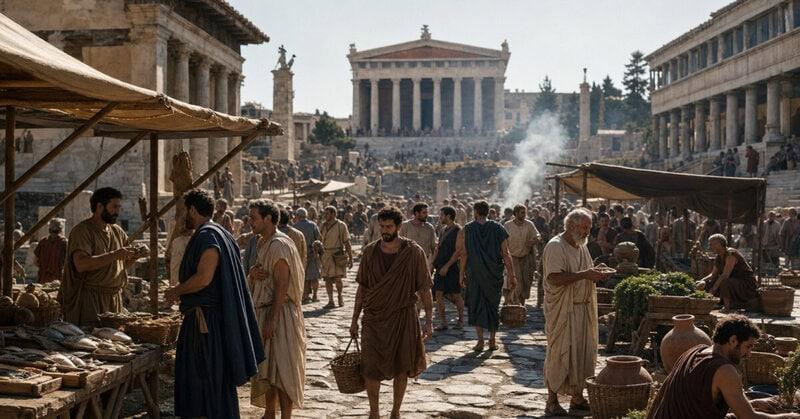
The smell hits you before anything else. Rotting fish, charcoal smoke, animal dung, and somewhere beneath it all, the sharp tang of fresh herbs laid out on wooden boards — this is the Athenian Agora at dawn, around 450 BCE, and it is already loud, already filthy, already alive with the noise of a city doing everything at once.
What the Agora Actually Was — And Wasn’t

Most people, if they know the word at all, associate it with philosophy and democracy. But to understand what the agora actually was in ancient Greece, you have to resist the urge to make it noble. It wasn’t a building or a monument. It was an open, roughly rectangular expanse of ground at the heart of a Greek city — a precinct where the entire machinery of civic life ran simultaneously and without much dignity. Commerce, justice, religion, gossip, punishment, and political debate did not take turns. They happened on top of each other, in the same dust, on the same afternoon.
In Athens, the Agora sat in the low ground northwest of the Acropolis, and the contrast between the two spaces was almost philosophical in itself. If the Acropolis — crowned by the Parthenon and its procession of marble gods — was where Athenians spoke to the divine, the Agora was where they spoke to each other. Which meant they argued, cheated, philosophized, sentenced men to death, and sold human beings, often within shouting distance of one another.
Archaeologists excavating the site have recovered stone boundary markers — called horoi — that literally bear the inscription I am the boundary of the Agora. That phrase, chiseled into rock and planted in the earth, is a reminder that this was not simply a neighborhood or a plaza. It was a defined, charged space with rules about who could enter, what could happen inside, and what was forbidden. The boundary was legal, religious, and social all at once.
The Agora’s form evolved over centuries. Originally a loose gathering ground, it was formalized in the late 6th century BCE through civic reforms attributed to Cleisthenes, whose reorganization of Athenian political life gave the space new institutional weight. Over subsequent generations, permanent stoas — long colonnaded porches — along with fountains, council houses, and law courts were added, turning an informal meeting ground into something closer to a civic campus. By the 5th century BCE, at the height of Athenian power, it was the most complex public space in the Greek-speaking world.
The Democracy Engine: Where Athenian Self-Rule Was Built — and Broken

The connection between the Agora and Athenian democracy was not metaphorical. It was architectural. The Bouleuterion — the council house where 500 randomly selected citizens gathered to draft legislation and manage the day-to-day business of the city — sat directly on the western edge of the open market. A citizen could walk from a debate about war funding into a fishmonger’s stall in under a minute. The proximity was the point.
The Stoa Poikile — the Painted Porch — displayed trophy shields from Athenian military victories and, according to ancient sources, murals depicting famous battles including Marathon. The Stoa of Zeus Eleutherios served as a space for public notices, effectively a civic bulletin board where laws and decrees were made visible to anyone who passed through. These were not decorative structures. They were information infrastructure, the means by which a city of tens of thousands tried to keep its citizens informed about what their government was doing.
Perhaps the most striking democratic artifact the Agora produced was the kleroterion — a stone allotment machine used to randomly assign citizens to jury duty. The logic behind it was radical: randomness was fairer than appointment, because appointment could be bought or manipulated. The kleroterion made chance a pillar of Athenian justice. It also meant that any given trial could be decided by a jury that included a farmer who had never studied law and a merchant who barely paid attention. Democracy, in practice, was messy.
And then there was the contradiction that sat at the center of the entire enterprise. Athenian democracy — celebrated across millennia as a founding achievement of Western civilization — excluded women, enslaved people, and non-citizen residents known as metics. Together, these groups made up the clear majority of the people physically present in the Agora on any given day. They hauled goods, ran stalls, worked as laborers, cooked food, and performed the hundred invisible tasks that kept the market functioning. They simply had no vote in the institutions that governed their lives. The Agora was a democracy built on a foundation of exclusion, and the exclusion was not incidental — it was structural.
The Marketplace: Commerce, Fraud, and the Architecture of Trade

If democracy was the Agora’s official story, commerce was its daily reality. The word agora itself carries the meaning of marketplace as well as gathering place, and in Athens that dual identity was never resolved — it was embraced. The market sprawled across the open ground in a semi-organized arrangement of permanent shops built into the bases of the surrounding stoas and temporary stalls that appeared at dawn and vanished by afternoon. Fishmongers, perfume sellers, arms dealers, physicians offering consultations, and bankers conducting loans all operated in close proximity.
The city attempted to regulate this chaos. Officials called agoranomoi — market inspectors — were appointed to police weights, measures, and the authenticity of coins. Their existence tells you something important: fraud was common enough to require a permanent bureaucracy dedicated to catching it. Athenian coinage was among the most respected in the Mediterranean world, stamped with the owl of Athena and theoretically guaranteed by the state. But archaeologists excavating the Agora have recovered counterfeit coin molds and lead weights that do not match official standards. The cheating was routine, and the inspectors were apparently not always enough to stop it.
The money-changers, known as trapezitai, operated at low wooden tables — trapeza in Greek, meaning table — from which our modern word bank descends through a long chain of linguistic transmission. They exchanged currencies from across the Greek world, accepted deposits, and made loans. They worked with little formal oversight and considerable autonomy, functioning as something between financial brokers and private lenders. Some grew wealthy. Some were prosecuted for fraud. Most operated in the space between those two outcomes, which in ancient Athens as now was where most financial life was conducted.
Slavery, Punishment, and Public Shame

The Agora’s darkest function was also among its most routine. Athens was a slave society, and the Agora served as one of its primary venues for the sale of enslaved people. Human beings were inspected and sold in the same precinct where citizens bought olives, debated legislation, and stopped to hear a philosopher’s argument. The proximity was not considered ironic. It was simply how the city worked.
Public punishment was conducted as civic theater. The execution of Socrates in 399 BCE — ordered by an Athenian jury of 500 of his fellow citizens who found him guilty of impiety and corrupting the youth — was a civic act, embedded in the same institutional framework that produced the democracy he had spent his life wandering and questioning. His death by hemlock was carried out within the city’s legal apparatus, not apart from it.
The practice of atimia — the formal stripping of a citizen’s civic rights — was announced publicly in the Agora. A man subject to atimia was not imprisoned. He was socially erased, barred from the spaces and institutions that gave Athenian life its meaning. The horoi, those boundary stones, also enforced ritual purity rules that could legally bar certain individuals — those considered polluted by serious crimes or awaiting judgment — from entering the Agora at all. The open space had a guest list, and being removed from it was a form of civic death.
Socrates, Stoics, and the Agora as Athens’s Living Room

Socrates did not teach in a building. He had no school, no fixed address, no lecture hall. He taught in the Agora, moving among merchants, officials, and idlers, asking questions that irritated and enlightened in roughly equal measure. This was not an accident of biography. It reflected what ancient Greek public life actually looked like — performed in the open, before an audience, in the middle of everything else.
The Agora was also where rumor traveled fastest. News of a military defeat, a political scandal, or a piece of gossip about last night’s symposium circulated through the market before any official announcement was made. In a city without newspapers or public broadcasting, the Agora functioned as the information network. Walking through it on a significant morning, you could piece together a picture of the city’s mood before speaking to a single official.
The Stoa Poikile gave its name to one of history’s most durable philosophical traditions. Around 300 BCE, the philosopher Zeno of Citium began teaching beneath that painted porch, and his followers came to be called Stoics — people of the stoa. The movement he founded, with its emphasis on reason, endurance, and indifference to fortune, spread across the Mediterranean world and eventually shaped Roman philosophy, early Christian thought, and ideas still discussed today. Stoicism was born in a marketplace, among fishmongers and money-changers and the daily noise of a city that never stopped negotiating with itself.
What the Ruins Tell Us — And Why the Agora Still Matters

Since 1931, the American School of Classical Studies at Athens has been excavating the Athenian Agora, recovering an extraordinary catalogue of objects — pottery, tools, lamps, figurines, coins, and more than 700 ostraka, the pottery shards that Athenian citizens inscribed with names and submitted as ballots to send a political rival into exile for ten years. Holding an ostrakon scratched with the name of Themistocles or Aristides is a different experience than reading about ostracism in a textbook. It makes democratic cruelty tangible and personal — a broken piece of pottery deployed as a weapon of political expulsion.
The Agora was not unique to Athens. Every significant Greek city organized civic life around an agora, from Corinth to Miletus to the colonial outposts planted across Sicily and the Black Sea coast. The institution traveled with Greek settlers wherever they went, stamping a common template of civic space onto the Mediterranean world. When the Romans built their forums, they were translating the same idea into Latin. When modern cities design public squares and civic plazas — from the Piazza Navona to New York’s City Hall Park — they are working in the same tradition, however distantly.
What made the original so powerful — and so unsettling — was its refusal to separate the aspirational from the sordid. The Agora did not reserve one corner for democracy and another for the slave trade. It did not schedule philosophy in the morning and punishment in the afternoon. Everything happened together, in the same space, under the same sky, breathing the same air of fish and smoke and argument. That compression was not a failure of planning. It was an accurate picture of what cities are — places where the best and worst of human arrangements exist not in opposition but in intimate, uncomfortable proximity. The Agora holds that mirror up clearly enough that, two and a half millennia later, we still have trouble looking directly into it.

 English
 Arabic
 Spanish
 Portuguese
 Deutsch
 Turkish
 Dutch
Dutch
 Italiano
 Russian
 Romaian
 Portuguese (Brazil)
 Greek
Greek