


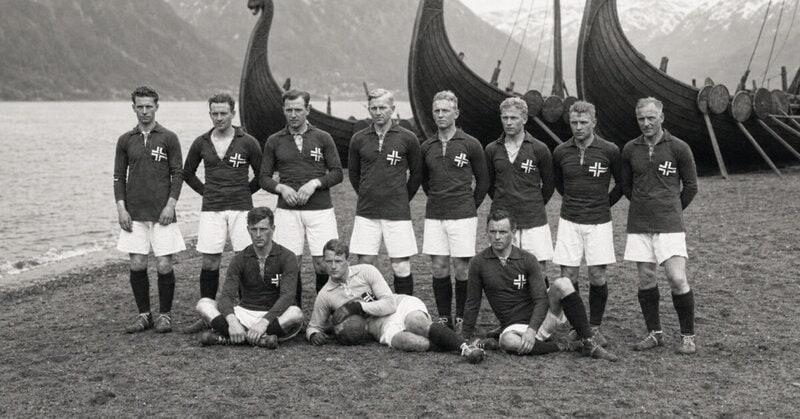
On a grey Oslo morning, Erling Haaland and his Norway teammates stood on a beach before three Viking longships, their wooden prows carved and salt-weathered, while photographer David Yarrow composed one of the most striking squad photos in international football history. The image went viral almost immediately — but the longships are doing more work than they might appear to be, pulling a thread that runs all the way back to the summer of 1936, when a group of Norwegian footballers walked into Adolf Hitler’s Berlin and did something the Nazi propaganda machine never recovered from.
The Photo That Started a Conversation About Norway’s Deeper Story

The World Cup squad shoot, captured by celebrated wildlife and sports photographer David Yarrow ahead of the 2026 tournament, was conceived as something more than a pre-tournament formality. The longships are among Norway’s oldest enduring symbols — vessels of exploration, of warrior resolve, of a people who refused to be contained by geography or fear. Posing before them, today’s squad chose a visual language that was deliberate and weighted.
Because Norwegian footballers have been here before — not on a scenic beach, but in a stadium draped with swastika flags, under the gaze of the Führer himself. And they won.
Berlin 1936: The Olympics Hitler Built as a Mirror of Aryan Supremacy

The 1936 Berlin Games were among the most politically saturated events in the history of sport. The Nazi regime had spent years engineering them as a global advertisement for an ideology — the stadium rebuilt to monumental scale, the torch relay developed partly to project an image of classical European civilisation reborn under German leadership, Leni Riefenstahl’s cameras positioned everywhere to turn athletic bodies into propaganda. Every result, every ceremony, every flag carried weight that no ordinary sporting competition ever bears.
The pressure on visiting nations was immense and contradictory. Across Europe and North America, governments and Olympic committees debated whether participation itself amounted to an endorsement of Nazi racial laws, which by 1936 had stripped Jewish citizens of their rights and driven many into exile. Some athletes and officials pushed hard for a boycott. In the end, most nations attended — and in doing so, made their conduct at the Games a political statement by default. There was no neutral position in Berlin that summer.
Into this atmosphere walked the Norwegian delegation: a small, northern European nation with deep democratic instincts, a powerful winter sports tradition, and a football team that almost nobody outside Scandinavia expected to matter.
August 7, 1936: The Day Norway Sent Hitler Walking Out of His Own Stadium

The quarterfinal between Norway and Germany took place on August 7, 1936, with Hitler reportedly present in the stands. What followed was not a narrow escape or a fortunate deflection. Norway won 2-0. They outplayed a German side that had been constructed and promoted by Nazi sports officials as a physical embodiment of national strength — a team whose results were supposed to confirm everything the regime claimed about German vitality and superiority.
Instead, the scoreboard told a different story entirely. Contemporary accounts described Hitler leaving the stadium before the final whistle, reportedly unwilling to watch the humiliation reach its conclusion. The specific details of his exit have been subject to varying accounts in the decades since, but the result itself was real and undeniable, and word of it spread across Europe with the particular delight that attaches to stories of the powerful being embarrassed by the supposedly lesser.
In a Games where every scoreboard carried ideological meaning, a 2-0 defeat to a neighbouring Nordic nation was not merely a sporting failure for Germany. It was a crack running through the very myth the Reich had spent years building — the Aryan athlete, perfected and unstoppable, beaten at home, in front of the world.
The making of Norway’s 2026 Viking photo has revived interest in exactly this kind of story — the moments when Norwegian sport reached beyond competition and into something that felt like national character.
The Salute They Refused to Give

The match result was not the only statement Norway made in Berlin. During the opening ceremony parade, as teams marched past Hitler’s viewing box, each national delegation faced a charged choice: offer the Nazi salute, perform the Olympic dip of the flag, or refuse both. The gestures blurred together in photographs and newsreels — some nations claiming their Nazi-adjacent arm movements were purely Olympic tradition — but the distinctions were understood at the time by everyone in that stadium.
Norway’s delegation declined the Nazi salute. It was not a dramatic scene; it was a quiet, firm refusal that carried more dignity for its understatement. For a small country sharing a continent with a rapidly militarising Germany, the gesture was not without risk. It was the kind of principled stubbornness that, seen in retrospect, feels deeply characteristic of a nation that would spend the years from 1940 to 1945 resisting Nazi occupation — in the mountains, in the cities, in classrooms and fishing villages and government offices.
The internal Norwegian debate about whether to attend the Berlin Games at all mirrored arguments raging across the democratic world. A full boycott never materialised, but the fact that the debate happened at all signals something important: Norway was not sleepwalking into Berlin. Its athletes arrived with their eyes open.
The Men Who Played That Match

It is worth pausing on who these players actually were. Norway’s 1936 football squad were not professionals in any modern sense. They were largely working men — labourers, craftsmen, men from fishing communities and industrial towns who had trained hard and loved the game without any expectation that it would change their lives or make them famous. There was no commercial machine behind them, no sports science department, no media entourage. They crossed Europe by train and boat and showed up to play football.
Their style was physical and disciplined, tactically coherent in a way that the German side, for all its institutional backing, struggled to handle. Norway had come through earlier rounds in the tournament not by luck but by genuine footballing quality — they were not accidental giant-killers. They were a team that had earned the right to be taken seriously, and in the quarterfinal, they proved it conclusively.
Several of these men were still alive and active when Germany occupied Norway in April 1940 — just four years after Berlin. Some served in the resistance. The defiance they had shown on a football pitch, it turned out, was not a one-off performance. It was a preview of something durable in their character, and in Norway’s.
From the Longships to the Premier League: What Norwegian Football Carries Forward

Modern Norwegian football has never been richer in individual talent. Haaland has rewritten Premier League goalscoring records with a consistency that has moved beyond sport and into something approaching mythology. The current squad contains genuine world-class quality across multiple positions. In pure football terms, Norway has rarely been better placed.
But the 1936 story is a reminder that Norwegian footballers have always carried something beyond tactical systems and physical gifts onto the pitch. They have carried an identity — stubborn, dignified, unwilling to be diminished by external pressure, whether that pressure comes from a fascist regime or from the weight of expectation surrounding a team built around the world’s most prolific striker.
The David Yarrow photograph — those players arrayed before the longships, the sea behind them, the ancient timber framing the modern — is striking on its surface. It will circulate widely because it is visually extraordinary, because Haaland is in it, and because Viking imagery has a particular hold on the global imagination. But underneath the visual impact, the image is doing exactly what great sports photography does at its best: capturing a nation in the act of telling a story about itself.
Sport, Power, and the Courage to Keep the Scoreboard Honest
The 1936 Norway-Germany match is a reminder that sport is never truly separate from politics — that it never has been, and that pretending otherwise serves mainly the interests of those who would prefer athletes and fans to remain passive. The stadium has always been a place where power is asserted, tested, and occasionally, gloriously humbled.
The questions raised by the 1936 Berlin Games have not gone away. Debates about athletes competing under authoritarian governments, about the ethics of hosting major tournaments in states that use sport as propaganda, about when participation becomes complicity — these arguments are contemporary and urgent. The 1936 Norway team did not resolve those questions. But they showed one way of navigating them: attend, refuse the salute, and then go and win the match.
That Oslo beach photograph, the longships, Haaland’s steady gaze — it is a striking image. It is more striking still when you know what it is connected to: the long history of a small country’s refusal to be overshadowed, on the pitch or anywhere else.

 English
 Arabic
 French
 Spanish
 Portuguese
 Deutsch
 Turkish
 Dutch
Dutch
 Italiano
 Romaian
 Portuguese (Brazil)
 Greek
Greek