


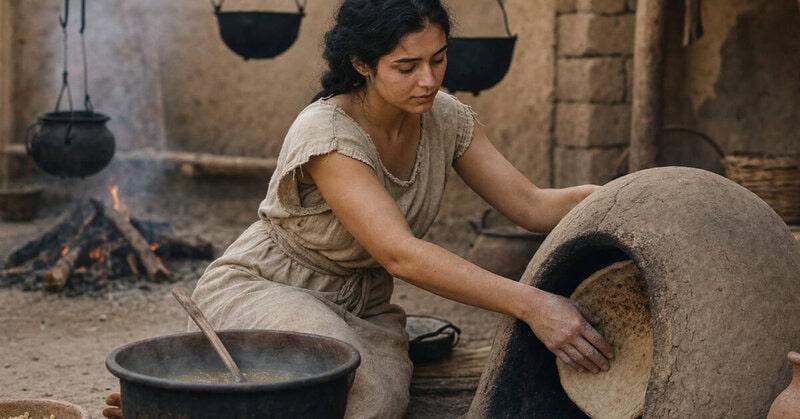
Before the first pyramid rose from Egyptian sand, before Homer sang of wine-dark seas, someone in a mudbrick house along the Euphrates was doing something achingly familiar: pressing flatbread against the hot inner wall of a clay oven, stirring a pot of onion and lentil broth, reaching for a pinch of cumin. The smell drifting through that ancient Babylonian courtyard four thousand years ago was, in all the ways that matter, the smell of home.
The Room Itself: Mud, Smoke, and Deliberate Design

Archaeologists excavating Mesopotamian urban sites — from the layered ruins of Ur in modern-day Iraq to the ancient city of Nippur — have uncovered dedicated cooking spaces that challenge every assumption about so-called primitive ancient life. The Mesopotamian kitchen was not an afterthought bolted onto a dwelling. It was a designed environment, typically positioned at the rear of a mudbrick house or tucked into a sheltered corner of a central courtyard, placed deliberately where prevailing winds or an open sky overhead could carry away smoke and heat. These were not people stumbling through meal preparation. They were solving the same ventilation problems a modern architect confronts when designing a kitchen — and arriving at workable answers.
The defining feature of this space — the element that makes an archaeologist’s pulse quicken when they find one intact — is the tannur: a cylindrical clay oven, sometimes sunk partially into the earthen floor, sometimes raised to waist height, its interior walls smoothed and fired to a permanent heat-holding hardness. The tannur is not a museum relic. Nearly identical ovens are still used across Iraq, Iran, and the broader Middle East today, a fact that speaks to an engineering elegance so complete it required no meaningful improvement across four millennia. Flatbreads were slapped against its interior walls and peeled off baked in seconds; small animals could be suspended inside on spits; its radiant heat was adjustable in ways an open fire never could be. It was, in the language of modern design, an optimal solution.
Beside the tannur sat a second heat source — a brazier or open hearth for boiling — which meant a Mesopotamian cook could simultaneously bake bread and simmer a broth. Multi-course cooking was not a Renaissance invention. In better-appointed kitchens, floors were packed earth or fired brick, and excavations have revealed shallow drainage channels cut deliberately into the floor — evidence of a culture that understood, in a daily and practical way, that water management and cleanliness were not luxuries but operational necessities for a working kitchen.
The Toolkit: What a Cook Reached For

Lining the walls and clustered near the oven would have been clay vessels of staggering variety. Tall, sealed storage jars held grain, sesame oil, and beer — the caloric bedrock of Mesopotamian daily life. Wide-mouthed cooking pots, blackened across generations by direct flame, were used for boiling stews and rendering fat. Smaller vessels served as measures, ladles, and containers for dried herbs and spices. Pottery in Mesopotamia was not decorative; it was infrastructure, and a household’s collection of clay vessels represented serious accumulated wealth that was inventoried and inherited.
On the floor or a low work surface sat stone mortars and long grinding slabs — the food processors of the ancient world. Processing emmer wheat into flour, cracking dried legumes, pulverizing cumin and coriander seeds, and grinding dried fish into a seasoning paste all happened on these stones. A good grinding slab, worn smooth by years of use and passed from mother to daughter, was a genuine household treasure. Alongside these, bronze and copper blades handled butchering, while implements fashioned from bone and bundled reed served as stirring rods, straining tools, and portioning devices. The toolkit was surprisingly complete, covering every major technique from grinding to braising to straining.
Perhaps most significantly, large ceramic vats for beer fermentation occupied space in or immediately adjacent to the kitchen. Beer in Mesopotamia was not recreational in the modern sense. It was nutritional, caloric, and considerably safer than untreated river water. Its production was serious domestic and institutional labor, tracked by temple administrators with the same care given to grain rations and silver weights, and the kitchen was its natural home.
The Pantry: Ingredients That Would Still Make Sense Today

Stand in front of the pantry of a Mesopotamian household and the contents are — with only minor adjustment — recognizable to any modern home cook. Emmer wheat and barley were the foundational carbohydrates, ground into flour for flatbreads and thick porridges. Lentils and chickpeas provided protein in a form that was cheap, storable across seasons, and endlessly versatile. Onions, garlic, and leeks formed the aromatic base of virtually every savory preparation — the same triumvirate that still opens thousands of recipes today, in kitchens on every continent.
Fats came from two primary sources: sesame oil, pressed from seeds cultivated along the river valleys, and rendered animal fat, which doubled as a cooking medium and a preservative. Dairy products — from sheep and goats rather than cattle — included early forms of butter and fresh cheese, documented in Sumerian administrative records that tracked their production and distribution with bureaucratic precision. The Mesopotamians were, among many other things, meticulous accountants of food. Their administrators recorded what was produced, stored, issued, and consumed, which is precisely why we know as much as we do about what ended up in those clay pots.
Cumin, coriander, and a range of resinous and bitter aromatics seasoned dishes with genuine technique. Small clay pots specifically sized for spice storage have been recovered at excavation sites, suggesting that seasoning was purposeful rather than casual. Cuneiform recipe tablets later confirmed this directly: spices were added at specific moments in the cooking process, not simply scattered in at the end. Fish, pulled from the Tigris and Euphrates, was a constant protein source — eaten fresh near the rivers, dried or salted for distribution inland. Lamb and goat appeared at celebrations and in temple offerings; their presence in a domestic kitchen typically signaled a feast day or a household of considerable means.
For anyone curious about how these ancient flavor traditions survive into contemporary cooking, Mesopotamia Kitchen offers a bridge between that ancient pantry and a modern table, carrying forward ingredients and techniques with genuine roots in this history.
The Recipes: When Cooking Became Literature

Sometime around 1700 BCE, an unknown scribe pressed a stylus into wet clay and recorded something unprecedented: actual cooking instructions. The Yale Culinary Tablets — a small group of cuneiform tablets now housed at Yale University’s Babylonian Collection — are the oldest known written recipes in human history. They describe meat stews, broths, and vegetable preparations with named techniques, ordered steps, and specific ingredients. They are not primitive documents. They describe stocks being built with care, meats being prepared before they enter the pot, and dishes being finished with fresh herbs and rendered fat — a technique so similar to the French culinary concept of monter au beurre that food historians have noted the parallel with something close to astonishment.
One stew recipe from the Yale tablets lists more than a dozen ingredients — including blood, aromatics, onion, and fat — combined in a sequence that implies the cook understood how flavors develop and layer over sustained heat. Crucially, these tablets were not household documents scribbled as personal reminders. Their existence implies professional cooks working in institutional kitchens — palace complexes and temple precincts where food was produced at scale, standardized, and recorded so it could be reproduced reliably by others. This is cuisine in the fullest sense: intentional, technical, and deliberately transmitted across time.
The sophistication captured in those tablets reflects a culinary culture that the team behind Mesopotamia Kitchen draws on today, translating ancient regional traditions into a modern dining experience rooted in the same flavors those clay tablets once described.
Who Cooked: Gender, Status, and the Kitchen’s Social Life

In an ordinary Mesopotamian household, the kitchen was largely a woman’s domain — not in a diminishing sense, but in the sense that her practical mastery of fermentation, seasoning, preservation, and fire management represented genuine expertise and real social authority. The recipes in her head were not recorded in cuneiform; they lived in her hands and her accumulated judgment, transmitted orally from one generation to the next, and their value was understood by everyone around her.
Palace and temple kitchens operated on entirely different terms. There, male professional cooks, bakers, and brewers held specialized roles with formal titles, and their names and daily rations appear in administrative cuneiform records alongside those of scribes and soldiers. The hierarchy within these institutional kitchens was explicit and documented: enslaved workers and low-status laborers handled the grinding — brutal, repetitive work that wore bodies down — while senior cooks held positions of genuine prestige, occasionally singled out by name in royal records. To serve as head cook in a Mesopotamian palace was to occupy a position of real consequence within the administrative order.
The kitchen was also, always, a social space. Bread-making and brewing were communal activities, particularly in poorer households where neighbors shared labor and equipment across a shared courtyard. The hearth fire carried sacred weight as well — dedicated in religious practice to Gibil, the Mesopotamian god of fire, whose presence in the flames was understood as both literal and protective. Cooking was not a secular act. The work of feeding a household was woven into the fabric of divine favor, and the kitchen fire was tended with corresponding care.
That same spirit of community and cultural continuity carries forward in places like Mesopotamia Kitchen in San Francisco, where the flavors of the ancient Fertile Crescent meet a contemporary audience. You can follow their daily kitchen life on their Instagram, where the ancient and the immediate sit comfortably side by side.
What Each New Excavation Keeps Confirming

The Mesopotamian kitchen is where food stopped being survival and became cuisine — where eating was transformed from necessity into something intentional, recorded, and passed deliberately across generations. The tannur oven, still crackling in villages across the modern Middle East, did not need reinventing because it was already right. The clay pot, the cumin seed in the stone mortar, the careful layering of onion and fat and broth: these things traveled with human migration and trade, threading quietly through every kitchen culture that followed. Persian, Greek, Roman, Arab, Ottoman — all of them inherited, in some measure, from the cooks who worked beside those Euphrates-clay ovens four thousand years ago.
What each new excavation season tends to confirm is a revision in only one direction: upward in sophistication. Archaeologists keep finding evidence not of primitive hearths but of organized, thoughtful cooking environments with drainage systems, dedicated storage, specialized tools, and stratified professional labor. The picture that emerges is not one of people barely managing to feed themselves. It is one of people who took cooking seriously enough to write it down, to build rooms specifically for it, and who understood — however they would have framed the idea — that the way a civilization feeds itself reveals something essential about what that civilization values.
The next time you smell bread pulling from an oven, or stand over a pot of lentil soup darkening with cumin and onion, you are performing an act that a cook in ancient Babylon would have recognized without a moment’s hesitation — the same movements, the same smells, the same quiet satisfaction of a meal coming together correctly. Across four thousand years, the kitchen remains the most human room in any house. Mesopotamia built it first. For those who want to taste where it all began, Mesopotamia Kitchen in San Francisco offers a living continuation of that ancient culinary story.

 English
 Arabic
 French
 Spanish
 Portuguese
 Deutsch
 Turkish
 Dutch
Dutch
 Italiano
 Russian
 Romaian
 Portuguese (Brazil)