


JRomero04/Shutterstock
Ever since its founding in 1983, Sam's Club has steadily built its presence in the U.S., with over 600 locations across the country. It would be logical to assume that the world's biggest branch was located somewhere in the United States — particularly in Houston, the city with the most Sam's Club locations alongside Dallas — but that guess would be off by more than 7,500 miles. The Walmart-owned membership store has a strong presence in China, and built its largest location yet in the country's most populous city.
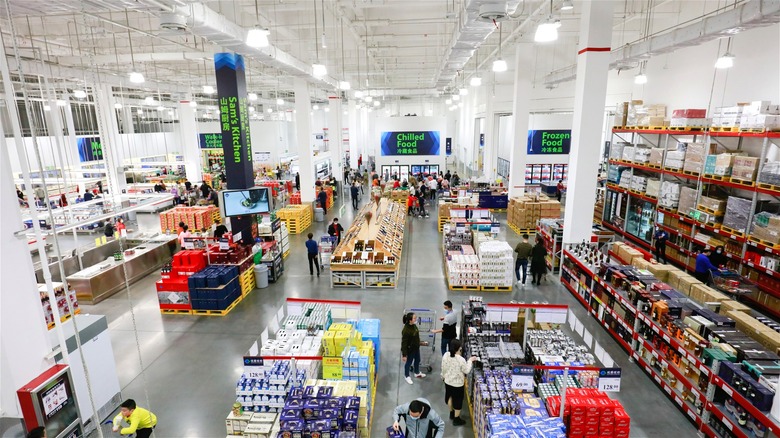
Launched in 2021, the Sam's Club in Waigaoqiao Xin Development Park, Shanghai stands at a staggering 753,473.7 square feet. To put things into perspective, the largest Sam's Club in the U.S., located in Pineville, NC, measures 185,000 square feet. That puts the Shanghai flagship store at just over four times its size. There are currently seven Sam's Club locations in Shanghai, but the one in Waigaoqiao is still the largest. It's so huge, in fact, that it broke a few other Sam's Club China records upon launch, including having the largest cafeteria and the biggest parking lot at 1,100 spots.
Why build such a massive store? It turns out that Sam's Club is wildly successful in China. According to a report by FoodTalks, Sam's Club was responsible for over two-thirds of parent company Walmart China's revenue from February 2024 to January 2025, earning roughly $14.8 billion on its own against a total of $21.8 billion.
The Sam's Club fandom in China is next level
humphery/Shutterstock
In China, a membership at Sam's Club is often treated as a status symbol. According to a Reddit user, the membership fees aren't considered affordable by the average person, so being able to shop at one — especially the world's largest location — puts you in more select company. In fact, at least one real estate agent has advertised an apartment as having a view of Sam's Club.
A big reason for this, according to a 2025 Wall Street Journal report, was the brand's pivot to the upscale market in China. Sam's Club China increased its membership fees in the 2010s to create a sense of exclusivity, with a basic membership now costing roughly $30 and a premium one costing around $97. It also curated its number of stock keeping units (SKUs) down to just 4,000, prioritizing store exclusives, whereas regular supermarkets average 8,000 to 10,000 SKUs (per McKinsey & Company). Another example of this high-end market trend across the Pacific: While the meat aisle at Sam's Club USA is typically worth avoiding, the brand is known for its quality meat selection in China.
This deliberate focus on premium items, however, is not without its issues. In mid-2025, there was furor over Sam's Club adding Orion pies, a mass-market snack cake, to its lineup of products (via China Daily). There were concerns that its introduction to Sam's Club shelves was missing the point of why customers were willing to pay high membership fees in the first place. The product was promptly removed from the Sam's Club China app, and a statement was made reassuring customers that the brand took feedback seriously (via Global Times).

 English
 Arabic
 French
 Spanish
 Portuguese
 Turkish
 Dutch
Dutch
 Italiano
 Russian
 Romaian
 Portuguese (Brazil)
 Greek
Greek