


"ShipGoo001": Mystery Of Entirely New Lifeform Discovered Coating A Great Lakes Ship
"ShipGoo001": Mystery Of Entirely New Lifeform Discovered Coating A Great Lakes Ship
Researchers investigating a strange "goo" discovered when maintaining a ship in Cleveland have discovered an entirely new lifeform.
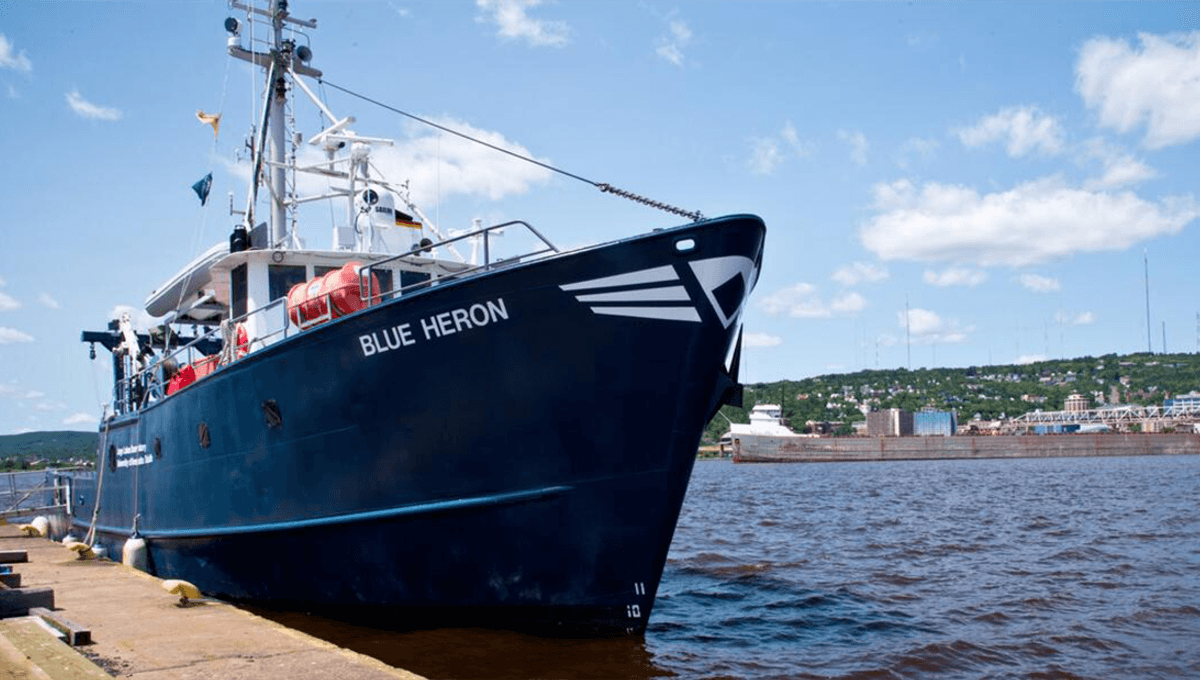
Last September, the research vessel Blue Heron – the largest US academic research fleet vessel on the Great Lakes – was brought out of Lake Erie and into the Great Lakes Shipyard to fix a noisy propeller shaft. During maintenance, a strange goo was found oozing out of the ship's rudder shaft. Large Lakes Observatory (LLO) Marine Superintendent Doug Ricketts contacted researchers at the University of Minnesota Duluth, asking them to investigate. While he and the researchers were not expecting to find much of interest, to their surprise, the goo contained life; microbes thriving in the semi-warm, oxygen-less environment. "The biggest surprise was that the ship goo had life in it at all," biologist and lead researcher Cody Sheik explained in a statement. "We thought we'd find nothing. But surprisingly, we found DNA and it wasn’t too destroyed, nor was the biomass too low." Sequencing the DNA and comparing it to global databases, the team found that the goo contained a species unknown to science, which they have dubbed "ShipGoo001". "It's fun science," Sheik added. "By calling it ship goo for now, it brings some joy to our science. We can find novelty wherever we look." Where the new microbes were found. Image courtesy of University of Minnesota Duluth ShipGoo001 comes with a few mysteries attached. For one, the microbes appear to thrive in environments with no oxygen, and in the unique ecological niche created by the ship's grease. Yet the ship traveled through oxygenated waters, and during a previous repair in 2021, no goo was observed either. Though a newly discovered lifeform, it is similar to other microbes previously discovered in petroleum wells and tar pits around the world, and is thought to be a single-cell organism. Sheik suspects that the lifeform remained dormant in the rudder oil before growing later when the conditions were right, and that the organism may even contribute to erosion of the metal rudder shaft. As yet, we don't know much more than that, though the team will continue to investigate the organism and its metabolic processes, and make the genome publicly available and publish their findings in due course. The fact that life was found while analyzing the ship's goo, however, implies that it might be worth investigating other objects (or other research vessels) we come across every day. "Scientists don’t often have time to be playful – we're focused and have projects to complete," Sheik added. "Time and resources for exploratory work can be daunting. But this shows why it matters."

 English
 Arabic
 French
 Spanish
 Portuguese
 Deutsch
 Turkish
 Dutch
Dutch
 Russian
 Romaian
 Portuguese (Brazil)
 Greek
Greek