


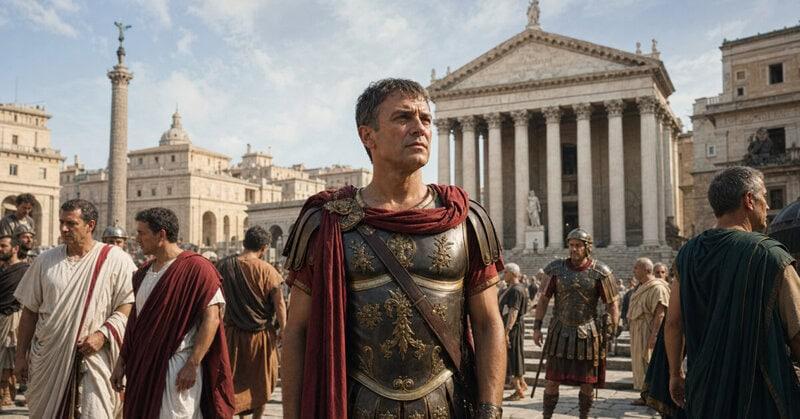
In September 2023, a deceptively simple question — “How often do you think about the Roman Empire?” — ricocheted across the internet with the force of a battering ram at the Aurelian Wall. What began as a TikTok prompt became a cultural flashpoint that media critics, feminist scholars, and Silicon Valley billionaires all felt compelled to weigh in on, revealing something stranger and more interesting than anyone bargained for about the way ancient history lives inside the modern mind.
How the Meme Started on TikTok in September 2023

The meme was born from a gesture so casual it might have happened at a thousand kitchen tables simultaneously: women picked up their phones, turned to the nearest man, and asked how often he thought about the Roman Empire. The answers that came back were not what anyone expected. “Every day.” “Multiple times a week.” “Pretty much constantly.” The women’s reactions — a mixture of bafflement, delight, and genuine alarm — made for irresistible viewing, and the videos multiplied rapidly.
The story’s velocity was confirmed by the media pile-on that followed almost immediately. Forbes, CNN, Time, CBS News, The Guardian, and The Atlantic all published dedicated coverage within the narrow window of September 18-21, 2023 — a rare synchronised chorus from outlets that rarely agree on anything. The fact that the media frenzy itself became news was a distinctly twenty-first-century twist.
The Shocking Frequency: Men Weren’t Saying Occasionally — They Were Saying Daily

The meme’s real punch was not the subject matter but the dosage. Nobody was particularly surprised that some men harboured a soft spot for legions and aqueducts. What landed like a revelation was the frequency: not once a year during a documentary marathon, not vaguely at a museum, but on a near-daily — sometimes several-times-daily — basis. A civilisation that collapsed in the West in 476 CE was apparently showing up in men’s heads as reliably as a morning alarm.
That gap between male self-report and female expectation became the emotional engine driving thousands of response videos. It followed the classic architecture of viral content — the reveal, the reaction, the relatability — but applied that architecture to a civilisation dead for fifteen centuries. Reporters scrambled to explain why a question about ancient history could feel so urgently, hilariously contemporary, and the answer said as much about the internet as it did about Rome.
What “My Roman Empire” Means — and Why the Phrase Took On a Life of Its Own

Any meme that survives more than a week on TikTok must mutate, and this one did so efficiently. Users began detaching the phrase “my Roman Empire” from Rome itself and redeploying it as shorthand for any idea, memory, or grievance that the brain returns to on its own stubborn schedule — uninvited, unkillable, oddly compelling. A perceived slight from seventh grade. A TV show cancelled on a cliffhanger. The perfect comeback thought of three days too late. All of it, suddenly, was someone’s Roman Empire.
As the phrase entered everyday vocabulary, it came to describe the experience of a thought that will not stay buried — something the brain loops back to on its own schedule, regardless of whether it is welcome. Rome became a metaphor for the mind’s own circuitry, which is why the phrase spread so far beyond the people who had ever genuinely pondered the Punic Wars. The original trend had asked why men think about Rome; the evolved version asked something more interesting — why do any of us think about anything obsessively?
Mark Zuckerberg’s Caesar Confession Added Celebrity Fuel

When the meme needed a celebrity cameo to push it into the mainstream news cycle, Mark Zuckerberg obliged. The Meta CEO publicly joked that his children are named after Roman emperors — a detail that landed with perfect comic timing, confirming that one of the most powerful people on the planet was, in his own domestic life, a living illustration of the meme’s central premise. Roman naming conventions had quietly colonised a Silicon Valley nursery.
His comment was widely shared and amplified the story beyond the confines of internet culture into the celebrity-and-tech press. It was also, inadvertently, a small piece of evidence for something historians have long noted: the Roman Empire never entirely ended. It dissolved into language, law, architecture, and religion — surfacing in places its original architects could not have imagined but might not have found entirely surprising.
Know Your Meme Gave It Official Internet Taxonomy

Every meme that achieves genuine cultural traction eventually earns its place in the unofficial canon, and this one was formally catalogued by Know Your Meme under the title “How Often Do You Think About the Roman Empire?” — granting it a permanent entry alongside other monuments of internet history. The entry documented the meme’s origin, spread, and variations with analytical seriousness, which is itself a kind of tribute.
More tellingly, the fact that a website dedicated to internet humour felt compelled to produce quasi-academic content about ancient history is perhaps the most Roman thing about the entire episode: even in decline, the empire demands serious attention.
The Atlantic Framed It as a Window Into Male Psychology and Algorithmic Culture
The Atlantic took the longest view of the coverage wave, positioning the trend not as a throwaway joke but as a technology and culture story about what the meme reveals at the intersection of male psychology and algorithmic social media. The argument was that the meme’s virality was not accidental — recommendation engines are extraordinarily good at finding audiences already primed for a particular kind of identity content, and the image of Rome as masculine, ordered, and powerful fits neatly into categories those engines have learned to reward.
It was one of the more intellectually ambitious pieces to emerge from the September pile-on, because it refused to stop at “why Rome?” and pushed on to “why does this particular question spread the way it does?” The answer implicated not just ancient history but the architecture of platforms that had not existed a generation ago — a reminder that every viral moment is also a mirror held up to the medium that carries it.
CNN’s Opinion Section Argued Men’s Rome Obsession Is ‘Mostly Just Vibes’

CNN’s opinion coverage offered a more pointed assessment, arguing that men’s enthusiasm for the Roman Empire amounts to mostly just vibes combining mythic ideas around ancient Greece and Rome — filtered through decades of Hollywood imagery — rather than any rigorous engagement with historical reality. The suggestion was that what most men are thinking about is not the actual Roman Empire, with its grinding bureaucracy, epidemic disease, and brutal slave economy, but an aestheticised myth of power and order.
The critique added a productive layer of self-awareness to the conversation. If the obsession is more aesthetic than intellectual, does that make it less meaningful — or simply differently meaningful? The debate that followed was a reminder that loving something vaguely and knowing it deeply are two distinct relationships with the past, and that most of us, at one point or another, have confused the two.
Teen Vogue’s Op-Ed Challenged the Meme’s Assumption That Rome Is Inherently Male Territory

Teen Vogue published an op-ed that pushed back against the meme’s foundational premise: the idea that thinking about Rome is an essentially male trait. The piece argued that the meme’s framing — positioning Rome as a distinctly male obsession — reflected and reinforced misogyny by implying women have no relationship to classical history. Roman women existed, shaped Roman society in ways both visible and invisible, and have been the subject of serious scholarship for centuries. To frame classical antiquity as a male intellectual playground was not just a harmless joke, the argument went — it was a small act of historical dispossession, echoing much larger patterns in who gets assigned authority over the past.
The op-ed injected genuine feminist criticism into what had begun as a lighthearted TikTok prompt and sparked a counter-conversation about who gets to “own” ancient history as a cultural identity marker. It was a useful complication. The Roman Empire was, among many other things, a society in which women of various classes and statuses navigated power, religion, commerce, and family life — and any version of Rome that erases them is already a fiction, however vivid.
Women’s Counter-Trend Argued Obsessive Thinking Is a Human Trait, Not a Male One

The meme’s final major mutation came when women across TikTok and other platforms began sharing their own equivalents — the recurring thoughts, unresolved memories, and stubborn preoccupations that occupy their mental loops just as persistently as Rome allegedly occupies men’s. The format flipped the original dynamic entirely: instead of women as the astonished interviewers, they became the subjects, asserting that obsessive, intrusive preoccupation is not a gendered quirk but a human one.
The speed with which this counter-content spread demonstrated how efficiently the original meme had established a recognisable template — simple enough to be imitated, flexible enough to be subverted, and resonant enough to make the subversion feel satisfying rather than forced. The whole cycle, from opening question to feminist counter-trend, played out in under a week — a testament to the internet’s creative velocity, and perhaps evidence that the Romans, with their gift for rapid infrastructure, would have taken to social media with frightening competence.
Two thousand years after the Senate last sat, a question posed on a smartphone managed to make millions of people argue about history, identity, memory, and the strange persistence of dead empires — which suggests that whatever Rome actually was, it remains, stubbornly and inexplicably, a live wire in the collective imagination.

 English
 Arabic
 French
 Portuguese
 Deutsch
 Turkish
 Dutch
Dutch
 Italiano
 Russian
 Romaian
 Portuguese (Brazil)
 Greek
Greek