


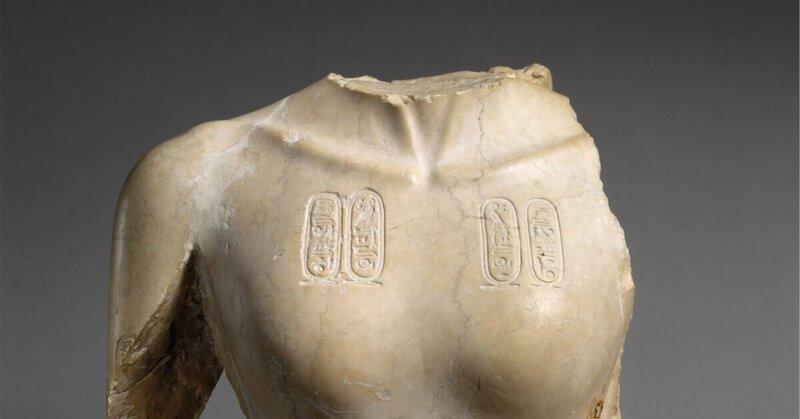
The stonemasons moved through Akhetaten in near silence, their chisels rising and falling in the afternoon heat, carving away something far more dangerous than stone. They were not destroying art. They were destroying a man — not his body, which was already in the ground, but his existence across all of time, forward and backward, erasing him from eternity one careful strike at a time.
The Ren: Your Name as a Piece of Your Soul

To understand why those chisels mattered so absolutely, you have to accept a premise that ancient Egyptians held as plain fact: a person was not a single thing. The human being was a composite of five distinct spiritual elements — the ka, or life force; the ba, something close to personality or individual spirit; the ib, the heart as the seat of conscience; the shut, the shadow-self; and finally the ren, the name. Each part had its role in sustaining the soul through death and into eternity. But the ren was different from all the others in one fundamental way: it was the only part of a person that human hands could preserve — or annihilate.
The ka departed with the last breath. The ba flew free of the tomb each morning like a human-headed bird. But the ren lived precisely where people put it: carved into temple columns, painted inside coffin lids, scratched onto clay figurines, spoken aloud in ritual. It existed in the world only as long as the world kept it there. This made it uniquely precious and uniquely fragile, a flame that required constant tending by the living.
The tending was literal. Priests recited the names of the honored dead during offering ceremonies — not as performance or poetry, but as theology. To speak a name was understood as a genuine act of resurrection, a momentary recall of the person into being, a feeding of the eternal soul. Temples were, among other things, enormous machines for keeping names alive. Carving a name deep into granite was not decoration; it was insurance, the most durable medium available pressed into service against the erasure of time.
Ancient Egyptian naming customs surrounding birth reflected the same gravity. Naming a child was a sacred act, often performed by the mother, and the name given was understood to shape not merely the child’s social identity but their divine fate, their relationship to the cosmic order. A name announced what a child was in the sight of the gods before it announced who they were to their neighbors.
What Egyptian Names Actually Meant — and Why That Mattered

Most ancient Egyptian names were not names in the way we use the word today — personal labels attached more or less arbitrarily at birth. They were compressed theological statements, prayers frozen in sound, declarations of faith worn on a human body. Ancient Egyptian names functioned as miniature creeds, and every time someone was called across a marketplace or greeted at a temple gate, a small act of worship occurred.
Consider Amenhotep — jmn-ḥtp in the original Egyptian — which translates directly as “Amon is satisfied.” The name combines the name of the great god Amon with ḥtp, meaning peace or satisfaction. A man named Amenhotep was not merely called Amenhotep. He was, every time his name was spoken, a living announcement that a chief god of the Egyptian pantheon was at peace with the world. His name was a continuous theological statement, renewed with every greeting.
This was not unusual. From the time of the Middle Kingdom, virtually every Egyptian person carried a god’s name or title within their own. Men bore names invoking Horus, Khons, or the “Lord of the gods.” Women carried names meaning “Lady of” a particular deity. The major gods — Amun, Ra, Ptah, Thoth, Horus, Mut — appeared across thousands of personal names, distributed through the population like seeds scattered across the Nile valley. Egyptian society was, in effect, a walking litany of divine invocation. Neighbors greeted each other, and gods were named. Children were called in from play, and the divine order was reasserted.
Dynastic naming patterns reveal how deeply pharaonic power shaped this landscape. When a great ruler reigned, their name — or structural elements of it — spread downward through the social order. Ordinary families named children after royal figures, not out of mere admiration but to capture some fragment of that sacred royal authority, to bind a child’s ren to the divine force that surrounded a living god-king. The most common names in ancient Egypt cluster around precisely these royal and divine connections, and tracking their rise and fall across centuries amounts to a map of which gods and kings held the Egyptian imagination at any given moment.
Names also carried transparent literal meanings that would have been immediately legible to any Egyptian speaker. Nefertiti means “the beautiful one has come.” Thutmose means “Thoth is born.” Ramesses means “Ra has fashioned him.” Unlike modern names whose original meanings have grown opaque through centuries of borrowing and drift, these names were heard as full sentences every time they were spoken — sentences addressed, in a real sense, to the gods.
Cartouches, Crowns, and the Name That Protected a King

If the ren was a living force for every Egyptian, for a pharaoh it was something even more charged: a nexus of divine identity so complex and powerful that it required its own architectural protection. The cartouche — the oval rope-loop that enclosed royal names on monuments and papyri — was not a decorative frame. It was a protective spell in visual form. The looped rope had no beginning and no end, symbolizing the pharaoh’s dominion over everything the sun encircled, and the name enclosed within that loop was shielded by that symbol of infinity.
A pharaoh did not have one name. Royal naming customs gave each king an elaborate five-part titulary — five separate names, each describing a different aspect of the king’s divine nature and cosmic role. These included the Horus name, the Two Ladies name, the Golden Horus name, the throne name, and the birth name. A pharaoh moved through the world carrying five living spells as their identity, five distinct claims on eternity, each carved into monuments and recited in rituals throughout their reign and long afterward.
Temple walls were engineering projects in immortality. Carving a royal name deep into granite was chosen precisely because granite resists time in ways that wood, papyrus, and paint do not. A name in granite was a name that could outlast the body, the dynasty, and possibly the civilization itself — and as long as it lasted, the ren it preserved kept its owner alive in the afterlife regardless of what happened to the physical remains. Commoners understood the same logic and worked within it. Clay shabtis scratched with a name, painted coffin boards, modest stelae set up in local sanctuaries — the impulse was identical to the pharaoh’s granite temple reliefs, scaled to what a family could afford.
Damnatio Memoriae: How Egypt Perfected the Ultimate Punishment

Long before Rome gave it a Latin name, Egypt had already perfected the practice of condemning a person to what its practitioners understood as a second and total death. Egyptian name erasure stretches back across dynasties, and the logic behind it was precise: exile destroyed freedom; execution destroyed the body; imprisonment destroyed liberty. But name erasure — damnatio memoriae in the Roman vocabulary that history has settled on — destroyed the soul while potentially leaving the body entirely intact. It was the punishment beyond death, the only act that could reach a person after they were already in the ground.
The stonemasons working through Akhetaten after Akhenaten’s death were performing exactly this. The pharaoh who had promoted the singular sun-god Aten and restructured Egyptian religious life had made powerful enemies. After his death, a systematic campaign of erasure was carried out — so thorough that later Egyptians had no usable name for him. He was referred to in surviving texts only as “the enemy” or “the criminal of Akhetaten” — his actual name avoided as though to write it would be to feed the very soul they were starving. The campaign worked so effectively that for much of recorded history he was essentially unknown, a gap in the king lists where a pharaoh should have been.
Hatshepsut’s erasure by Thutmose III offers another layer of complexity. One of Egypt’s most capable rulers, a woman who had reigned as pharaoh for roughly two decades, her images were chiseled away, her cartouches re-carved with Thutmose’s name, her monuments attributed to others. Scholars still debate the precise motive — political rivalry, succession anxiety, ritual necessity — but the mechanism and its intended effect were the same. A living god-queen was being made to un-exist. The terror embedded in this practice was not abstract. Every Egyptian who passed a freshly chiseled wall, who saw the outline where a cartouche had been, understood exactly what had happened there and exactly what it meant for the person whose name had occupied that space.
Name Changes, Conversion, and the Living Spell Rewritten

The same metaphysical logic that made name erasure so devastating also made deliberate name-changing a profound act of transformation. In Egyptian understanding, changing your name was not rebranding. It was a genuine reconfiguration of the soul — a new ren meant a new relationship with the divine, a new identity at the most fundamental level of existence.
Ancient Egyptian naming customs around adoption and priestly initiation made this explicit. Receiving a new sacred name upon entering a priestly order or being adopted into a noble family was understood as receiving a new soul-configuration, a new self in the fullest theological sense. The old name did not simply become disused; its power over the person was genuinely believed to shift.
When Alexander the Great conquered Egypt in 332 BCE and presented himself to Egyptian priests and people within the full pharaonic framework — taking Egyptian titles and being acknowledged as pharaoh — he was, by Egyptian theological logic, actually becoming something new. His ren was merging with pharaonic tradition, and the divine force that pharaonic names carried was, in the Egyptian understanding, genuinely transferring to him.
The spread of Christianity through Egypt between the third and fifth centuries CE created a collision of these naming systems that the Egyptians themselves would have recognized as metaphysically significant. Egyptian converts took Biblical names — names entirely outside the divine framework of Amun, Ra, and Horus. To the Egyptian theological tradition they were leaving, this represented a genuine severance from the old name-soul, a deliberate self-erasure of one divine identity and the assumption of another. The act of conversion was, in the logic of the ren, a kind of voluntary transformation: a chosen death of the old self and the birth of something entirely new.
How to Read an Egyptian Name Today

Ancient Egyptian was written in a consonantal script — vowels were generally not recorded, which means that modern pronunciations of ancient names are scholarly reconstructions built from Coptic, Greek transliterations, and comparative linguistics. The names we say aloud today — Nefertiti, Ramesses, Amenhotep — are approximations, useful conventions rather than phonetic certainties. This is worth holding in mind: even our careful modern invocations of these names are reaching across a language barrier that no amount of scholarship has fully dissolved.
What we can read clearly is structure. Egyptian names followed recognizable grammatical patterns. Theophoric names — names embedding a divine name — follow a template: god’s name plus verb or adjective. Ramesses: Ra plus ms, “fashioned” or “born of.” Amenhotep: Amun plus ḥtp, “satisfied.” Tutankhamun: the living image of Amun. Reading the structure of an Egyptian name is reading a compressed theological argument, and once you learn to spot the divine elements — Ra, Amun, Ptah, Thoth, Horus — you begin to see them everywhere, distributed through personal names across thousands of years of Egyptian history like a recurring signature.
Why This Ancient Logic Still Echoes
It would be too easy — and not quite honest — to claim that we have simply inherited the Egyptian belief in the ren and dressed it in modern clothes. But something genuine persists. Across cultures and millennia, the instinct to preserve names — on gravestones, in memorial readings, in the simple act of saying a dead person’s name aloud at a family gathering — carries the ghost of a very old intuition: that to name is, in some way that resists complete rational explanation, to keep alive.
Grief counselors note that survivors often feel the person is somehow more absent when their name goes unspoken. Memorial traditions across many cultures — the Jewish Yizkor, the Catholic commemoration of the dead, the reading of names at war memorials — share the structural conviction that the speaking of a name does something, reaches somewhere, matters beyond the mere sound. The theology differs. The instinct is remarkably stable.
Return, then, to Akhetaten. The stonemasons chipping away at cartouches in the years after Akhenaten’s death were not vandals settling scores, not soldiers following orders they privately considered superstitious. They were performing what their world understood as the most final act available to human hands. Their targets — if any survived to witness what was being done — knew with complete clarity what was being taken from them. Not their reputation. Not their legacy in any modern, secular sense. Their existence. Their presence in eternity. The ability of anyone, anywhere, any time in the future, to speak their name and momentarily call them back into being.
And yet here is the haunting remainder: every Egyptian name that survives — Amenhotep, Nefertiti, Thutmose, Hatshepsut — is still doing exactly what it was carved to do. Still present in the world. Still being spoken. Still, by the logic of the people who first gave those names their power, keeping its owner alive in some register of existence that their civilization spent three thousand years trying to reach.
If a name spoken aloud is a resurrection, what does it mean that we are still saying these names today?

 English
 Arabic
 French
 Spanish
 Portuguese
 Deutsch
 Turkish
 Dutch
Dutch
 Italiano
 Russian
 Romaian
 Portuguese (Brazil)