


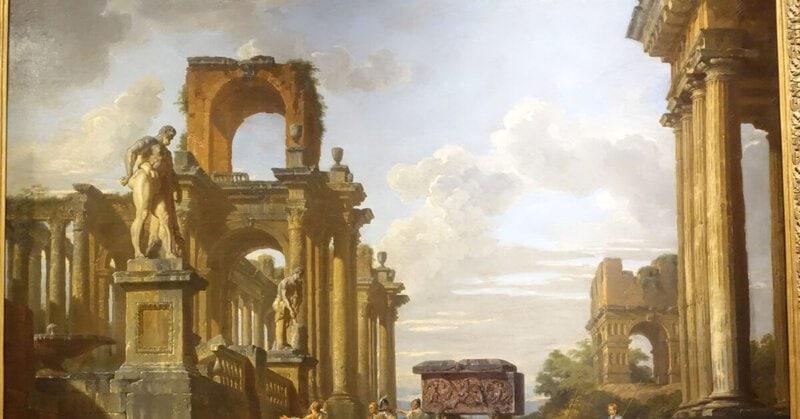
It started at a dinner table sometime in 2023. A woman looked across at her boyfriend mid-meal and asked, almost as an experiment, how often he thought about the Roman Empire. He didn’t pause, didn’t qualify, didn’t laugh it off. “Every day,” he said. She was stunned. TikTok was not.
The Question That Broke the Internet

When that simple dinner-table exchange migrated onto social media, it detonated. Women across the world turned to the men in their lives — partners, brothers, fathers, friends — and posed the same question. The responses flooded back with an almost eerie consistency: weekly, daily, multiple times a day. Not because anyone had assigned it, not because a documentary had just aired. Simply because ancient Rome, unprompted, kept showing up uninvited in the minds of millions of modern people.
Within weeks, the Roman Empire trend had transformed into something stranger and funnier than a simple history lesson. The phrase detached itself from togas and gladiators entirely and evolved into a universal shorthand: your Roman Empire is any idea, person, mystery, or mild cultural grievance you cannot stop mentally circling back to. Rihanna’s Super Bowl halftime show. Why hot dogs come in packs of ten. The ending of a television series cancelled fifteen years ago. “This is my Roman Empire,” people began saying, with a mixture of confession and comedy, and everyone immediately understood what they meant.
But underneath the laughter, a genuinely interesting question remained. Of all history’s empires — the Ottoman, the Mongol, the British, the Han — why does this particular one live rent-free in so many modern minds? Why Rome, specifically? The answer turns out to be much older, and much stranger, than a TikTok trend.
The Meme Decoded: What “This Is My Roman Empire” Actually Means

The trend’s mechanics were straightforward. Beginning in 2023, posts encouraged women to ask the men in their lives a single question about Rome and then film the response. What emerged was the discovery that a remarkable number of men genuinely, regularly, and somewhat sheepishly think about the Roman Empire — not because they are historians or re-enactors, but because something about Rome had lodged itself permanently in the background of their thinking, like a browser tab they never quite close.
The phrase’s evolution was swift and linguistically elegant. Once “Roman Empire” became a container for any persistent, slightly irrational obsession, people found it gave them a funny, low-stakes way to confess their own fixations. The “my Roman Empire” construction captured something true about how certain ideas colonize the mind without permission — and naming that phenomenon, even jokingly, brought collective relief.
There is a cultural irony worth pausing on. A civilization that collapsed roughly 1,500 years ago became a viral internet moment not through a prestige documentary or an academic paper, but through the oldest possible human ritual: two people having a conversation over dinner. Rome has always spread that way — person to person, story to story — and the meme was simply the latest dispatch in a very long chain of transmission.
It also raised a more pointed question that the jokes tended to obscure: why are so many people, most of them with no formal training in classical history, carrying Rome around in their heads at all? The meme was the symptom. The real story is the disease — and it turns out to be both ancient and entirely logical.
Rome Is Literally Everywhere You Look

Consider a single ordinary day. You wake in January — named for Janus, the Roman god of beginnings and doorways. You drive on roads whose straight-line engineering principles trace back to Roman surveyors who understood that the fastest route between two points was also the fastest way to move an army. You pass a courthouse or a capitol building fronted with columns and a triangular pediment — architectural forms copied almost directly from Roman temples. You check a calendar whose months still carry Latin names: March for Mars, August for the emperor Augustus, and the stubborn numerical ghost of September through December, which preserves the memory of a Roman year that once began in spring.
The language you use is saturated with Rome. Roughly thirty percent of English words derive from Latin, a proportion that climbs toward sixty percent in legal, scientific, and medical writing. Every time someone says “et cetera,” “status,” “agenda,” “exit,” or “video,” Rome is speaking through them. The word “candidate” comes from the white toga — toga candida — that Roman office-seekers wore to signal purity. “Salary” derives from sal, the Latin word for salt, reflecting the historical practice of compensating Roman soldiers partly in salt or in money to buy it.
The architecture of democratic governance is even more directly Roman. The United States Senate takes its name, its bicameral logic, and much of its institutional self-image from the Roman senate. The concept of the veto — literally “I forbid” in Latin — was a Roman mechanism allowing tribunes to block legislation. The philosophical presumption of innocence, the adversarial trial, the codification of law: the American Founders studied Rome obsessively and consciously. They wanted to build a republic on Roman foundations while avoiding Rome’s particular slide into autocracy — though they were not uniformly successful on that second point, and they knew it even as they wrote.
Then there is the physical inheritance: the arch, the dome, poured concrete, underfloor heating systems called hypocausts, long-distance aqueducts that moved water across mountains with extraordinary precision. Rome didn’t merely build impressive structures. It built the template of what a built environment could be — and that template remains the visual grammar of almost every Western city still standing.
All of this means that when someone says they “keep thinking about Rome,” they are, in a quiet and literal sense, thinking about the world they already live in. The obsession is not eccentric. It is, arguably, the most rational response to the built and linguistic and institutional environment that surrounds us.
The Ancient Roots of the Obsession: Rome Thinking About Itself

Here is the twist that makes the Roman obsession genuinely fascinating: it did not begin with TikTok, or with Hollywood, or even with the Renaissance. It began with Rome itself. The empire was almost pathologically self-mythologizing — producing Virgil’s Aeneid to link its origins to the fall of Troy, commissioning Livy to write a sweeping national history across 142 books, and erecting monuments designed not merely to impress contemporaries but to make posterity feel small. Rome wanted to be thought about forever, and it engineered that outcome with the same systematic energy it brought to road-building.
When the Western Roman Empire fell in 476 CE, the obsession did not diminish — it intensified, because now Rome could be mourned and idealized rather than merely inhabited. Charlemagne was crowned “Emperor of the Romans” by Pope Leo III on Christmas Day 800 CE, explicitly leveraging Rome’s symbolic authority for political legitimacy. Medieval monks copied Roman manuscripts as though handling sacred relics. The Byzantine Empire, centered in Constantinople, called itself the Roman Empire and continued doing so for another thousand years after Rome’s fall in the West. The word “Byzantine” is a modern coinage by historians — the people themselves called themselves Romans, simply and without irony, until the very end in 1453.
The Renaissance was essentially a civilizational fan account for Rome. Architects measured Roman ruins with calipers. Painters studied Roman sculpture to understand proportion and weight. Philosophers translated Cicero as though recovering a lost scripture. Crucially, Renaissance thinkers did not believe they were creating something new — they believed they were recovering something lost and perfect, a model of human achievement that needed only to be found again. This is not the behavior of people indifferent to the past. It is the behavior of the deeply, helplessly obsessed.
Napoleon studied Caesar’s campaigns the way a film student studies a master director. The American Founders debated the fall of the Roman republic across pamphlets and letters as though it had happened last decade, not two millennia prior. Mussolini ransacked Rome’s visual vocabulary for fascist aesthetics, constructing a grotesque simulacrum of imperial imagery to legitimize his regime. Each era finds in Rome exactly the warning or the inspiration it needs — which reveals something important. Roman obsession has always been, at its core, a mirror. We look at Rome and see ourselves, or what we fear we might become.
The Psychology of the Obsession: Why Our Brains Love Rome

Rome offers the brain an almost perfect narrative cocktail. Grand rise and spectacular fall. Moral complexity at every turn. Sex, violence, political intrigue, engineering genius, and genuine philosophical sophistication all coexisting in the same civilization — sometimes in the same person. Julius Caesar was simultaneously a brilliant military commander, a gifted prose stylist whose Gallic Wars is still taught in Latin classes, a serial adulterer by ancient and modern accounts, and the pivot point of an assassination that altered the course of Western history. Minds wired for story find this combination essentially irresistible.
What makes Rome especially compelling is the collision of vast scale with startling intimacy. We are talking about an empire of tens of millions of people stretched across three continents — and yet we have Cicero’s private letters complaining about his finances and his difficult son-in-law. We have Pliny the Younger’s eyewitness account of Vesuvius erupting over Pompeii, written with a journalist’s precision for sensory detail. We have graffiti scratched into Pompeii’s walls that reads with an immediacy indistinguishable from a social media comment: insults, boasts, love declarations, crude jokes. Rome is simultaneously alien and startlingly recognizable, which is exactly the combination that keeps minds returning without invitation.
There is also Rome’s power as a thinking tool. In an era of climate anxiety, political polarization, and debates about institutional decay and overreach, the question “how did Rome fall?” is rarely a purely historical inquiry. It is a way of asking: could we fall too? What are the early signs? How long does collapse actually take from the inside? Rome functions as something like a controlled laboratory for thinking about power, legitimacy, and civilizational fragility — and that laboratory feels urgently relevant when contemporary headlines seem to rhyme with it. The historian’s question and the citizen’s anxiety turn out to be the same question, dressed differently.
The Empire That Refuses to Die on Screen

From Quo Vadis in 1951 to Gladiator in 2000 to Ridley Scott’s sequel released in 2024, Hollywood has returned to Rome more reliably than to almost any other historical setting. Each film rewrites Rome’s meaning for its generation’s particular anxieties. Gladiator arrived at the turn of the millennium as an allegory about democracy corrupted by spectacle and the manufactured consent of entertainment, and the fit was not forced. HBO’s Rome dramatized the republic’s collapse with a novelistic attention to human cost. Mary Beard’s television documentaries brought rigorous scholarship to mass audiences without condescension. Mike Duncan’s podcast The History of Rome — which ran to 179 episodes and accumulated millions of downloads across several years — demonstrated that appetite for Rome scales from prestige television budgets all the way down to a single person with headphones on a morning commute.
Video games added a generational layer that purely passive media cannot match. The Total War series and numerous grand strategy titles let players govern provinces, manage legions, and make the decisions that Rome’s real rulers made — decisions with cascading consequences. When you have personally managed the grain supply of a Roman province, or watched your virtual legion shatter under a Germanic cavalry charge, Rome stops being abstract. It becomes, in some small but real way, yours. The TikTok meme, seen through this lens, was not an aberration. It was simply the latest episode in a 1,500-year content franchise that Rome has been producing since the moment it ended.
Rome’s Shadow Side: What the Obsession Can Obscure
Any honest account of the Roman obsession has to reckon with what the romanticism tends to leave out. Rome was a slave society on a staggering scale — at the empire’s height, scholars estimate that enslaved people may have constituted between twenty and thirty percent of the Italian peninsula’s population. The infrastructure we admire, the roads and aqueducts and monumental buildings, was built substantially on coerced labor under brutal conditions. The legal sophistication we inherit coexisted with systematic exclusion of women from public life, the casual use of torture, and the spectacularized killing of human beings as mass entertainment.
Rome’s military expansion, which we often describe with neutral words like “conquest” and “pacification,” meant the destruction of cultures, the enslavement of defeated populations, and the violent suppression of resistance across Britain, North Africa, the Near East, and much of continental Europe. The Gallic Wars that made Caesar’s reputation, and that he wrote about with such elegant clarity, killed an estimated one million people and enslaved another million according to ancient sources, figures that modern historians treat as plausible in their general magnitude if not their precision.
None of this makes Rome less historically important or less worth studying. It makes Rome more important to study carefully — because the parts we tend to romanticize and the parts we tend to omit are inseparable from each other. The aqueducts and the slave markets were the same civilization. Understanding that fully is more useful, and more honest, than the sanitized version that tends to go viral.
What Rome Is Really Asking Us
Return to the dinner table. The reason the meme was funny — genuinely, recognizably funny — is that it accidentally exposed something serious. We live inside Rome’s decisions every day without fully noticing: every time we use a Latin word, walk into a domed building, expect a fair trial, or read a January calendar. When we suddenly notice all of that at once, the combination of absurdity and profundity is almost vertiginous.
Rome endures not because it was uniquely virtuous — it was not, as the previous section makes clear. It endures because it was among the first civilizations to argue, in stone and law and literature and the very names it gave to months and planets, that it would last forever. The argument was persuasive enough to echo across two millennia and surface on someone’s phone screen over dinner in 2023. That is, by any reasonable measure, an extraordinary achievement in cultural persistence, whatever its moral complexities.
The meme’s true gift was linguistic. It turned a niche historical preoccupation into a shared vocabulary for talking about our own fixations — which is itself a deeply Roman move. Rome has always provided the language for things humans couldn’t otherwise name. It gave us the words for law, for power, for time, for civic life. Now, improbably, it has given us the phrase for the peculiar experience of having an idea that simply will not leave you alone.
Your Roman Empire might be ancient aqueducts or the engineering of the Pantheon’s unreinforced concrete dome, which has stood for nearly two thousand years. It might be something else entirely — some question or mystery or memory that surfaces uninvited while you are doing the dishes or staring out a train window. But the fact that you have one, that there is something you return to without intending to, connects you across centuries to every human mind that has ever needed a story larger than itself to make sense of the present. Rome understood that need. It built an entire civilization around it. And whatever its failures — and they were many and grave — it built that civilization to last in the minds of people it would never meet. Clearly, it succeeded.

 English
 Arabic
 French
 Spanish
 Portuguese
 Deutsch
 Turkish
 Dutch
Dutch
 Russian
 Romaian
 Portuguese (Brazil)
 Greek
Greek