


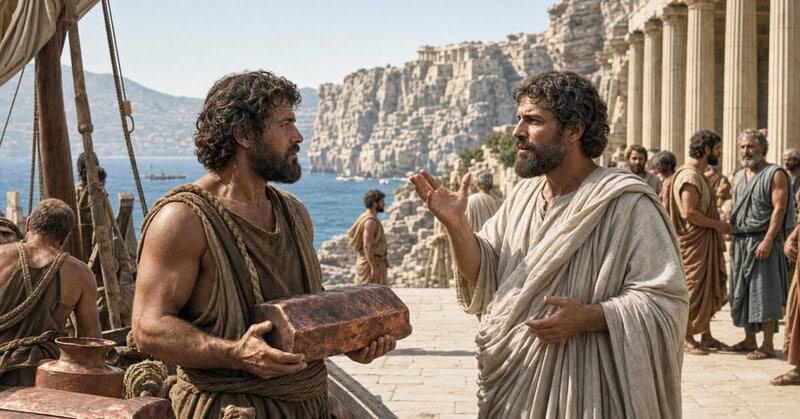
Imagine two men, both ancient Greeks: one is a Bronze Age sailor hauling copper ingots across the Aegean in 1600 BCE, squinting at the limestone cliffs of Crete; the other is a philosopher sparring with strangers in an Athenian agora in 400 BCE, half a millennium later. They share a world — the same sea, roughly the same gods, a cultural kinship we label with the same two words — yet the gap between them is longer than the gap between us and the First Crusade. Ancient Greece was not a single golden moment frozen in marble. It was a living, shape-shifting civilization that lasted well over a thousand years, and understanding it means learning to see all of its faces at once.
Before Greece Was Greece: The Prehistoric Foundations (7000-3200 BCE)

The story begins quietly, without drama or monument. Around 6000 BCE, small farming communities were settling the flat, sun-baked plains of Thessaly in northern Greece, cultivating emmer wheat, keeping goats, and building mud-brick houses — the kind of anonymous, patient life that rarely makes it into history books. Yet those Neolithic villagers were laying the invisible foundations of everything that followed. Agriculture created food surpluses. Surpluses supported population growth. Population growth demanded trade. Trade networks, slowly thickening across the Aegean, made complex societies possible.
This Neolithic period, running roughly from 7000 to 3000 BCE, was itself the latest chapter in a vastly longer human story on the Greek peninsula. Paleolithic humans had moved through the region for hundreds of thousands of years; Mesolithic foragers hunted and gathered there from around 13000 to 7000 BCE before agriculture gradually took hold. But it is the Neolithic revolution — the shift to farming, herding, and settled village life — that seeded the demographic and economic conditions for what came next. By around 3200 BCE, copper and tin were beginning to transform tools, weapons, and social hierarchies across the eastern Mediterranean. The Bronze Age was opening. The Aegean was about to produce its first recognizable high cultures.
Palaces, Bulls, and Sea Kings: The Bronze Age (3200-1100 BCE)

The first great flowering of Aegean civilization rose not on the Greek mainland but on the island of Crete. The Minoans, flourishing from roughly 2200 to 1450 BCE, built sprawling, multi-story palace complexes at Knossos that would have astonished any visitor: bright frescoes of acrobats vaulting over charging bulls, storerooms packed with clay jars of oil and grain, workshops producing jewelry of extraordinary delicacy. They traded with Egypt, Cyprus, and the Levant. They wrote in a still-undeciphered script called Linear A. By any reasonable measure, they were one of the most sophisticated societies the ancient world had yet produced — and they left behind the legend of the labyrinth, the Minotaur, and a culture so puzzling that scholars still debate whether their rulers were priests, queens, or something else entirely.
On the mainland, a different civilization was rising. The Mycenaeans — Greek-speaking, warrior-aristocratic, and expansionist — emerged around 1600 BCE and looked south toward Crete with a mixture of admiration and ambition. They absorbed Minoan art, religion, and administrative technology, adapting Linear A into their own Linear B script, which we can read because it turns out to be an early form of Greek. They eventually supplanted Minoan dominance across the Aegean. Their shaft graves at Mycenae yielded gold death masks of haunting beauty. Their warlords built massive stone walls, commanded fleets, and — if Homer preserved any genuine memory at all — launched a famous siege against a wealthy city called Troy on the coast of Anatolia.
At its peak, the Bronze Age Aegean was not a narrowly Greek story — it was a chapter in a globe-spanning system. Egyptian pharaohs, Hittite emperors, Canaanite merchants, and Mycenaean kings exchanged tin, ivory, copper, and diplomatic letters in a networked Mediterranean that would not be matched in scale for centuries. Then, around 1200 BCE, it all collapsed. Mycenae was abandoned. The palaces burned. Linear B vanished from the record. Long-distance trade routes went dark. Whether the cause was climate disruption, migrating Sea Peoples, internal revolt, or some cascading combination of all three, historians still debate — but the result was unmistakable: the ancient world’s first great international system had fallen apart, and Greece was about to enter its longest and strangest silence.
The Long Silence and the Slow Rebirth: The Greek Dark Age (1100-800 BCE)

For roughly three centuries after the Bronze Age collapse, the Aegean world shrank. Population fell sharply. Monumental building stopped. Long-distance trade nearly disappeared. Writing — that sophisticated administrative tool the Mycenaeans had borrowed and adapted — was simply lost. The period historians call the Greek Dark Age is dark partly because the archaeological record grows thin and almost wordless, and partly because life for most people genuinely became harder, smaller, and more local.
Yet the darkness was not total. Oral poets kept the memory of the Mycenaean world alive, singing of bronze-armed heroes and sea-girt kingdoms — raw material that Homer, centuries later, would shape into the Iliad and the Odyssey. Iron-working spread across the Aegean during this period, and iron, unlike bronze, did not require rare imported tin; it democratized weaponry and agricultural tools alike. Small communities began slowly reconnecting across the sea. Something was fermenting in the ruins of palace monarchy — a new political form, smaller and more participatory, that would eventually become the defining Greek institution: the polis, the city-state.
Around 800 BCE, the lights began coming back on. Greeks encountered the Phoenician alphabet and adapted it brilliantly, adding vowels and producing the direct ancestor of every alphabet used across the Western world today. Trade networks reopened. Population recovered. The first great Panhellenic sanctuaries at Olympia and Delphi drew worshippers from across the Greek-speaking world, creating a shared identity across hundreds of independent communities. The Dark Age had not been merely a gap — it had been a crucible.
City-States, Colonies, and the Birth of the West: The Archaic Period (c. 785-481 BCE)

Between roughly 785 and 481 BCE, the Greek world exploded outward with an energy that still seems almost impossible to account for. Hundreds of city-states were founded or expanded, from the shores of the Black Sea to the coasts of southern Spain and what is now southern France. Massalia (modern Marseille), Neapolis (Naples), Syracuse — Greek colonists planted language, religion, coinage, and political ideas across the Mediterranean like seeds scattered by a strong wind. This was not empire-building in the sense that the Persians or later Romans understood it; it was the organic, competitive spread of a culture that had found its feet.
The experiments happening inside those city-states were just as consequential as their geographic spread. In Athens, a reformer named Cleisthenes redesigned the political system in 508 BCE around the radical idea that ordinary male citizens should govern themselves — democracy, still the most contested word in politics, took shape here. In Sparta, a rigorous warrior culture refined itself into something no other society has quite replicated: a militarized state that produced the finest heavy infantry in the Greek world at the cost of nearly everything else. Along the coast of Anatolia, in the city of Miletus, thinkers including Thales and Anaximander began asking what the physical world was actually made of without invoking divine will — the first tentative steps toward natural philosophy and, eventually, science.
Coinage, too, transformed economic life during this period. Lydia had pioneered struck coinage in the seventh century BCE, and Greek city-states rapidly adopted and elaborated the practice, each minting their own distinctive coins and accelerating the market exchanges that underwrote civic life. Tyrants — strongmen who seized power outside constitutional channels — rose and fell across the Greek world, occasionally sponsoring art and public works but more often demonstrating the fragility of any order not grounded in broader consent. The tensions between concentrated power and popular participation would define Greek politics for generations.
Then came the shock that galvanized everything. The Persian Wars (490-479 BCE) threw the enormous Achaemenid Empire against the fractious, quarrelsome Greek city-states, and by any reasonable calculation, the Greeks should have lost. They didn’t. Athenian citizen-soldiers held the line against the Persians at Marathon in 490 BCE. Three hundred Spartans and their allies made a stand at Thermopylae that became the defining myth of sacrifice. At Salamis in 480 BCE, an Athenian fleet destroyed the Persian navy in a narrow strait, effectively ending the invasion. The defeat of Persia left Athens flush with prestige, confidence, and tribute money — and about to spend it in ways that would echo for two and a half millennia. For a useful chronological framework covering these events, the Wikipedia timeline of ancient Greece provides a solid reference, while Britannica’s survey of ancient Greek civilization offers essential context for the period’s broader significance.
The Golden Age and Its Undoing: The Classical Period (480-323 BCE)

For a few extraordinary decades in the fifth century BCE, Athens became something the world had not seen before and has arguably not seen since: a small city producing foundational contributions to drama, history, philosophy, architecture, and political theory simultaneously, at a pace that defies easy explanation. The Parthenon rose on the Acropolis under the artistic direction of Pheidias, its proportions so carefully calibrated that its horizontal lines subtly curve upward to correct for optical illusion. Sophocles and Euripides staged tragedies at the festival of Dionysia that still hold audiences rapt today. Herodotus invented the discipline of history by interviewing witnesses, weighing evidence, and writing up the Persian Wars as a human story rather than divine decree. Socrates wandered the agora asking uncomfortable questions that would eventually get him killed — condemned by a democratic jury in 399 BCE on charges of impiety and corrupting the youth.
The wealth behind this flowering had a darker source. Athens’ cultural confidence rested partly on the Delian League, an anti-Persian alliance whose treasury Athens had relocated to its own Acropolis in 454 BCE, effectively converting allied tribute into an imperial fund. The Parthenon itself was built with that money. The contradiction between Athens’ democratic ideals and its imperial behavior over subject allies was not lost on contemporaries — and it poisoned relations with Sparta irreparably.
The self-destruction came with terrible thoroughness. The Peloponnesian War (431-404 BCE), pitting Athens against Sparta and their respective allies, lasted a generation and tore the Greek world apart. Thucydides, who fought in it and was exiled from it, chronicled it with a cold analytical clarity that still feels contemporary — because the dynamics he describes, of imperial overreach, of democracies voting for disastrous military adventures, of alliances fracturing under stress, are permanently human. Athens lost. The brief, brutal rule of the Thirty Tyrants followed. The Greek world emerged exhausted and fractured.
Yet the fourth century BCE produced its own brilliance. Plato founded the Academy, the Western world’s first institution dedicated to sustained philosophical inquiry, and wrote dialogues still assigned in philosophy courses today. His student Aristotle systematized biology, logic, ethics, politics, and literary criticism with an ambition so total it shaped European thought for the next two thousand years. And while Athens philosophized, a tough, modernizing kingdom in the north was watching. Macedonia under Philip II crushed the last coalition of resisting Greek city-states at the Battle of Chaeronea in 338 BCE. Philip’s son Alexander inherited a unified Greece, a battle-hardened army, and a plan to invade Persia. In 334 BCE he crossed into Anatolia. Eleven years later, having conquered Egypt, Persia, Central Asia, and reached the edge of India, he died in Babylon at thirty-two, leaving no stable succession and an empire no one could hold together — but also a transformed world.
One World, Greek-Flavored: The Hellenistic Era (323-30 BCE)

Alexander’s generals spent the decades after his death fighting each other with the ferocity of men who had conquered the world together and now had to divide it. Out of the chaos, three great kingdoms eventually stabilized. The Antigonid dynasty ruled Macedonia and mainland Greece from 306 to 168 BCE. The Ptolemaic dynasty governed Egypt, Libya, and the Aegean from 305 to 30 BCE. The Seleucid kingdom controlled vast territories stretching from Syria toward Central Asia. Greek — koine, the common tongue — became the shared medium of this enormous, diverse world, a vehicle for administration, commerce, literature, and philosophy from the Nile Delta to the fringes of the Indian subcontinent.
The Hellenistic age is often treated as a long epilogue to the Classical period, a pale imitation of the fifth-century peak. This is a serious misreading. The Library of Alexandria, under Ptolemaic patronage, attempted to collect every text ever written — a project of intellectual ambition without real parallel until the digital age. Eratosthenes calculated the circumference of the Earth with impressive accuracy using geometry and the angle of sunlight measured in two different cities. Archimedes in Syracuse laid foundations for calculus and hydrostatics. Stoicism and Epicureanism offered philosophies designed not for the confident citizen of a powerful polis but for individuals navigating an uncertain, cosmopolitan world — philosophies whose appeal persists precisely because that description fits most of human history. Cities like Alexandria and Antioch grew to populations that Classical Athens could never have imagined. The World History Encyclopedia’s Greece timeline and the detailed chronology at ancient-greece.org are useful resources for tracing the full sweep of this era.
Rome’s absorption of the Greek world was gradual and then sudden. Roman armies defeated the Antigonid kingdom at the Battle of Pydna in 168 BCE, and in 146 BCE sacked Corinth — a brutal demonstration of who now made the rules in the Mediterranean. But conquest, as it often does, ran in both directions. Roman aristocrats became obsessed with Greek art, shipped Greek statues home by the boatload, hired Greek tutors for their children, and built temples in Greek architectural styles. The poet Horace would later observe, with dry precision, that captive Greece had taken its fierce conqueror captive.
The last act belonged to a woman. Cleopatra VII of Egypt — brilliant, polyglot, politically shrewd — was the final ruler of the Ptolemaic dynasty and the last independent Greek-speaking monarch in the ancient world. She navigated the lethal currents of Roman power politics with extraordinary skill, aligning first with Julius Caesar and then with Mark Antony. When Antony’s forces were defeated by Octavian at the Battle of Actium in 31 BCE, her options ran out. She died in Alexandria in 30 BCE, and with her the last Greek kingdom fell to Rome.
The civilization that had begun with Neolithic farmers on the Thessalian plain, that had built labyrinthine palaces and golden death masks, that had invented democracy and tragedy and systematic philosophy, that had spread its language from Spain to Afghanistan, was now formally folded into someone else’s empire. Yet as Roman elites writing in Greek, medieval scholars preserving Greek texts in monasteries, and Renaissance artists reaching back to Greek forms all understood, folding a civilization into an empire is not the same as ending it. The ideas that Athens and Alexandria and Miletus generated across more than a millennium became, through Rome and Byzantium and the Arab world and the European Renaissance, the common intellectual inheritance of modernity. The Bronze Age sailor and the Athenian philosopher are both ancestors of something that never quite finished arriving. For those looking to explore further, the Imagining History timeline of ancient Greece and the Reed College humanities chronology offer accessible supplementary overviews of the full arc covered here.

 English
 Arabic
 French
 Spanish
 Portuguese
 Deutsch
 Turkish
 Dutch
Dutch
 Russian
 Romaian
 Portuguese (Brazil)
 Greek
Greek