


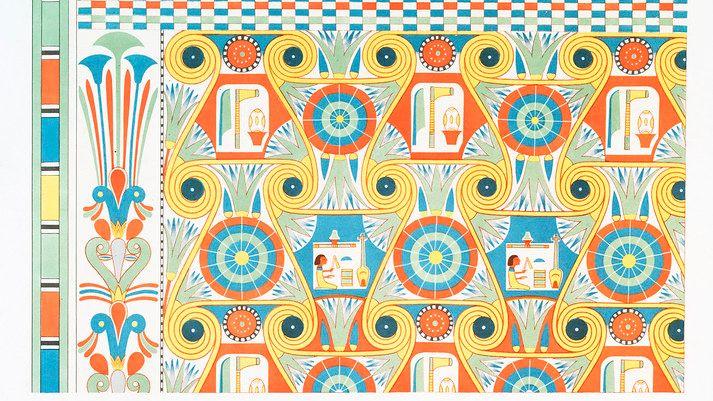
Somewhere outside Memphis, around 2500 BCE, a craftsman crouched over a clay crucible and did something that would not be repeated anywhere else on Earth for another two thousand years: he manufactured a color. By heating a precise blend of sand, limestone, and copper ore to temperatures exceeding 850 degrees Celsius, he coaxed a vivid, stable blue powder from the kiln — a shade so permanent that flakes of it still glow under laboratory light today. The civilization that produced this achievement is often cited in popular linguistics for supposedly having no word for blue. The truth, as Egypt so often insists on being, is far stranger and far more beautiful than that.
Color as Theology: How the Egyptians Really Saw Their Palette

For the painters, priests, and pharaohs of ancient Egypt, color was not decoration. It was a coded language — a theological, medical, and cosmic operating system running simultaneously across temple walls, mummy wrappings, medicine chests, and royal regalia. To read an Egyptian artwork purely for its visual beauty is to miss most of what it is saying. Built on six principal hues — green, red, blue, yellow, white, and black — the Egyptian palette was a complete worldview compressed into pigment.
The six main colors carried formal names that have survived in hieroglyphic texts: wadj (green), desher (red), irtyu or khesbedj (blue), khenet (yellow), hedj (white), and kem (black). These were not positions on a spectral wheel but cosmological categories, each loaded with narrative meaning that any literate Egyptian could decode at a glance. Perhaps most striking to modern eyes: blue and green were sometimes treated as interchangeable — two faces of the same life-force, the Nile’s water and its flooded banks, the sky and the reed fields, all flowing into a single concept of renewing vitality.
The pigment sources were equally deliberate. Egyptian artists ground malachite for green, red ochre for red, orpiment (arsenic sulfide) for yellow, gypsum or crushed white limestone for white, and carbon or soot for black. The blue was the engineering marvel: a copper-calcium silicate compound now called cuprorivaite, synthesized in kilns and reproducible at scale, making it effectively the world’s first synthetic pigment. By the New Kingdom period (roughly 1550-1070 BCE), artists had expanded their technical range further, using various types of blues and greens such as cobalt, Egyptian blue, Egyptian green, and possibly azurite, evidence of ongoing material experimentation across centuries of artistic practice.
The Two Words for Blue: A Civilization That Cared More Than Anyone

The popular claim that ancient languages lacked words for blue became widely known through cross-cultural studies of color terminology. Homer’s seas were “wine-dark.” Sanskrit texts had no dedicated blue term. And yet here were the Egyptians — not only perceiving blue with evident sophistication but manufacturing it, exporting it, and developing two separate words to describe its different registers: irtiu for the common blue of sky and water, and khesbedj specifically for the prestige blue of lapis lazuli, the gemstone imported across thousands of miles of desert from mines in what is now Afghanistan. That linguistic distinction — ranking a single color by its social and spiritual weight — tells you almost everything you need to know about how Egyptians thought about color in general.
Before the kiln breakthrough, obtaining true blue meant obtaining lapis lazuli, a semi-precious stone traveling by trade routes across hostile terrain before arriving in Egyptian workshops. This made natural blue among the most precious commodities in the ancient world, reserved for objects and images of the highest divine and royal significance. When craftsmen developed their synthetic alternative around 2600 BCE, they did not displace lapis’s prestige so much as democratize the hue, making it possible to paint blue across vast temple walls and produce blue faience amulets by the thousands.
The divine résumé of blue was remarkable even by Egyptian standards. Amun, regarded as king of the gods, was painted with blue skin — the color of the sky, of primordial water, of creation itself. Blue faience amulets shaped as scarabs, eyes, and djed pillars were mass-produced as protective charms tucked into mummy wrappings and worn by the living. Egyptian Blue became one of antiquity’s most widely traded pigments, found in Roman-era artifacts as far north as Britain and Scandinavia — a product that outlasted the civilization that invented it by more than a millennium.
Green (Wadj): The Color the Nile Wore Every Spring

Look at any painting of Osiris — the god of the dead and of resurrection — and notice his skin. It is unmistakably, emphatically green. Not the green of illness or decay, as a modern viewer might assume, but the green of the Nile floodplain in the weeks after inundation, when black silt and warm water conspire to turn a desert into an explosion of growth. Osiris was green because he had died and returned. His color was proof of the promise.
Wadj carried a triple meaning that made it one of the palette’s most versatile tools: fertility, hope, and immortality, often simultaneously. Amulets carved from green stone or faience were placed directly on mummified bodies, their color doing theological work in the darkness of the wrappings. The hieroglyph for “flourishing” was a green papyrus stem. Eye makeup — the distinctive liner worn by both men and women across all social classes — was often made from ground malachite, the same mineral that gave painters their green pigment. This was not merely cosmetic: malachite was believed to protect against eye infections, and in a desert environment where trachoma and other ocular diseases were endemic, the belief carried genuine practical weight. Science and symbolism functioned as a unified system, each reinforcing the other.
In tomb paintings, the paradise awaiting the virtuous dead — the Field of Reeds — was rendered in lush, explicit green. Eternal life did not look like clouds and diffuse light; it looked like the best version of the Nile Valley on its finest spring morning, painted in wadj on every available surface.
Red (Desher): Duality Made Visible

Red was Egypt’s most psychologically complex hue. Desher was the color of chaos, of the scorching desert, of Set — the volatile god of storms and disorder. Scribes wrote certain dangerous or potent spells in red ink, the color itself functioning as a kind of containment field around volatile words. And yet pharaohs wore red crowns. Soldiers carried red shields. The word deshret meant both “the Red Land” — the barren desert that threatened to swallow civilization — and the red crown of Lower Egypt, symbol of ordered royal authority. The same syllables, the same color, two diametrically opposed meanings held in permanent and productive tension. Red was duality made visible, a reminder that power and destruction flow from the same source.
This duality was not confusion but philosophy. The Egyptians understood that the forces capable of destroying life were often the same forces that sustained it: the desert wind that killed crops also drove sailing boats up the Nile. Red named that ambiguity rather than resolving it, which is a more sophisticated position than most color systems manage.
Black (Kem): The Mud That Made Civilization

Black seems, to modern sensibilities, the natural color of death and endings. The Egyptians thought the opposite. Kem was the color of the rich, dark silt that the Nile deposited across its floodplain every year — the very substance from which crops grew and civilization ate. Egypt did not call itself by the name we use; it called itself Kemet: the Black Land, named for this fertile darkness. When Anubis, the jackal-headed god of embalming and guardian of the passage between worlds, was painted black, it was not a statement about death being dark and final. It was a promise: this transformation will be generative. Black meant renewal. It meant the mud that makes wheat grow.
Every tomb painting of Anubis was, in this reading, an act of agricultural optimism applied to the afterlife — a reminder that what looks like ending is simply the precondition for the next growth cycle. Understanding black as the color of fertile potential reframes nearly every Egyptian funerary image in which it appears.
Yellow and White: The Metals of the Gods

Yellow in Egypt was never really about yellow. It was about gold — specifically, about the theological claim that the flesh of the gods was made from it. Khenet, the yellow pigment, was deployed wherever a painter wanted to invoke divine immortality: the permanent, warm gleam of a substance that does not tarnish, does not rot, and does not yield to time. Pharaohs appeared in certain funerary images with yellow-gold skin, positioning them within the company of the eternal. The gold of tomb artifacts was not a display of wealth; it was a claim about the nature of the person buried inside.
White (hedj) carried purity, sacredness, and truth. Temple floors were whitewashed, ritual objects wrapped in white linen, and the white crown of Upper Egypt — the hedjet — embodied righteous, ordered rule. The word hedj also meant silver, collapsing the color and the metal into a single concept. Gold and silver were understood as complementary: gold was the sun, the eternal day, the warmth of creation; silver was the moon, the cooler light, and — in a detail that collapses the cosmic into the anatomical — the bones of the gods. Together, they formed the visual grammar of temple interiors, where walls painted to simulate gold and ivory created an environment that a worshipper did not merely visit but physically entered.
Color as Information Architecture: Reading a Tomb Wall
Stand mentally in front of a major tomb painting from around 1300 BCE and consider what a literate Egyptian saw. Every color carried specific, layered meaning: green skin announced resurrection, black promised renewal, blue signaled divine proximity, red flagged power and danger in equal measure, yellow spoke of eternal flesh, white certified sacred space. A viewer could decode a figure’s spiritual status, cosmic alignment, and narrative role without reading a single hieroglyph. Color was the ancient world’s most efficient information system — high-bandwidth symbolism painted directly onto the walls of the culture’s most consequential spaces.
This was not accidental. Egyptian artistic conventions were codified and deliberately taught, maintained across centuries by workshops and scribal schools. The consistency of color meaning across dynasties separated by hundreds of years — Osiris remained green, Anubis remained black, Amun remained blue — demonstrates that this was a managed symbolic system, not an informal tradition. The conventions governing Egyptian pigment use were among the most durable in the ancient world, outlasting political upheaval, foreign invasion, and dynastic change across more than three thousand years.
The Legacy That Outlived Egypt: Why Egyptian Blue Is Still Doing Its Job
The reach of Egyptian color extends far beyond the Nile Valley and far beyond antiquity. Egyptian Blue has been detected in artifacts across the Roman Empire, carried by trade and cultural fashion into contexts where the original theology had long been forgotten — yet the pigment’s visual authority apparently had not. It has been found in wall paintings in Roman Britain, in Scandinavian votive objects, and in medieval European artworks, passed hand to hand through economies that no longer remembered who invented it or what it originally meant.
Then there is the detail that reframes the entire story: Egyptian Blue fluoresces under near-infrared light. Conservators today use this property to detect invisible paint layers in ancient objects — colors the naked eye can no longer see are still transmitting information across four millennia, still doing precisely the work the craftsmen designed them to do. A pigment engineered before writing systems had reached their mature form is still yielding new data to twenty-first century scientists.
A civilization supposedly without a word for blue invented its mass production, ranked it by social register with two distinct vocabulary entries, painted their king of gods with it, and exported it to the far edges of the known world. The deepest truths about any culture are often hidden in its most ordinary materials — in the pigment ground into a crucible before dawn, in the color mixed into the mud of a valley that called itself, with quiet precision, the Black Land.

 English
 Arabic
 Spanish
 Portuguese
 Deutsch
 Turkish
 Dutch
Dutch
 Italiano
 Russian
 Romaian
 Portuguese (Brazil)
 Greek
Greek