


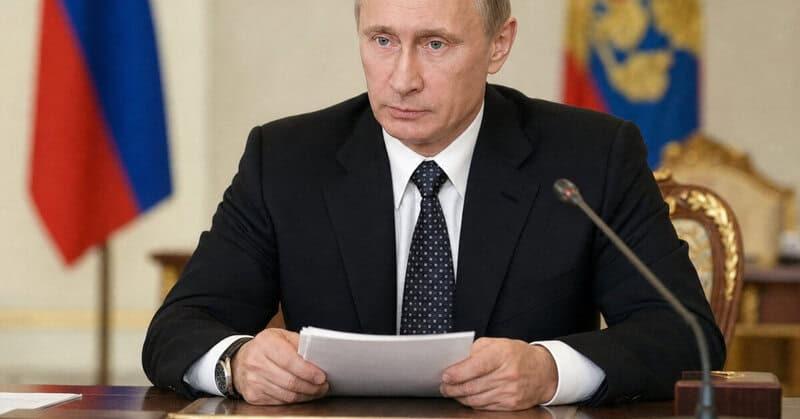
Few figures in modern history have risen from such obscure, scarred beginnings to wield such extraordinary power — and few have done it so fast, or so quietly. These nine facts trace the arc of Vladimir Putin’s life, from the rubble of postwar Leningrad to the longest grip on the Kremlin in a generation.
1. Born into the wreckage of a city that had barely survived a siege

When Vladimir Putin came into the world on 7 October 1952, Leningrad was still wearing its wounds. The city had endured an 872-day Nazi blockade — one of the deadliest sieges in recorded history, claiming an estimated one million civilian lives — and its people carried the trauma in their bones. Putin’s family was no exception: his mother, Maria, had nearly starved during those years, and his older brother Viktor died of diphtheria during the siege, before Vladimir was born, a ghost sibling he never knew.
The family lived in a communal apartment with shared kitchens and thin walls — the ordinary texture of Soviet life in a city that had survived the extraordinary. That particular combination of scarcity, loss, and resilience in a place that had refused to fall left a permanent watermark on the boy who grew up there. Putin has spoken about his mother’s wartime suffering in rare personal interviews, and historians who have studied his worldview frequently point to the Leningrad siege as the foundational experience shaping his later conviction that national survival justifies almost any cost.
2. A street-fighting kid who found discipline — and a governing philosophy — through judo

By his own telling, the young Putin was no model student. He scrapped in courtyards, ran with rough company, and earned his bruises the old-fashioned way. The turning point came when he discovered sambo, a Soviet combat sport that blends elements of wrestling and judo, and then judo itself — a discipline that rewards not brute force but leverage, timing, and the ability to turn an opponent’s own momentum against them.
He trained seriously enough to win the Leningrad city judo championship and earn a black belt, a genuine athletic achievement in a competitive environment. The philosophy has stayed with him in ways that go beyond sport. Putin has returned to judo as a metaphor for statecraft throughout his career, explicitly describing geopolitics in terms of reading an adversary’s weight and letting it work in your favour. The street kid’s logic, dressed in a gi, became a template for how he approaches confrontation at every level.
3. He approached the KGB as a teenager and was told to get a law degree first

At around sixteen, Putin did something that would strike most teenagers as unthinkable: he walked into a KGB office in Leningrad and asked a recruiter, in person, what it would take to become an intelligence officer. The answer was brisk and almost comically bureaucratic — the KGB did not accept volunteers, the officer told him, and completing a law degree would be a sensible starting point.
Putin took that advice with a seriousness that suggests he had already decided who he wanted to become. He enrolled at Leningrad State University, studied law, and upon graduating in 1975 was recruited by the very organisation he had walked in to ask about nearly a decade earlier. The episode is worth dwelling on: most people who say they want to be spies at sixteen mean something else entirely by twenty-five. Putin did not. The sixteen-year-old at the KGB front desk had, in a sense, made a formal appointment with his own future.
4. His KGB career was competent and provincial, not the stuff of spy thrillers

The Cold War intelligence officer of popular imagination works the shadows of Vienna or West Berlin, trading secrets in fog. Putin’s reality was more modest: from 1985 to 1990 he was stationed in Dresden, in the German Democratic Republic, recruiting informants and gathering intelligence on NATO in what amounted to routine fieldwork for an officer of his mid-level rank. Dresden was a backwater posting compared to the prestige assignments in Western capitals that marked out the KGB’s elite.
Then history moved faster than anyone in the Stasi building had anticipated. When the Berlin Wall fell in November 1989 and crowds surged toward the Dresden KGB compound, Putin reportedly spent hours feeding files into a furnace to prevent them falling into protesters’ hands — burning so much paper that the furnace eventually burst. He later recalled that he called Moscow repeatedly seeking instructions and that the centre simply went silent, leaving him to act alone. That experience — of an empire dissolving beneath his feet while Moscow offered nothing — is one he has referenced as formative. Understanding it helps explain his subsequent obsession with projecting state strength and never again appearing to abandon allies in the field.
5. He returned from Germany to serve a liberal reformer — and loyalty briefly cost him his career

Putin came back to a city in the middle of reinventing itself: Leningrad had voted to restore its original name, Saint Petersburg, and the mood was heady with possibility. He attached himself to Anatoly Sobchak, the charismatic law professor turned liberal mayor, serving as a senior aide and officially resigning his KGB commission in 1991. For several years he was part of a genuine reformist experiment, a former intelligence officer navigating the turbulent new Russia alongside a very different kind of politician.
When Sobchak lost his re-election campaign in 1996, the new administration offered Putin a post. He turned it down — a gesture of personal loyalty to a defeated patron that temporarily left him without an income or a clear future. That combination of demonstrated discretion and principled stubbornness proved to be precisely the signal Kremlin officials in Moscow were looking for. He was brought into the federal bureaucracy, and a door that looked like it was closing had quietly opened onto something far larger.
6. His ascent from obscure bureaucrat to acting president took less than eighteen months

As late as mid-1999, Vladimir Putin was a name that meant almost nothing to most Russians. Boris Yeltsin had appointed him director of the FSB — the KGB’s post-Soviet domestic successor — in 1998, and named him prime minister in August 1999. Five months later, on the last day of the twentieth century, Yeltsin went on national television, announced his resignation with a public apology to the Russian people, and handed the acting presidency to the man he had chosen. Putin won the subsequent presidential election in March 2000 with 53 percent of the vote in the first round.
The speed of that rise was extraordinary even by the turbulent standards of the Yeltsin era. From near-total national obscurity to the most powerful office in the country in under two years demanded not just ambition but a particular and rare talent: the ability to be exactly what powerful people decided they needed, at exactly the moment they needed it, while leaving them confident he would remain manageable. The last part, at least, would prove to be a serious miscalculation on their part.
7. Russia’s constitution forced him to step aside in 2008 — so he and Medvedev simply swapped jobs

The Russian constitution was unambiguous: no president could serve more than two consecutive terms. By 2008 Putin had served his two, and the rules required him to leave. His solution was simple and transparent enough to invite open mockery. Dmitry Medvedev, his chosen ally, won the presidency while Putin moved across the Kremlin to become prime minister — a role that carried enormous informal authority even if the formal title had changed hands. Most independent analysts concluded that Putin continued to direct policy throughout.
The arrangement honoured the letter of the constitution while making a considerable mockery of its purpose. When Putin returned to the presidency in 2012 and Medvedev returned to the prime ministership, commentators reached for the chess term “castling” — a manoeuvre in which the king is protected by repositioning the pieces around it. The interlude had been precisely what it appeared to be: a constitutional pause, not a departure from power. The 2012 transition prompted some of the largest street protests Russia had seen in years, a signal that the manoeuvre had not gone unnoticed by the public.
8. A 2020 constitutional revision reset his term count, opening the door to power until 2036

In a nationwide vote held in June and July 2020, Russians approved a sweeping package of constitutional amendments covering everything from God and marriage to minimum wage guarantees. Among the changes was a clause, introduced by a member of parliament rather than by Putin directly, that reset his previous presidential terms to zero. The practical arithmetic was stark: with prior terms expunged, Putin became eligible to stand for two further six-year terms after his current mandate, with 2036 — when he would be eighty-three — as the outer limit.
The official result showed approximately 78 percent in favour, though independent monitors raised serious concerns about the conduct of the vote. Critics described the term-reset clause as a constitutional coup executed through procedural sleight of hand; supporters argued it provided the continuity and stability that an increasingly volatile international environment demanded. Whatever framing one accepts, the revision fundamentally altered the legal architecture of Russian political life in ways that would have been difficult to imagine when a relatively unknown bureaucrat first took the oath of office in the spring of 2000.
9. His economics doctorate exists — but researchers found large sections may have been plagiarised

In 1997, while serving as a senior official in Saint Petersburg’s city government, Putin completed a Kandidat Nauk degree in economics — the Russian academic qualification broadly equivalent to a Western doctorate — at the Saint Petersburg Mining Institute. His dissertation addressed strategic planning in Russia’s natural resources sector, a subject of obvious practical relevance to the country he would soon be running.
In 2006, researchers at the Brookings Institution published a detailed analysis concluding that substantial passages of the dissertation — including specific text, tables, and diagrams — appeared to have been reproduced, with minimal alteration, from a 1978 American management textbook co-authored by two professors at the University of Pittsburgh. The Kremlin denied any plagiarism, and Russian academic authorities declined to investigate. The allegation has never been formally resolved, and it remains one of the stranger and more revealing footnotes in the biography of a man who has otherwise proved exceptionally careful about what he puts in writing and what he leaves behind.
From a communal apartment in a besieged and half-starved city to a constitutional framework that could sustain his presidency into the 2030s, Putin’s trajectory is one of the most consequential — and most contested — of any leader alive today. The details of how he got there matter, because they are not incidental to what he has become: they are the explanation for it.

 English
 Arabic
 French
 Spanish
 Portuguese
 Deutsch
 Turkish
 Dutch
Dutch
 Italiano
 Romaian
 Portuguese (Brazil)
 Greek
Greek