


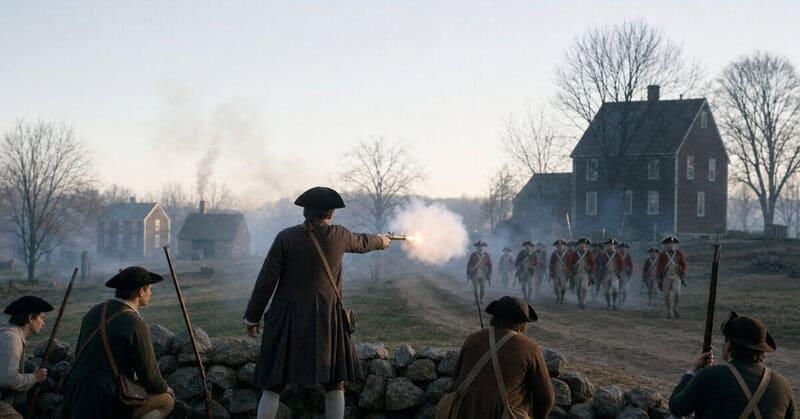
The sun had not yet risen over Lexington, Massachusetts, on the morning of April 19, 1775, when a single gunshot split the cold air and — in the span of a heartbeat — made the world a different place. Two hundred and fifty years later, not one historian, forensic investigator, or documentary filmmaker has been able to say with certainty who pulled the trigger. That unresolved question is not a footnote to the story of the American Revolution. It is, in many ways, the story.
A Morning Nobody Owned

The surviving records allow us to reconstruct the scene only so far. In the darkness before dawn, a thin mist lay over Lexington Green, and roughly seventy colonial militiamen stood in loose formation — farmers, tradesmen, teenagers, men who had spent the previous hours being roused from their beds by riders warning that the Regulars were coming. Their captain, John Parker, had reportedly told them to stand their ground but not to fire unless fired upon. They were badly outnumbered. The British column bearing down on them numbered around seven hundred men — professional soldiers who had marched through the night from Boston with orders to seize colonial military supplies stored in Concord, some sixteen miles away.
Major John Pitcairn, commanding the British advance, ordered the colonists to disperse. For a long, taut moment, neither side moved. Then — from a direction that nobody has ever agreed upon — a shot rang out. It may have come from behind a stone wall. It may have come from the doorway of the Buckman Tavern, which stood at the edge of the green. Some witnesses later claimed it came from a British soldier who broke ranks; others insisted it was fired by a colonial sympathizer watching from a distance. One theory holds that Pitcairn’s horse reared and his pistol discharged accidentally. No powder burns appear in any account that survives. No discarded flintlock was recovered. No confession was ever made.
What followed was not a battle so much as a collapse of order. British soldiers fired a volley, then another. Eight colonists were killed and ten wounded on Lexington Green. The British column reformed and marched on to Concord, where a second and far more organized exchange erupted at the North Bridge — the engagement that most military historians mark as the true beginning of sustained combat in the American Revolution. By the end of that long day, as the Redcoats retreated toward Boston under relentless fire from militiamen shooting from behind trees and fence lines, the political world had shifted on its axis. The shot that launched it belongs to nobody and to everybody at once.
Emerson’s Poem and the Making of a Myth

The phrase we reach for when we talk about that morning — “the shot heard round the world” — did not come from a newspaper account or a military dispatch. It came from a poem, written sixty-two years after the fact, by a man whose grandfather had witnessed the fighting at Concord. In 1837, Ralph Waldo Emerson composed his “Concord Hymn” for the dedication of a monument at the North Bridge. That poem is, in a sense, the history of how messy events become clean legends.
Emerson was a master of the resonant abstraction, and “the shot heard round the world” is one of his finest achievements. The phrase does enormous political work in very few words. It takes a confused skirmish on a New England village green and stretches it across continents — connecting a local dispute over taxation and self-governance to the Enlightenment ideals then reshaping France, Latin America, and the broader Atlantic world. The shot, in Emerson’s framing, was not merely a colonial farmer’s act of defiance. It was a signal fire, heard wherever people were beginning to ask whether kings had any legitimate claim over them.
But there is a tension buried at the heart of that beautiful line. Emerson’s poem demands a heroic, deliberate act — a conscious choice made by someone who understood the stakes. The historical record offers something far less cinematically satisfying: an accidental spark, a moment of mass confusion, a shot that almost certainly surprised whoever fired it as much as anyone else present. The legend says a patriot chose to begin a revolution. The evidence says a revolution began, and no one chose it.
The Witness Problem: Why the Mystery Endures

In the days immediately after April 19, 1775, depositions were collected from British officers and colonial survivors alike. Historians have been sifting through them ever since, and the results are maddening. Every account agrees that a shot was fired before the general exchange began. Almost no two accounts agree on anything else — the direction it came from, whether it was a single report or two close together, whether it preceded or followed a British order to fire. The witnesses were frightened, the smoke was thick, and every surviving participant had a powerful interest in placing the guilt on the other side.
The competing theories each carry genuine archival support. A colonial sympathizer firing from cover near the Buckman Tavern: plausible, given the layout of the green. A nervous British regular breaking ranks before Pitcairn gave the order: equally plausible, given what we know about the tension of that march. The pistol-and-rearing-horse theory: documented in at least one British account, dismissed by many colonial ones. Forensic historians working in the twenty-first century have used period weaponry, ballistics modeling, and careful mapping of eyewitness positions to narrow the window of suspects — but they have not closed it.
What the who-fired-first debate really illuminates is something larger than ballistics. It shows how history is made under pressure, by people with stakes in the outcome. The colonists needed to have been fired upon — their moral and legal case for rebellion depended on it. The British needed the colonists to have fired first — their narrative of restoring order to a rebellious province required it. Both sides shaped their testimonies accordingly, not necessarily through deliberate lying but through the entirely human tendency to remember events in ways that justify what came after.
The Shot Heard Round the World project’s resources on April 19, 1775 take a notably honest approach to this problem. Rather than declaring a winner in the evidentiary debate, they present the day as a layered narrative of conflicting accounts, inviting audiences to sit with the ambiguity rather than resolve it artificially. For a founding myth, that is a striking choice — and a valuable one.
What the Documentaries Reveal
Filmmakers and educators have returned to this story repeatedly, drawn by the same qualities that make it so frustrating to historians: the human scale, the dramatic compression, the sense that something enormous pivoted on a single unattributed moment. The best recent treatments share a common instinct — they trust the ambiguity rather than paper over it, and they place ordinary people at the center rather than relying on a roster of famous names.
The PBS documentary The Shot Heard Round the World: The Coming of the American Revolution takes the long view, tracing how the settlement of the original 13 American colonies and a gradual cultural drift away from English identity — made the violence of April 19 feel, in retrospect, almost inevitable. The argument the documentary advances, implicitly but powerfully, is that this history is less about one trigger finger than about a civilization slowly making up its mind. By the time that unnamed gun fired on Lexington Green, the decision had already been made in ten thousand kitchens, meetinghouses, and print shops across New England. The gun merely announced what had already become unavoidable.
What distinguishes the PBS treatment from earlier, more reverential approaches is its willingness to show the revolution as a process of political radicalization rather than a sudden awakening. Colonists who considered themselves loyal British subjects in 1763 had, through a series of specific parliamentary acts and crown decisions, come to see the relationship as irreparable by 1775. The documentary names those steps and shows their cumulative weight — a structural argument that resists the temptation to reduce history to a single dramatic morning.
For educators working with younger audiences, PBS Learning Media’s collection The Shot Heard Round the World distills that same arc into classroom-ready excerpts, chronicling the 19 years leading up to the American Revolution and centering the lived experience of ordinary colonists rather than the celebrated figures most students already recognize. The effect is to make the revolution feel less like a masterwork of political genius and more like what it probably was: a collective improvisation by people who were making consequential decisions without any certainty about where those decisions would lead. That reframing is pedagogically significant. Students who see themselves reflected in the uncertainty of the historical actors are more likely to take the history seriously.
Perhaps the most viscerally immediate of the recent documentary projects is the American Battlefield Trust’s virtual reality experience The Shot Heard Round the World: A Nation is Born, which draws on battlefield archaeology and period accounts to reconstruct the geography and sequence of events on Lexington Green. Grounding the story in physical space — the precise distance between the militiamen and the British column, the sightlines from the Buckman Tavern, the angles that determined what any given witness could and could not have seen — clarifies why the evidentiary record is so contradictory. The green was not a controlled space. It was a chaotic one, and the accounts it generated were chaotic accordingly.
All three projects share a core conviction: the ambiguity of the first shot is not a gap in the story waiting to be filled with a satisfying answer. It is the story.
Why the Mystery Still Matters in 2025

The 250th anniversary of April 19, 1775 arrives at a moment when Americans are actively — and sometimes bitterly — re-examining the founding narratives they inherited. In that context, the unknown shooter functions as a kind of Rorschach test. If a colonist fired first, the revolution began in defiance — in the willingness of ordinary people to answer oppression with force before that force was turned on them. If a British soldier fired first, it began in oppression itself, in an imperial power’s refusal to acknowledge what it had already lost. If no one knows — if the shot belongs to chaos rather than to intention — then the revolution began in something altogether more unsettling and perhaps more honest: the moment when accumulated grievance becomes uncontrollable, when history takes the wheel away from any individual hand.
Each version carries a different lesson about political violence, legitimacy, and the stories nations tell themselves in order to hold together. None of them is simply wrong. The debate has generated serious academic work well into the twenty-first century precisely because the stakes of the answer remain live. Who fired first is not merely a question of 1775 record-keeping. It is a question about what kind of beginning the American experiment had — and what that beginning authorizes or forecloses in the arguments Americans continue to have about self-governance, resistance, and the use of force.
There is something paradoxically fitting about all of this. The unresolved shot may be the most American thing about the American Revolution — a nation that began not with a clear command from a recognized authority but with a question nobody can fully answer, and that has been arguing about it, productively and sometimes furiously, ever since.
Standing in the Gap

Return, one last time, to Lexington Green at first light. The mist, the cold, the outnumbered men in their civilian coats. Whatever happened in that fraction of a second before the world changed is not a failure of the historical record. It is a reminder that world-altering moments are rarely clean, rarely authored by a single hero, and rarely understood by anyone present in the instant they occur. The men on that green did not know they were beginning a revolution that would inspire upheaval on other continents for the next two centuries. They were trying to survive a morning.
Emerson understood something important when he wrote his hymn, even if he smoothed away the chaos to write it. “The shot heard round the world” was always more metaphor than fact — a story a young nation needed to tell itself, a frame that made the accidental feel chosen and the terrifying feel noble. The gap between that metaphor and the messy, unresolved, deeply human truth of April 19, 1775 is not an embarrassment to be explained away. It is where the real history lives.
The documentaries, the classroom collections, and the battlefield resources surveyed here are all, in their different ways, invitations to stand in that gap — to hold the legend and the uncertainty at the same time, and to find that holding both is more intellectually honest than surrendering to either. Whoever pulled that trigger, if anyone pulled it deliberately at all, could not have known what they were starting. Two hundred and fifty years of argument, scholarship, and storytelling have not resolved the question. That is not a disappointment. It is a reminder that revolutions, like the gunshots that announce them, belong to no single author — and that the histories worth studying are rarely the ones with tidy endings.

 English
 Arabic
 French
 Spanish
 Portuguese
 Deutsch
 Dutch
Dutch
 Italiano
 Russian
 Romaian
 Portuguese (Brazil)
 Greek
Greek