


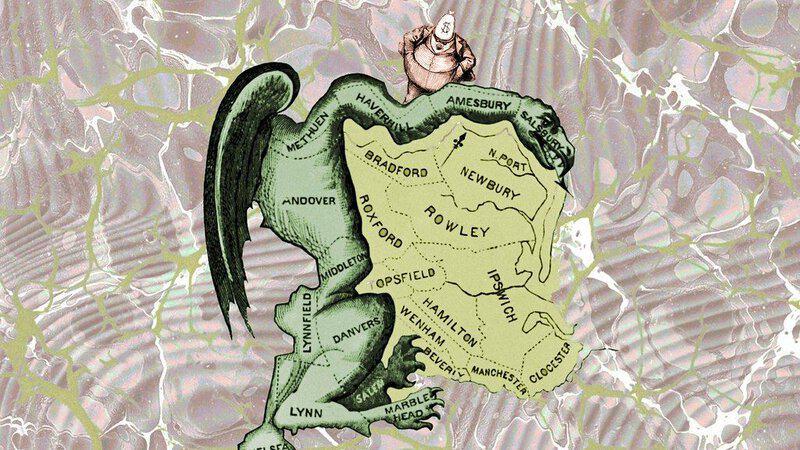
On a winter morning in 1812, an editor at a Boston newspaper stared at a freshly printed map of Massachusetts’ newly redrawn state senate districts and felt something between amusement and fury rising in his chest. One of the districts — a long, grotesquely contorted strip snaking through Essex County — looked less like a political boundary than like a creature from a nightmare. He reached for his pen, added a head, a pair of wings, and a set of claws, and the monster stared back at him, unmistakably alive. It looked, everyone agreed, like a salamander. And its political father was the sitting governor of the Commonwealth.
The Morning a Map Changed Everything
The governor’s name was Elbridge Gerry, and within days of that editorial cartoon making its rounds through Boston’s coffeehouses and counting rooms, a new word had been minted: the Gerry-mander. The portmanteau fused the governor’s name with the beast his mapmakers had conjured, and it appeared in print with the gleeful precision of a satirist who knows he has found exactly the right weapon. The word would outlive its subject by more than two centuries, embedding itself so deeply in the American political vocabulary that most people who use it today have no idea there was once a real man named Gerry who signed a real map.
The central irony is almost too rich to be believed. Elbridge Gerry was a Founding Father. He had signed the Declaration of Independence. He had sat in the sweltering heat of Philadelphia’s State House during the Constitutional Convention of 1787 — and then, in a dramatic act of conscience, refused to sign the final document, warning that it left the door open to tyranny and the dangerous concentration of faction. Here was a man who feared power’s tendency to corrupt itself. And here, a quarter-century later, was his signature on a map deliberately warped to deliver political dominance to his party.
Who Was Elbridge Gerry?

To understand how a man of Gerry’s stated principles ended up fathering one of American democracy’s most corrosive traditions, it helps to know something about the man himself. Born in 1744 in Marblehead, Massachusetts, Gerry was Harvard-educated and immersed in the revolutionary milieu from an early age. He was a onetime Cambridge resident who moved in the highest circles of the revolutionary generation, trading ideas and grievances with Adams, Jefferson, and Madison.
His patriot credentials were genuine and hard-won. He signed the Declaration of Independence in 1776, served in the Continental Congress, and threw himself into the machinery of the new republic with evident sincerity. At the Constitutional Convention, his refusal to sign the finished document was not a petulant gesture — it came from a principled, if sometimes stubborn, conviction that the Constitution as written lacked sufficient protections against the factionalism and tyranny the Revolution had been fought to escape. He was among those who pressed hard for what would become the Bill of Rights. By any fair reading, he was a man who took democratic ideals seriously.
And yet. Gerry’s career carried him from revolutionary firebrand to governor of Massachusetts and ultimately to the Vice Presidency under James Madison — a rise that brought with it the grinding pressures of partisan politics that no amount of revolutionary idealism fully insulates a man against. He died in office as Vice President in 1814, just two years after the salamander scandal, his name already transformed into something he could never have intended.
The Political War Raging in 1812 Massachusetts
To appreciate the redistricting episode, you have to feel the temperature of Massachusetts politics in the early nineteenth century. The young republic was not the placid, consensus-driven polity that romantic mythology sometimes suggests. The Democratic-Republicans — Jefferson and Madison’s party — and the Federalists were locked in a fierce, sometimes vicious struggle for control of the levers of government, and Massachusetts was a critical battleground. New England had been Federalist country, a stronghold of the commercial and mercantile classes who looked with deep suspicion on the agrarian, Southern-flavored politics of Jefferson’s coalition.
Gerry had been elected governor of Massachusetts in 1810 and re-elected in 1811, giving his Democratic-Republican allies a precious foothold in hostile territory. But state senate seats translated directly into legislative power, and the Federalists remained a formidable force. When the time came for redistricting, the temptation facing Gerry’s party was enormous and, in the logic of partisan warfare, almost irresistible. Redistricting itself was not new and was not illegal — the Constitution demanded periodic reapportionment. What Gerry’s allies proposed, however, was something categorically different: a deliberate, systematic distortion of district lines designed not to reflect population but to manufacture electoral advantage, packing Federalist voters into as few districts as possible while spreading Democratic-Republican voters efficiently across many.
The strategy had a cold, almost mathematical elegance to it, even if the resulting maps looked like the work of a cartographer having a breakdown.
The Bill, the Signature, and the Salamander
By most historical accounts, Gerry himself had reservations about signing the redistricting bill. He understood, at some level, that what his party was asking him to do sat uneasily alongside everything he had claimed to believe about the dangers of faction and concentrated power. But the machinery of partisan loyalty is a powerful thing, and in February 1812 he put pen to paper, reshaping Massachusetts’ state senate districts in a single stroke.
The resulting map was extraordinary. Districts were contorted into bizarre, elongated shapes that followed no discernible geographic or community logic, tracing instead the invisible topography of voter registration. The Essex County district was the most egregious example — a snaking, narrow strip of territory so geometrically absurd that it seemed to mock the very idea that a district boundary should reflect something meaningful about the people living within it.
When Federalist editors and cartoonists got hold of the map, their response was swift and savage. One illustration transformed the Essex district outline into a full-fledged monster — head, claws, and wings added in ink — and the name that attached itself was irresistible: the Gerrymander, part governor, part salamander, entirely damning. The satirical logic was perfect. A political cartoon needs a monster with a face, and Gerry’s map had accidentally provided both the body and the metaphor. The word spread through American political discourse with the velocity of a genuinely useful coinage — one of those rare neologisms that so precisely names a thing that people wonder how they ever discussed the concept without it.
Did the Gerrymander Even Work? The Ironic Electoral Aftermath

Here is the historical punchline, and it is a bitter one: the Federalists won a majority of the popular vote in the 1812 Massachusetts state senate elections. More people, casting more ballots, chose Federalist candidates. But Gerry’s redrawn map did its mechanical work regardless of democratic sentiment, and the Democratic-Republicans still captured a majority of senate seats. The manipulation had failed morally and succeeded operationally, and in that gap between the two outcomes lies the entire reason gerrymandering has proven so durable and so corrosive across American history.
Gerry himself did not escape unscathed. He lost his bid for a third gubernatorial term in 1812, the redistricting scandal having generated enough public fury to cost him the very office he had used to sign the bill. There is a particular political tragedy in that — a man consumed by the maneuver he had reluctantly authorized, neither principled enough to refuse it nor ruthless enough to survive its consequences.
The word “gerrymander” spread rapidly through American political life as a term of accusation, ridicule, and eventual grim familiarity. Both parties learned its lessons with enthusiasm. What had begun as a satirical label for one governor’s moral compromise became, in time, the operating manual for American electoral politics.
From One Salamander to a National Practice: The Long Shadow of 1812
What Gerry reluctantly codified in 1812, subsequent generations perfected with increasing shamelessness. Redistricting cycles became, in state after state, exercises in incumbent protection and partisan entrenchment. The practice crossed party lines with ease — Democrats drew self-serving maps when they held power, Republicans did the same — and the structural incentive never changed: in a system where elected legislators draw the districts that determine their own electoral fate, the temptation to abuse the process is not an aberration but a feature baked into the machinery itself.
Modern computing transformed gerrymandering from a rough art into a precise science. By the late twentieth century, practitioners armed with demographic databases and mapping software could optimize district lines block by block, targeting individual precincts with a granularity that makes Gerry’s salamander look touchingly crude by comparison. The Essex County district was drawn by hand, guided by intuition and rough political knowledge. Today’s equivalent creatures are optimized by algorithm, and they are far more efficient at swallowing votes whole.
The legal battles have been equally persistent. The Supreme Court has wrestled repeatedly with gerrymandering’s constitutionality, generally permitting partisan redistricting while placing stricter limits on racial gerrymandering — a distinction that has kept the practice alive and constitutionally sheltered even as arguments about its democratic legitimacy grow louder with each redistricting cycle.
The Reluctant Father of a Democratic Disease
Gerry had lived a long, complicated life in service of a republic he helped build, and it is unlikely he spent his final months contemplating the salamander. He probably thought of himself, if he thought about it at all, as a practical politician who had made a difficult call under partisan pressure — which is, of course, exactly what every practitioner of gerrymandering has thought about themselves in every decade since.
He was not, by the standards of his era, a villain. Partisan manipulation of electoral geography had existed before him in rougher, less systematic forms. But his name became the permanent label because the satirists of 1812 needed a monster and found one in that Essex County outline, and because language, once it finds the perfect word for a thing, does not let go. Gerry became the face of gerrymandering the way certain figures become the faces of the things that outlast them — not entirely fairly, not entirely unfairly, but permanently.
The question his story leaves unresolved is an uncomfortable one. If a Founding Father who genuinely, and on the record, feared the concentration of faction and power could rationalize partisan map-drawing as an acceptable political tool, what does that tell us about the relationship between principle and partisanship when the stakes feel high enough? The answer that American history keeps returning is not a reassuring one.
Somewhere in the archive of American political imagery, that cartoon salamander still slithers — half district, half monster, sketched once by a reluctant governor and redrawn, in a thousand variations, by every redistricting cycle that followed. Elbridge Gerry signed a map and left a mark on democracy that no subsequent election has fully erased.

 English
 Arabic
 French
 Portuguese
 Deutsch
 Turkish
 Dutch
Dutch
 Italiano
 Russian
 Romaian
 Portuguese (Brazil)
 Greek
Greek