


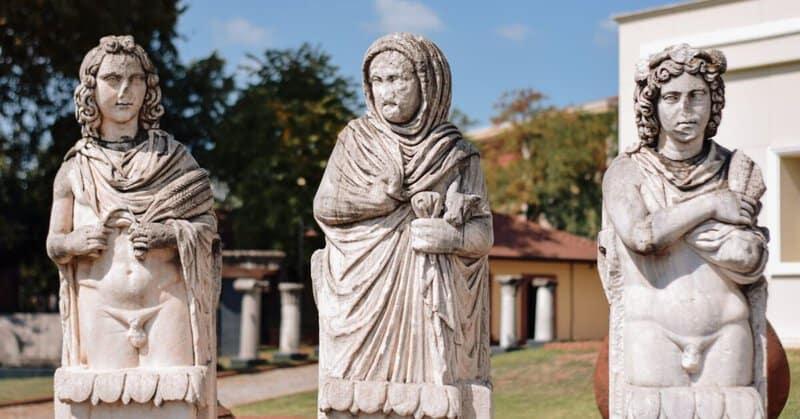
The construction crew working near Binyamina, in northern Israel, had seen plenty of unremarkable earth move beneath their machinery. Then the diggers slowed, and two enormous pale forms emerged from the soil — face down, silent, and utterly out of place inside what turned out to be an ancient winepress pit. After roughly 1,700 years in the dark, a pair of Roman marble statues had just stopped a railway project in its tracks.
The Discovery: Face Down in an Ancient Winepress

There is something viscerally strange about the scene. Not a temple crypt. Not a sealed tomb. Not even the rubble of a collapsed colonnade. The hiding place that sheltered these two statues through the entirety of the Byzantine Empire, the Arab conquest, the Crusades, the Ottoman centuries, and the modern age was a winepress — a utilitarian stone installation built for the entirely unglamorous business of crushing grapes. Someone moved two marble figures, each weighing roughly sixty kilograms, into that pit, laid them carefully face down, and walked away.
The question that makes this discovery so compelling is not just what was found, but why it was hidden there — and by whom. Archaeologists working the site describe the statues as possibly hidden for safekeeping, a cautious and honest phrase that contains, within its brevity, an entire human drama waiting to be reconstructed. The true reason remains unknown. That uncertainty is not a gap in the story. It is the story.
What Was Found: Marble, Weight, and Rarity

The two statues date to the Roman period, placing their creation roughly 1,700 years ago — a turbulent, transformative era in which the Roman Empire was lurching through military crises, religious upheaval, and the slow pivot toward Christianity that would remake the ancient world. Whoever commissioned these figures lived in a time of extraordinary change.
Sixty kilograms each. That is roughly the weight of an adult human being. Lift that in marble — cold, rigid, unyielding — and you begin to appreciate that moving or concealing these statues was not a casual act. It required planning, muscle, and purpose. This was not the slow burial of objects forgotten in a corner. It was deliberate.
The material itself speaks to status. Marble of the quality used for monumental Roman sculpture was not quarried anywhere in ancient Judaea. It was imported — hauled across the Mediterranean at considerable expense from quarries in Asia Minor, Greece, or Italy. Owning marble statues of this scale in the ancient world was a declaration: of wealth, of civic ambition, of cultural alignment with the Roman world centred on Rome itself. Whoever possessed these figures was someone of consequence in their community.
What is not yet known — and what makes the discovery endlessly intriguing — is who or what the statues depict. Were they gods? Emperors? Local benefactors rendered in the Roman portrait tradition? The find near Binyamina has already drawn significant attention, but iconographic analysis, which will help identify the subjects, is still underway. The statues were found with their faces turned toward the earth. We have not yet seen them properly.
The Winepress: The Strangest Possible Vault

To understand why the hiding place matters, it helps to picture what a Roman-Byzantine winepress actually was. These were stone installations, often cut directly into bedrock, consisting of a treading floor where workers crushed grapes with their feet, connected by channels to collection vats below where the juice pooled and fermentation began. They were practical, sometimes large, and in a region as agriculturally productive as the coastal plain south of Mount Carmel, they were common.
The find site near Binyamina sits squarely in the agricultural hinterland of ancient Caesarea Maritima — Rome’s great showpiece provincial capital on the Israeli coast, a city of harbours, amphitheatres, colonnaded streets, and statuary in abundance. The estates and farms that fed and supplied Caesarea stretched inland across exactly this landscape. A winepress here would have been a working installation, busy in the autumn harvest season, known to farm labourers and estate managers alike.
Which is precisely what makes its use as a hiding place so pointed. A busy agricultural space would have been semi-public, trafficked, and visible. For someone to lower two sixty-kilogram marble statues into a winepress pit without being observed — or without anyone who saw it asking questions — the burial almost certainly happened off-season, at night, or in a moment of sufficient chaos that secrecy was either easy or irrelevant.
The face-down placement is the detail that lingers. Laying sculptures face down protects their carved surfaces from abrasion and the slow damage of soil pressure. It is the instinct of someone who cares about what they are hiding — someone who intends to come back. The winepress was not chosen as a grave. It was chosen as a vault.
Caesarea Maritima: A City Built on Marble and Power

To grasp why marble statues of this quality existed in the agricultural fringes of this particular region, a brief portrait of Caesarea Maritima is essential. Built by Herod the Great at the end of the 1st century BCE as a showcase of Roman-style urbanism on the Judaean coast, Caesarea became the seat of the Roman governors of the province — including, for a period, Pontius Pilate. Its population was a layered mixture of Roman colonists, Hellenised locals, Jewish communities, Samaritans, and, increasingly through the 3rd and 4th centuries, Christians.
In the Roman world, statues were the social media of the age — everywhere, expressive, and politically charged. Gods lined the approaches to temples. Emperors gazed from forum pedestals. Civic benefactors who funded a public bath or a new road earned themselves a portrait in marble. To own a statue was to participate in Roman visual culture. To destroy or hide one was to make a statement, whether of fear, of faith, or of desperate self-preservation.
Decades of excavation around Caesarea have already produced a remarkable record: a Mithraeum, a Byzantine street grid, an amphitheatre, coins spanning centuries of occupation, and inscriptions that have quietly rewritten chapters of ancient history. The discovery of these Roman marble statues buried in Israel’s coastal plain fits within that long tradition of remarkable finds — but it also poses questions that previous excavations have not yet answered.
Why Were They Hidden? The Theories That Matter

Archaeologists, being careful people, will not yet commit to a single explanation. The honest position — that the statues were possibly hidden for safekeeping, and that the true reason is unknown — is the correct one. But history offers a range of plausible scenarios, each with its own texture and drama.
The most structurally compelling involves religion. The 4th century CE was the period in which Christianity moved from tolerated minority to official state religion under successive Roman emperors, culminating in Theodosius I’s edicts of 380-391 CE, which banned pagan sacrifice and effectively outlawed public pagan cult. Across the empire, statues of gods became contested objects — targets for Christian mobs, or for officials enforcing the new religious order. An owner of valuable marble divine figures faced an uncomfortable choice: smash what they had, surrender it, or hide it and hope.
Hiding was the pragmatic calculation of someone who could not bear to destroy what they owned, or who believed — perhaps correctly, perhaps not — that the religious storm would pass. Marble gods had survived political upheavals before. Perhaps they could again.
A second theory involves simpler, more secular danger: brigandage, military instability, or the threat of looting during one of the 3rd century’s many episodes of imperial fragmentation and provincial disorder. A wealthy estate owner, hearing that soldiers or raiders were in the region, might have buried the most valuable portable objects they owned and fled — intending to return when safety was restored.
A third possibility is the most quietly heartbreaking. Perhaps the owner did intend to return. Perhaps they made every reasonable plan to do so. And then something happened — death, displacement, the collapse of the social world that had given their property its meaning — and no one who knew where the statues lay ever came back. The winepress kept the secret. The marble waited.
How a Railway Gave the Past Back Its Voice

The mechanism of discovery is worth pausing on, because it is not romantic in the way archaeological finds are sometimes imagined. Israeli law requires that major infrastructure projects — roads, railways, pipelines — be preceded by mandatory salvage archaeology surveys. Before the railway works near Binyamina could proceed, archaeologists had to assess what lay beneath the surface. It was that bureaucratic requirement, unglamorous and essential, that put the right eyes in the right place.
This is how a very large proportion of modern Israeli archaeological discoveries happen: not through the heroic logic of an expedition seeking a specific site, but through the quiet insistence of development permits that something must be checked before it is built over. The winepress would have been identified as an ancient feature worth investigating. The careful hand-digging that followed would have been meticulous and slow, punctuated by the growing realisation that what was emerging from the earth was extraordinary.
There is a particular irony in the story. A 21st-century railway line — infrastructure designed to move people at speed across a landscape — accidentally recovered the memory of whoever, seventeen centuries ago, made the slow and careful decision to lower two marble figures into an agricultural pit and cover them with earth. Speed met stillness. The modern world blinked first.
What Happens Next — and What These Statues Mean
The statues will now enter the long, patient processes of conservation and analysis. Petrographic or isotope study of the marble itself can identify the geological source of the stone — whether it came from the quarries at Luna on the Italian coast, the famous Pentelic beds near Athens, or the Proconnesian quarries on an island in the Sea of Marmara that supplied much of the Roman imperial building programme. Each possible origin carries implications: Proconnesian marble, for instance, often signals patronage connected to imperial networks rather than purely local wealth.
Iconographic study will attempt to identify the statues’ subjects — and if they prove to be deities rather than imperial portraits or private individuals, the religious-concealment theory will gain considerable weight. Every answer, of course, will generate new questions, which is the particular gift and torment of archaeological discovery.
Zoomed out, what these 1,700-year-old Roman statues found near Caesarea represent is something both historically specific and universally human. They are the physical residue of a decision made under pressure, by someone whose name we do not know, in circumstances we can only partially reconstruct, about objects they valued enough to save rather than abandon. That impulse — to protect beautiful things from a world changing faster than one can manage — is not a Roman impulse or an ancient one. It is simply a human one.
Somewhere in the conservation laboratory that will receive these two figures, the slow work of understanding will begin. The marble faces, still bearing the chisel marks of a craftsman dead for seventeen centuries, will finally turn toward the light. They have been waiting, face down in the dark of an old winepress, for exactly this moment — and for the fuller story that only time and careful scholarship can now tell.

 English
 Arabic
 French
 Portuguese
 Deutsch
 Turkish
 Dutch
Dutch
 Italiano
 Russian
 Romaian
 Portuguese (Brazil)
 Greek
Greek