


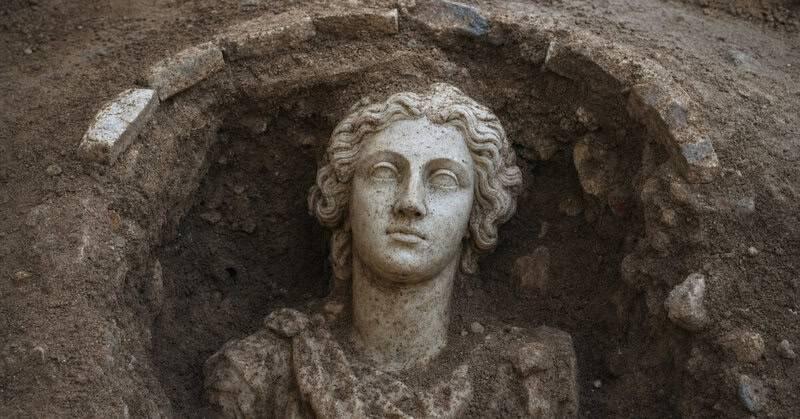
The trowel scraped stone, and then — staring back from the dark earth — came the unmistakable curve of a marble face. Not a fragment, not a shard, but a complete sculptural form, buried inside a Roman-Byzantine winepress for roughly 1,700 years, as patient and silent as the vines growing overhead.
A Winepress Full of Secrets
There is something genuinely disorienting about the scale of what archaeologists pulled from the earth at this site. These were not scattered coins or broken pottery — the kind of buried artifacts found routinely at excavation sites across the Mediterranean world. These were masterwork-quality statues, whole and deliberate, concealed inside a structure built for crushing grapes. Marble faces that once watched over a world of banquets and processions had spent nearly two millennia in the dark, sealed beneath a working agricultural landscape that had no idea what it was standing on.
And here is the detail that changes everything: nobody had reported them missing. No ancient inventory flagged them as lost. No gap in the historical record announced that something extraordinary once stood here and then disappeared. These Roman-era statues discovered buried in the winepress at Binyamina had not been lost in any official sense — they had simply been hidden so well that history forgot to mourn them. That is the central mystery, and it is the question that turns an archaeological excavation into something closer to a detective story.
Where Wine and Empire Intersected
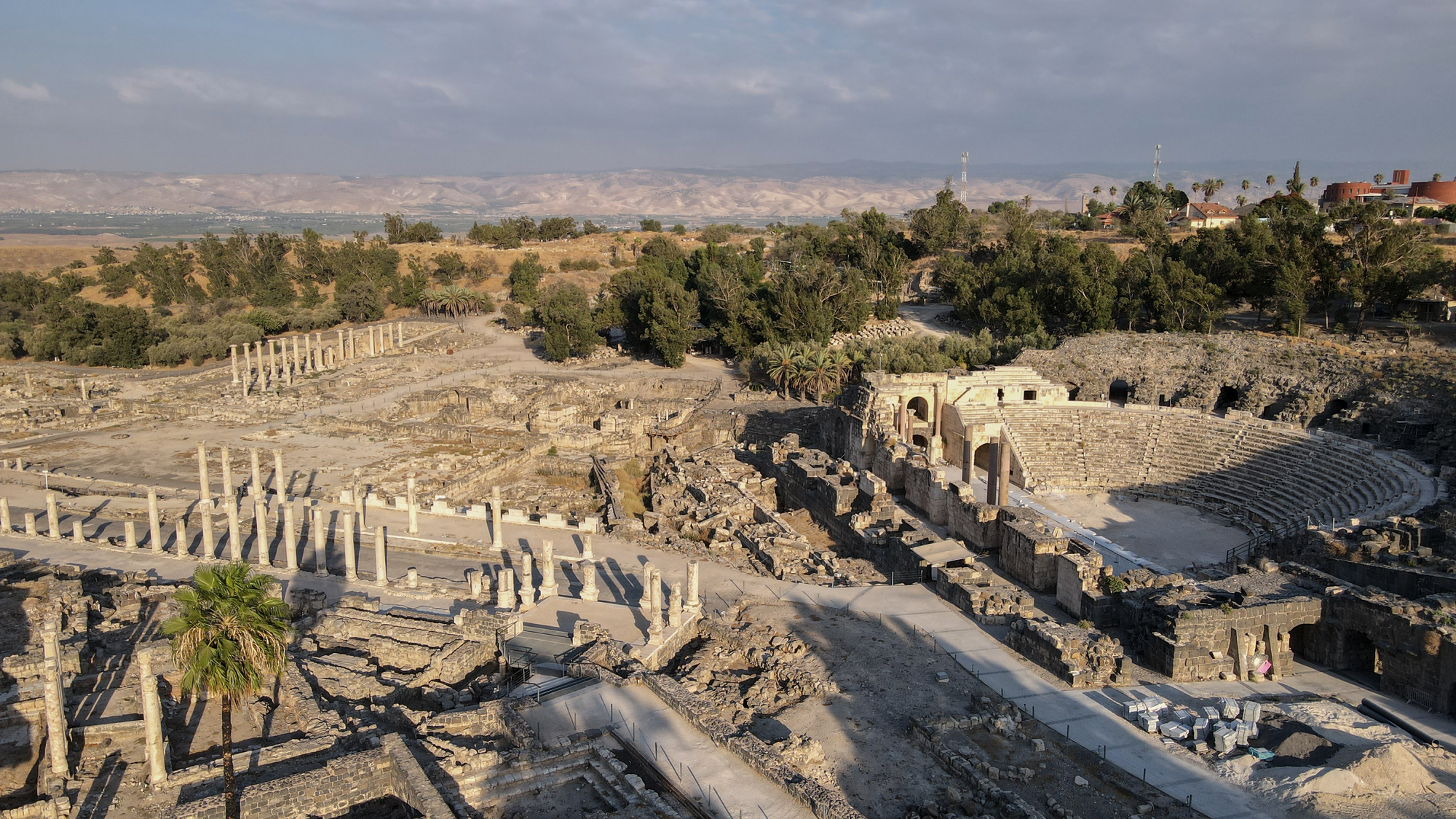
To understand why the discovery matters, you have to understand the place itself. The ancient vineyard complex is not a single moment in time but a layered world — Romans engineered it, Byzantine culture reshaped and built upon it, and then modern vines grew over all of it, unknowingly pressing their roots down through centuries of compressed history. Standing on the surface, you would see nothing but green rows and open sky. Below, an entire civilizational sequence waited.
The winepress at the heart of the find was no crude pit. Roman-Byzantine winepress construction was a sophisticated undertaking: engineered treading floors, collection vats, and drainage channels, all designed with the kind of systematic precision that Rome applied to everything from aqueducts to army camps. This was a facility built to process abundance. That someone chose this structure as a hiding place for priceless sculpture is not random — it is, in its way, a kind of terrible ingenuity. A utilitarian space, functional and unglamorous, the last place a looter or an invading soldier would think to search for art.
Roman villa culture helps explain why fine sculpture appeared in an agricultural setting at all. Elite Roman estates were not simply homes — they were performances of status, decorated with marble figures, painted walls, and elaborate mosaics to broadcast the owner’s wealth, education, and taste. The agricultural zones of these properties were extensions of that world, not separate from it. The presence of masterwork-quality statues near a working winepress hints powerfully at a nearby seat of power, a great house whose story has not yet been fully told.
That story grew more complex with a second discovery made in a comparable landscape: an 1,800-year-old Roman mosaic found just meters underground, reinforcing a broader narrative about what lies beneath deceptively ordinary ground across the Roman world.
Reading the Faces of the Roman-Byzantine World

Researchers classified the statues recovered from the Binyamina winepress as Roman-Byzantine period work, placing them at a cultural hinge point — a time when the classical Roman tradition in art and architecture was being slowly absorbed, transformed, and sometimes abandoned by the new order emerging from Constantinople. The quality of the pieces speaks to deliberate concealment rather than accidental burial. Objects hidden with care tend to survive differently from objects simply left behind; the condition of these statues carries the fingerprints of someone who wanted them to last.
Researchers believe the sculptures may have originated at a nearby elite site, which introduces a remarkable implication: these were not simply stored where they happened to be. They were moved. Someone — or several people — carried heavy, culturally significant marble sculptures across a working estate and lowered them into a winepress. That is not an absent-minded act. It is a decision made under pressure, driven by urgency, danger, or the kind of radical change that makes you gamble your most treasured possessions on the hope that you will be able to come back for them.
The interpretive challenge for archaeologists is real. A discovery of this type rarely arrives with documentation. There is no label, no ancient caption explaining who commissioned these figures, which workshop produced them, or what scenes they originally inhabited. Dating, attribution, and meaning must all be reconstructed from the objects themselves — from stylistic analysis, from the material composition of the marble, from comparison with dated examples in other collections. The statues speak, but they speak in a language that takes years of scholarship to translate.
The Mosaic: Eighteen Centuries Below the Surface

Shift the frame slightly and the story deepens. The 1,800-year-old Roman mosaic discovered deep beneath the vineyard has been described by researchers as an extraordinary find in remarkable condition — vivid and intact, its tesserae still holding color and form after nearly two millennia underground. It sat only a few meters below the modern surface, shockingly close to the world above, protected not by a vault or a tomb but simply by the weight of accumulated time.
For a general reader, it helps to sit for a moment with what a Roman mosaic of this age and condition actually represents. Mosaic floors were made tesserae by tesserae — small cubes of stone, glass, or ceramic, set by hand into wet mortar in patterns that could be geometric, floral, or elaborately figural, depicting gods, myths, hunting scenes, and portraits. The labor involved was enormous. The skill required was the product of specialized training passed through workshops over generations. A mosaic floor was not background decoration; it was a statement of permanence, a surface made to outlast its maker. And in this case, by a margin of eighteen centuries and counting, it has.
Generations of farmers worked land like this. Grape-pickers walked similar rows season after season. Children played on such ground. And just beneath their feet — as has been documented at comparable sites, including one beneath an Italian vineyard — the geometric perfection of a Roman floor waited, unseen by any living person. The soil kept its secret with perfect indifference.
Who Hid These, and When?

The deliberate concealment of Roman art is not without historical precedent. Periods of invasion, religious transformation, economic collapse, and political upheaval all motivated people in the ancient world to cache their most valued possessions — to bury what they could not carry or defend, with every intention of returning. The Roman-Byzantine transition was precisely such a period. As imperial authority fragmented and new powers moved through established regions, elite families faced impossible choices. Their estates, their collections, their entire material world were suddenly vulnerable in ways that would have been unimaginable a generation earlier.
The winepress makes a particular kind of sense as a hiding place in this context. It was utilitarian, unglamorous, and already full of stone and structural weight — nothing about it advertised value. A looter moving quickly through an estate would prioritize the main house, the treasury, the obvious repositories of wealth. A working press for grapes would be beneath notice. Someone thinking quickly and under pressure might have recognized exactly that logic and acted on it.
What cannot be answered — and may never be — is who made this decision, and what became of them afterward. Archaeology can show us what was hidden and suggest, through stratigraphy and stylistic dating, roughly when it was hidden. It cannot tell us whether the person who lowered those marble figures into the dark ever came back to retrieve them. The silence of 1,700 years suggests they did not. But that is the kind of conclusion archaeology arrives at reluctantly, because it carries the full weight of a human life and its ending.
How Archaeologists Date and Authenticate These Discoveries

A find of this complexity requires multiple lines of evidence before researchers can speak with confidence about what they have found. Stratigraphy — the study of soil layers and what each layer contains — establishes a relative timeline: objects found below a layer of known date were deposited before that layer formed. Stylistic analysis places the sculpture within a tradition and compares it against pieces with established dates. Material composition can be analyzed to identify the quarry source of the marble, which in turn narrows geography and chronology. All of these methods work in conversation with each other, cross-checking and refining.
The phrase “remarkable condition” carries scientific weight beyond its surface meaning. Underground environments, when sealed and stable, can preserve organic and inorganic materials with extraordinary fidelity. The absence of oxygen fluctuation, extreme temperature swings, and biological activity — the forces that degrade objects exposed to open air — means that some buried pieces emerge in better condition than museum objects that have been handled, cleaned, and exposed to light for centuries. The sealed winepress was, inadvertently, a near-perfect conservation environment.
Provenance reconstruction — determining that the statues may have originated at a nearby elite site — requires a different toolkit: cross-referencing architectural remains in the surrounding area, analyzing patterns of soil disturbance that might indicate earlier movement of heavy objects, and comparing the artistic typology of the pieces against the known decorative programs of similar Roman villas. It is painstaking work, and it is almost certainly ongoing. The broader complex surrounding these finds almost certainly holds additional material waiting for the next careful excavation season.
What These Finds Tell Us About Roman Life — and Loss
The deeper significance of discoveries like these is not simply about beautiful objects rescued from obscurity, though that is genuinely worth celebrating. It is about a moment of civilizational rupture caught in material form. The world that created these statues and mosaics was sophisticated, wealthy, and confident enough in its own permanence to commission art meant to last forever. The same world, not many generations later, became dangerous enough that those same objects had to be hidden in a grape press and abandoned.
Wine and art were not incidental companions in Roman elite culture — they were expressions of the same underlying reality. The ability to cultivate vines, process harvests, and turn agricultural surplus into wealth was the economic engine that funded the sculpture, the mosaics, and the entire apparatus of refined Roman life. When that world fractured, it fractured completely. The vineyard and the masterpiece went into the ground together.
The mosaic is perhaps the most affecting image to close on. It was made to be walked across, admired underfoot during dinner parties and morning routines, lived with so constantly that it became invisible through familiarity. Then the world changed, the floor was buried, and it waited. Eighteen centuries of waiting, while history accumulated overhead in layers — Byzantine, medieval, early modern, contemporary — until a trowel scraped stone and the tesserae came back into the light, still vivid, still articulate, still speaking across a distance of time that the human mind can barely hold.
What else lies a few meters below the vines? The honest answer is that nobody yet knows — and that, for anyone who has ever felt the pull of a hidden world pressing up against the surface of the ordinary one, is the most exciting sentence in archaeology.

 English
 Arabic
 French
 Spanish
 Portuguese
 Deutsch
 Turkish
 Italiano
 Russian
 Romaian
 Portuguese (Brazil)
 Greek
Greek